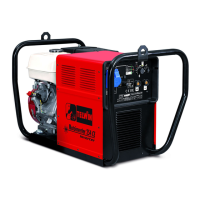
towing-motor. min >350a
- Let the wire run for the whole length of the torch, turn the - wire sti ck out : 10-20 mm
main switch to position “l” and press the button of the torch.
- ch oice of c hoke tap : minimum or a s
To prevent the wire from implanting itself into the end of the
pr eferred (no current
torch, in the position where the contact tip is located, the
transist or present )
tip should be removed.
Application : high heat input, high metal weld deposits,
molten pool very fluid. Only for positional welding on
WARNING! During the above described operations
thicknesses greater than 4mm.
Contact tube inside nozzle (5-10mm depending on
the wire is live and under mechanic force. Therefore if
strength of voltage)
proper precautions are not taken into consideration,
electric shocks, injury and striking of unnecessary
C GLOBULAR TRANSFER
electrical arcs may occur.
This is an intermediate method between "short arc" and
- Always wear protective and insulating clothes and
"spray arc". Irregular shaped drops fall to the molten
gloves
pool mainly under the action of gravity rather than "arc
- Do not direct torch towards parts of the body
forces" as with "spray" transfer. This transfer is
- Do not bring the torch near the gas cylinder
achieved using CO gas at voltages and currents higher
2
than those of "short arc", but because of the nature of
WELDING
CO the operating threshold of the "spray arc"
2
Once the machine has been prepared for welding by
technique is not reached.
carrying out the operations described above, simply place
- suitable wire diameters : 0.8-1.6
the earth clamp in contact with the workpiece and press the
- welding current range : 200-280a
torch button, keeping the torch at a safe distance from the
- arc voltage range : 20-26v
workpiece.
- suitable gases : CO (12-16 l/mim)
Before carrying out difficult sections of welding, tests should
2
- wire stick out : 10-15 mm
be carried out on scrap pieces. These tests should be
- choice of choke tap : high values to
carried out using the adjustment knob in order to obtain the
reduce current transients (spatter)
best welding possible. If the arc melts in drops and tends to
Application: metal weld deposits higher than for "short
go out, the speed of the wire should be increased or the
arc", lower heat input than for "spray arc", high level of
welding current decreased. If, however, the wire hits the
spatter.
piece violently and causes material to be projected, the wire
speed should be reduced.
Regulations
It should be remembered that in order to obtain the best
results, each type of wire is suited to a specific current and
Welding current: is determined for a given wire diameter
wire feed speed. Therefore, for difficult sections of welding
by its own advanc ement spee d. Current can be a djusted
and welding which requires a great deal of time, wires with
by regula tion pot entiomet er (on wi re feeder) . Remember
different diameters should be tried so that the most suitable
that for a given current the wire advanceme nt speed is
may be chosen.
inversely proportional to the diameter used.
Current range suitable for manual welding of various steel
wires:
STEEL WELDING
ø mm 0,8 1 1,2 1,6
(Basic information)
min (A) 40 50 60 100
Method of metal transfer
max (A) 180 250 350 450
A SHORT ARC TRANSFER
The melting of the electrode wire and the detachment of
Arc voltage: can be adjusted at short intervals (steps) by
the drop is produced by repeated short circuits (up to
switches on the power source. Voltage must comply with
200 times per second) from the tip of the wire to the
the chosen speed of wire advancement (current), and
molten pool
with the wire diameter and protective gas used. This may
- suitable wire diameter : 0.6-1.2 (1.6)
be set out in the following equation giving the medium
- welding current range : 40-210a
value : U = 14 + 0,05 l
- arc voltage range : 13-23v
22
- suitable gases : CO + argon/
Where : U = arc voltage in volts;
22
CO 8-12 l/min
l = welding current in amperes.
22
- wire stick out : 5-12 mm
Remember that in comparison with the no-load voltage
- choice of choke tap : low for thin wires;
supplied for each step, the arc voltage will be less 2-4V for
increases with increase in wire diameter
every 100A delivered.
Application: minimum heat input with weld pool kept
The argon/CO mixtures require arc voltages of 1-2V less
2
under control; suitable for welding in any position, on
than that required with CO .
2
thin thicknesses and on first runs only on vanish
threads. Contact tip level with nozzle or protruding
Welding
when finer wires and lower arc tension are used.
The quality of the weld seam is higher when less spatter is
produced. This is determined principally by a correct
B SPRAY ARC TRANSFER
balance of the welding parameters: current (wire speed),
Higher voltages and currents than for "short arc" are
wire diameter, arc voltage etc., as well as a correct choice
used here to achieve the melting of the wire. The wire
of choke taps.
tip does not come into contact with the molten pool; an
In the same way the torch position must comply with the
arc forms from the tip and through it flows a stream of
data table in order to avoid excessive spatter and faults on
metallic droplets. These are produced by the
the weld seam.
continuous melting of the electrode wire without short-
The weld speed (i.e. the advancement speed along the
circuits involved.
joint) is also a determining factor for the correct execution
- (suitable) wire diameter : 0.8-1.6
of the sean. This is particularly important for good
- welding current range : >200a
penetration and correct shape of the sean.
- arc voltage range : 24-40v
- suitable gases : argon/CO 12-16
2
l/mim; 20 l/
- 10 -
copyrighted document - all rights reserved by FBC


 To Next Page
 Loading...