A07A2200S
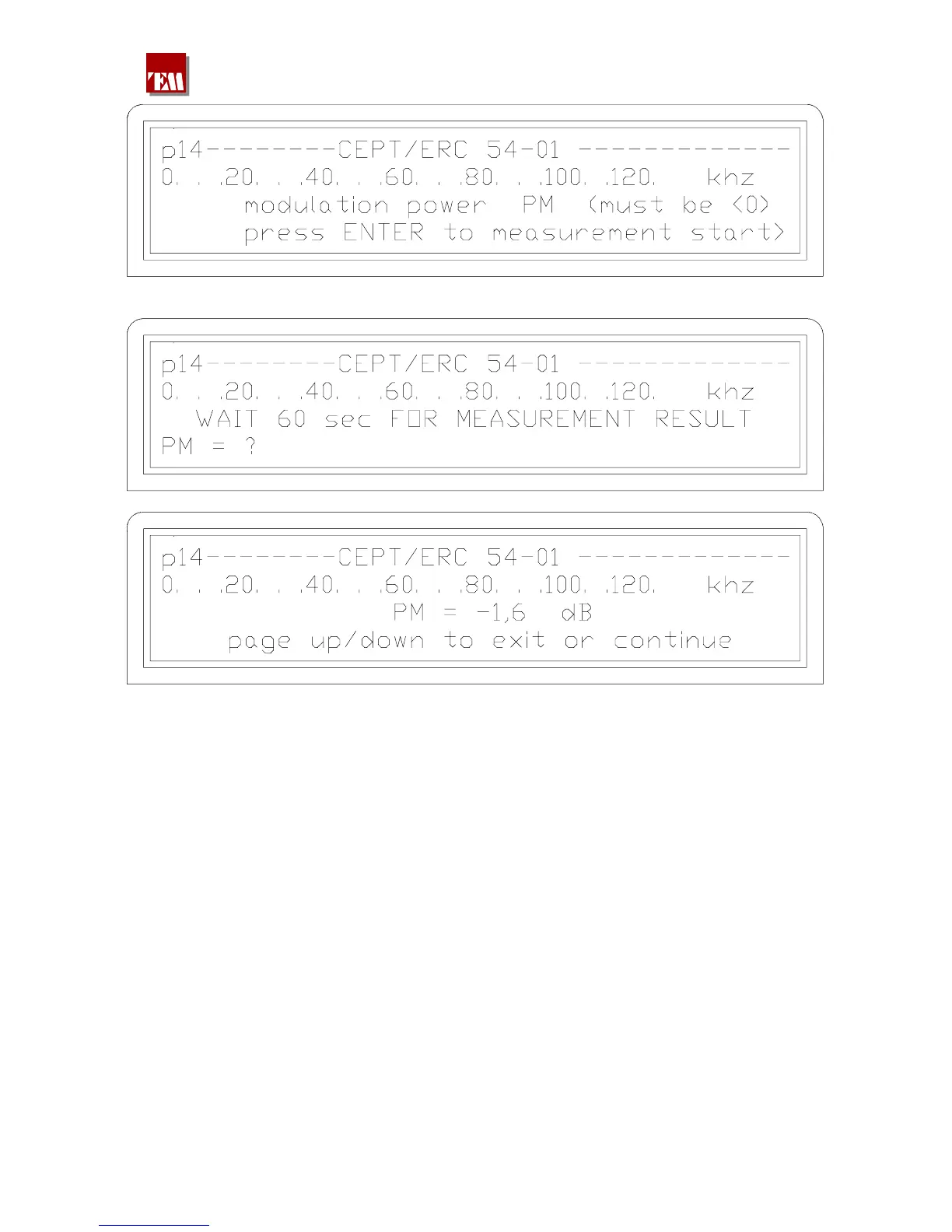
The previous eight screen shots, if selected, allow to perform the measurement of the modulation
analysis according to the CEPT 54-01rule. For an exhaustive explanation of this new measurement
method see chapter 7.
Briefly, it can be said that a music signal can exceed the limit threshold of 75kHhz, provided that
this exceeding is contained in a certain percentage. The rules concerning this topic are contained in
the above mentioned regulation and in the IEC-244. Thus it’s possible to quantify the excess of over
modulation peak and it’s possible to show, as in the appendix, that the numerical factor K fixing
this limit can not be greater than 0.2. Modulation power on the opposite can not be higher than the
one relating to a sine signal deviating 19KHz (reference =0dB)
The observation period, for the measurement and the calculation of these factors, is 1 minute, after
that the result will be displayed.
For the calculation of the K over modulation peak factor, 1200 samplings are performed during a 60
sec measurement, and the value factor is obviously 0 if no peaks exceed 75KHz. The value 0.2 is
acceptable as a higher over modulation limit; the value 0.5 shows that the modulation must be
reduced of 1dB at least, values higher than K indicates strong over modulations.
For the modulation power, over 10 millions of samplings are performed during the minute of
examination and power integral defined in the measurement segment is calculated; the result is
380 221 R02 Pag. 25


 To Next Page