A07A2200S
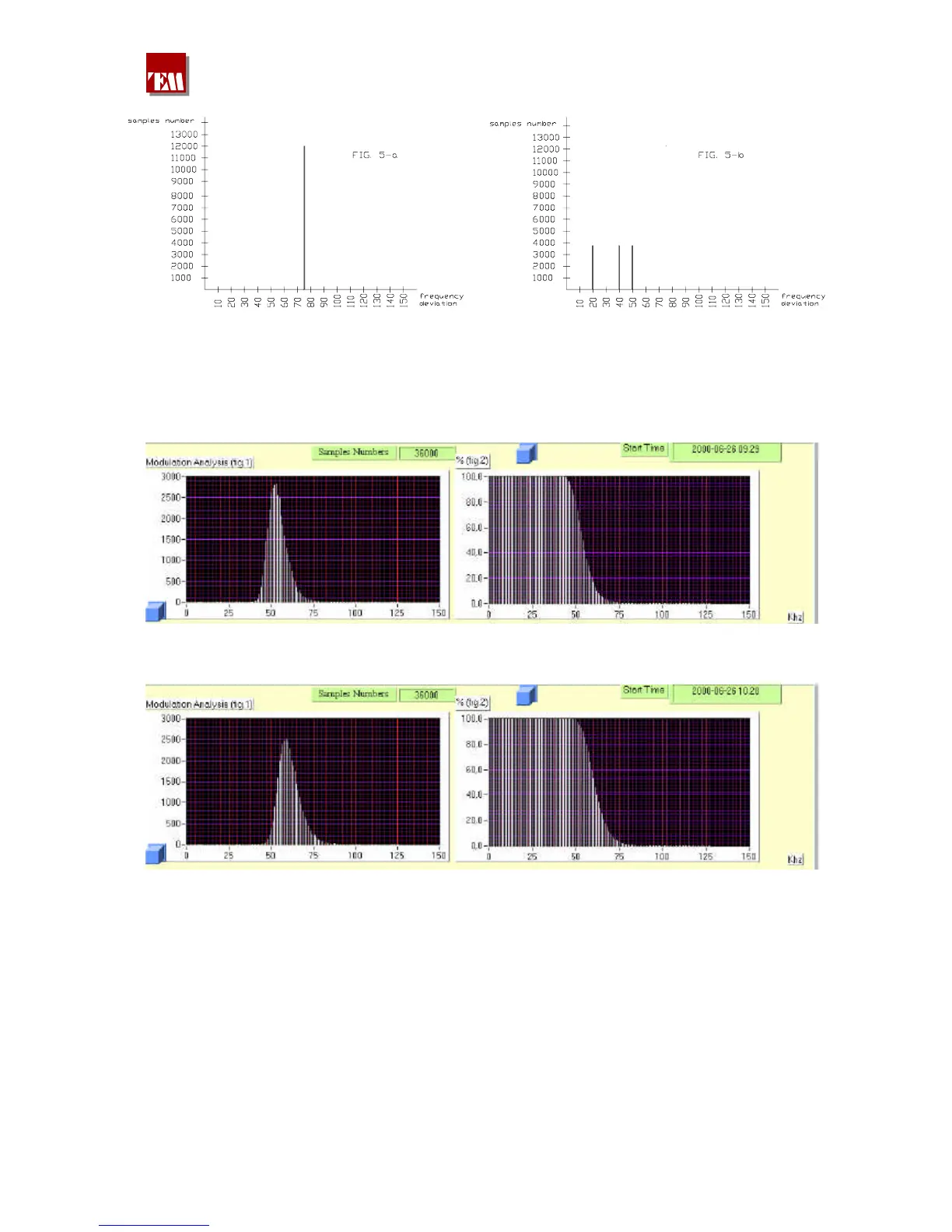
Now, instead of these simple examples, take our transmitter modulated with the sample noise
previously mentioned, and we detect in accordance with the CEPT 54-01 the modulation peak
samples in a 30 minutes observation period, so obtaining the graph. 5.c-a whereas, if we increase
the modulation, always with the same input signal, of 1dB, we’ll obtain the graph 5.d-a with a 30
minutes observation period:
fig. 5.c-a fig. 5.c-b
fig. 5.d-a fig. 5.d-b
On the first graph it can be observed that during the 30 minutes about 2600 peak samples have been
measured which have deviated the carrier of ±54KHz, 1500 ±60KHz, 10 ±75KHz, while about ten
samples resulted higher than ±75KHz. What has been measured is a signal which respects all the
spectrum occupation and over modulation rules; it can be soon noticed that this signal has been
higher with its modulation peaks than the threshold of 75KHz for about 0.2% of the samples so it’s
wrong to sustain that this value is never exceeded at all. Relying for the modulation adjustment on
the bar-graph of which almost all the transmitters are equipped, one risks to have to under modulate
if the trimmer is set to remain within 75KHz.
380 221 R02 Pag. 37


 To Next Page