quite large, requiring a large and expensive capacitor. To provide for this, fixed capacitors are placed
in parallel with the variable capacitor to obtain the value needed. This function is also provided by
switch S1; further rotation from the center position increases the value of capacitance in the circuit.
(see circuits illustrated in Figure 2 at the end of this manual)
ANTENNA SYSTEMS MATCHING THEORY
Most transmitters are designed to work into a 50 ohm resistive load, and they are not able to
effectively supply rf power to loads that depart far from this value. However, many antenna systems,
which include the antenna and transmission line, have complex impedance that make it difficult if not
impossible to load the transmitter properly. These impedances are a function of the operating
frequency, type of antenna, type and length of transmission line, height of antenna and proximity to
other objects.
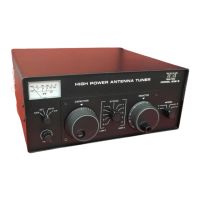
The Model 229 provides a coupling method to convert the resistive/reactive load to a pure
resistance of 50 ohms that will accept maximum power from the transmitter. This is not to say that
any and all antennas, when converted to a 50 ohm resistance impedance by means of a tuner, will
give identical performance. To best understand the tuner adjustments required, it is necessary to
have a fundamental knowledge of how antenna systems function. To this end, a short technical
discussion follows. It is recommended that additional reading on the subject be done by those
interested in obtaining maximum performance from their antenna systems. The ARRL Antenna
Handbook, ARRL Amateur's Radio Handbook (antenna and transmission line sections) and other
antenna books published by the publishers of Amateur Radio magazines are excellent sources of
information.
THE ANTENNA - Any conductor that has rf currents flowing in it can be looked on as an antenna or
radiator. The extent to which power leaves the conductor and radiates into the surrounding medium
depends on many factors -- length, frequency, amount of current, configuration, etc. Since the
antenna absorbs power from the device feeding it, it can be replaced with a resistance whose value is
such that the power delivered to this resistance is now a measure of the radiating effectiveness of the
antenna and is termed "radiation resistance." For a given value of antenna current, the higher this
resistance, the more power that is radiated. (P=I
2
R)
Due to the facts that an antenna has physical length, that currents travel at a velocity less than
instantaneous and that the conductor posses a certain amount of self-inductance and capacitance, the
current at the feedpoint may not be in phase with the voltage at this point. As a result, the
impedance at this point may not look like the pure resistance suspected, but as an impedance
consisting of resistance and either inductive or capacitive reactance. This added reactance will limit
the amount of current supplied to the antenna for a given voltage, and therefore reduce the amount
of radiated power. The reactance does not absorb power in itself -- only a resistance can do that --
but its presence reduces the overall radiated power and antenna current.
There are two ways to restore the power to its non-reactive value. The first, which is not the
preferred way because it does not maximize power transfer, is to raise the feedpoint voltage so that
the current returns to its original value. The second, and preferred method, is to add a reactance in
series , equal in value but opposite in type (sign) to the reactance value of the antenna. For example,
if the antenna at the operating frequency presents an inductive reactance of 100 ohms (+j100) along
with a resistance of 50 ohms, inserting capacitor whose reactance is also 100 ohms (-j100) in series


 To Next Page
 Loading...