6
Braking System - Air Drier
Section 250-0200
SM 1985 Rev 1 11-00
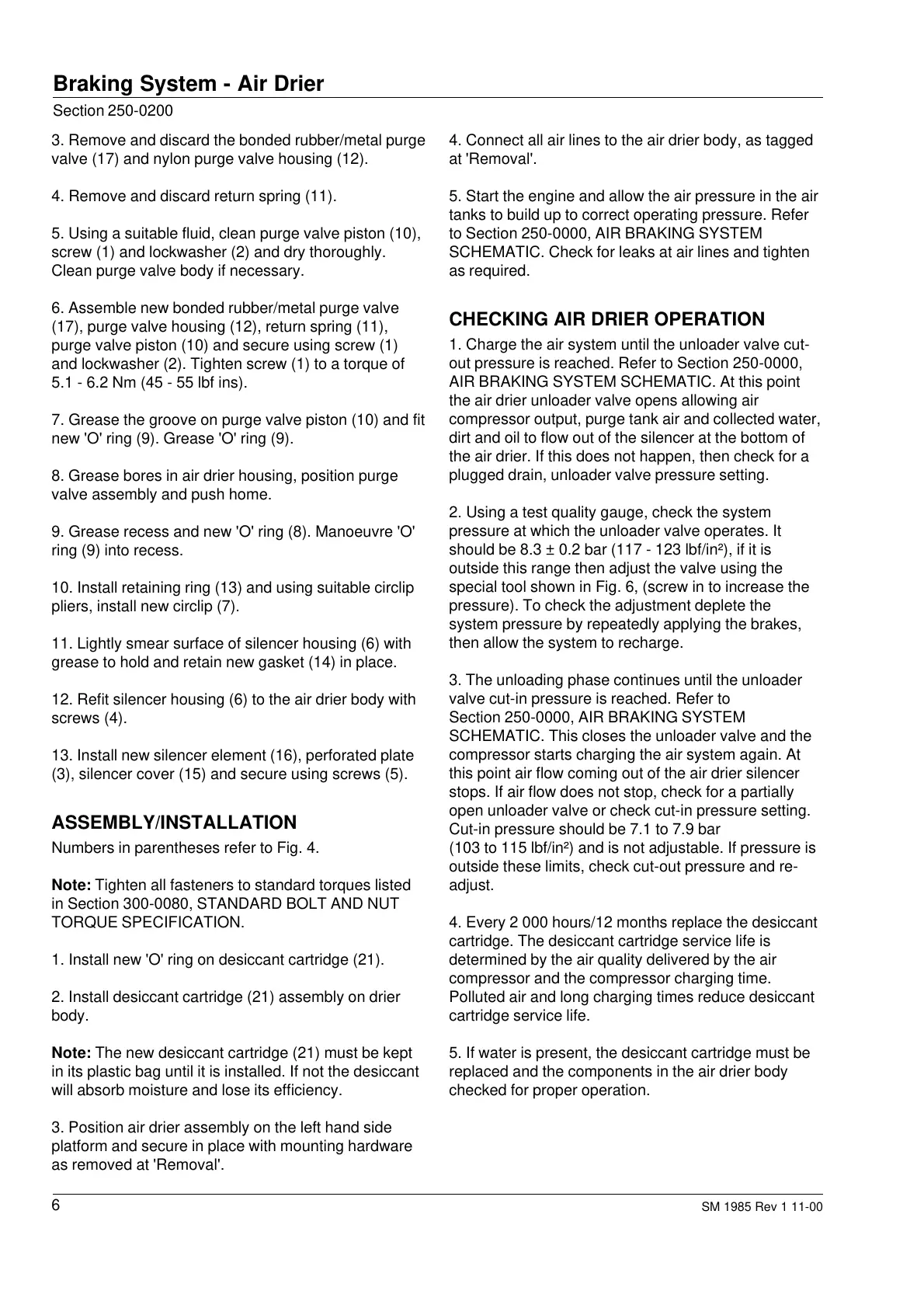
3. Remove and discard the bonded rubber/metal purge
valve (17) and nylon purge valve housing (12).
4. Remove and discard return spring (11).
5. Using a suitable fluid, clean purge valve piston (10),
screw (1) and lockwasher (2) and dry thoroughly.
Clean purge valve body if necessary.
6. Assemble new bonded rubber/metal purge valve
(17), purge valve housing (12), return spring (11),
purge valve piston (10) and secure using screw (1)
and lockwasher (2). Tighten screw (1) to a torque of
5.1 - 6.2 Nm (45 - 55 lbf ins).
7. Grease the groove on purge valve piston (10) and fit
new 'O' ring (9). Grease 'O' ring (9).
8. Grease bores in air drier housing, position purge
valve assembly and push home.
9. Grease recess and new 'O' ring (8). Manoeuvre 'O'
ring (9) into recess.
10. Install retaining ring (13) and using suitable circlip
pliers, install new circlip (7).
11. Lightly smear surface of silencer housing (6) with
grease to hold and retain new gasket (14) in place.
12. Refit silencer housing (6) to the air drier body with
screws (4).
13. Install new silencer element (16), perforated plate
(3), silencer cover (15) and secure using screws (5).
ASSEMBLY/INSTALLATION
Numbers in parentheses refer to Fig. 4.
Note: Tighten all fasteners to standard torques listed
in Section 300-0080, STANDARD BOLT AND NUT
TORQUE SPECIFICATION.
1. Install new 'O' ring on desiccant cartridge (21).
2. Install desiccant cartridge (21) assembly on drier
body.
Note: The new desiccant cartridge (21) must be kept
in its plastic bag until it is installed. If not the desiccant
will absorb moisture and lose its efficiency.
3. Position air drier assembly on the left hand side
platform and secure in place with mounting hardware
as removed at 'Removal'.
4. Connect all air lines to the air drier body, as tagged
at 'Removal'.
5. Start the engine and allow the air pressure in the air
tanks to build up to correct operating pressure. Refer
to Section 250-0000, AIR BRAKING SYSTEM
SCHEMATIC. Check for leaks at air lines and tighten
as required.
CHECKING AIR DRIER OPERATION
1. Charge the air system until the unloader valve cut-
out pressure is reached. Refer to Section 250-0000,
AIR BRAKING SYSTEM SCHEMATIC. At this point
the air drier unloader valve opens allowing air
compressor output, purge tank air and collected water,
dirt and oil to flow out of the silencer at the bottom of
the air drier. If this does not happen, then check for a
plugged drain, unloader valve pressure setting.
2. Using a test quality gauge, check the system
pressure at which the unloader valve operates. It
should be 8.3 ± 0.2 bar (117 - 123 lbf/in²), if it is
outside this range then adjust the valve using the
special tool shown in Fig. 6, (screw in to increase the
pressure). To check the adjustment deplete the
system pressure by repeatedly applying the brakes,
then allow the system to recharge.
3. The unloading phase continues until the unloader
valve cut-in pressure is reached. Refer to
Section 250-0000, AIR BRAKING SYSTEM
SCHEMATIC. This closes the unloader valve and the
compressor starts charging the air system again. At
this point air flow coming out of the air drier silencer
stops. If air flow does not stop, check for a partially
open unloader valve or check cut-in pressure setting.
Cut-in pressure should be 7.1 to 7.9 bar
(103 to 115 lbf/in²) and is not adjustable. If pressure is
outside these limits, check cut-out pressure and re-
adjust.
4. Every 2 000 hours/12 months replace the desiccant
cartridge. The desiccant cartridge service life is
determined by the air quality delivered by the air
compressor and the compressor charging time.
Polluted air and long charging times reduce desiccant
cartridge service life.
5. If water is present, the desiccant cartridge must be
replaced and the components in the air drier body
checked for proper operation.
Courtesy of Machine.Market


 To Next Page
 Loading...