5 Transport
Smaller Terhi boats can be transported by car on a
sturdy roof rack. Larger models should be transported
on a purpose-built boat trailer.
5.1 Trailer transport
You can easily transport your Terhi boat on a trailer.
Make sure, however, that the trailer is compatible with
your boat. Check that the load capacity of the trailer
is sucient for your boat, its engine and other equip-
ment. Terhi boats are very light for their length so
ensure that your trailer is suciently long to accom-
modate your boat. It should have an adequate number
of keel supports, and load bearing supports and all
these supporting points must have a suciently large
surface area, so that point loads do not become exces-
sive. This is especially important on small roller trailers
where there are few rollers as standard.
In transit, the engine should be in normal driving
position and the steering friction should be firmly set
(tiller models). However, make sure there is enough
space left to the ground. If there is a risk that the en-
gine might hit the ground while in transit, the engine
should be tilted up and supported with a separate sup-
port beam or detached from the boat.
WARNING! Do not transport the engine attached to
the boat when the engine is tilted up without having
secured it with a support beam. The engine or the boat
can be damaged, or in worst case the engine can fall o.
Check that the seat hatches are locked with their
security clips in place. Do not leave loose items or ex-
cessive loads in the boat during transportation.
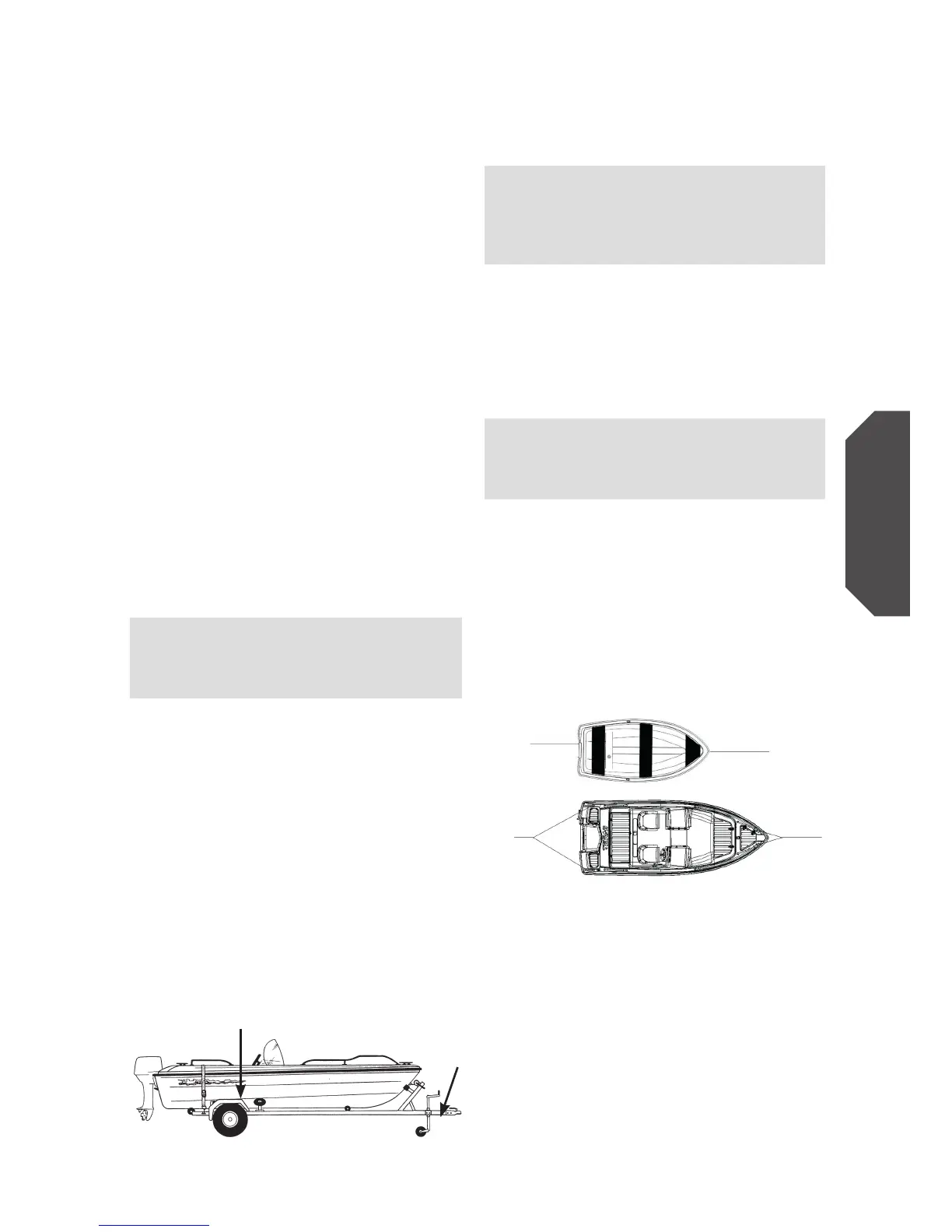
Fasten the boat securely to the trailer, before commenc-
ing the actual journey but take care not to over-tighte n
the fastening straps. The bow strap should point forwards
and downwards (the winch strap on its own is insucient
for securing) and swaying of the stern can be prevented by
tying a strap across the boat. To prevent the straps from
marking the boat use a soft material between the strap and
the hull. Adjust the trailer side supports or bunks, so that
the boat cannot move sideways. Clean all the supports of
sand and dirt, to prevent them scratching the hull.
Finally, check that the trailer is properly locked to the
trailer hook! Always loosen the fastening strap imme-
diately after transportation and when leaving the boat
stored on the trailer.
NOTE! The trailer’s centre of gravity must be toward the
front. Make sure that the boat is securely attached to the
trailer. A swaying boat may strike a single support point,
damaging the hull. The trailer’s keel supports should carry
most of the weight of the boat.
5.2 Using your boat for towing
When towing another boat, a buoyant rope of sucient
strength should be used. Start the tow carefully and
avoid jerking movements. Do not overload the engine.
When towing a rowing boat, remember that it is de-
signed for slow speeds only. It is not suitable for fast
towing, as it will not plane.
WARNING! The towing rope is highly tensioned when
towing. If it breaks, the end of the rope can reach dan-
gerously high speeds. Always use a thick enough rope,
and avoid being in the vicinity of the end of the rope.
It is the owner’s/operator’s responsibility to ensure that
mooring lines, towing lines, anchor chain(s), anchor lines
and anchor(s) are adequate for the vessel’s intended
use, and that the lines or chains do not exceed 80 %
of the breaking strength of the respective strong point.
The wear of the lines and the weakening of the breaking
strength due to knots/nodes should however be taken
into account.
Places for fastening of lines during towing, anchoring
and mooring:
In boats where there are no cleats, the loops found in
the stern and bow can be used as points for fastening
mooring/anchorage lines.
5.3 Launching & Recovery
When launching and recovering your Terhi boat on to its trail-
er ensure that the boat is empty of water and luggage. Winch
it carefully on to the trailer avoiding excessive strain on the
bow eye. Make sure the trailers rollers and supports do not
hit the angled scupper plate that covers the drain hole as the
boat is winched on. Always release the tension on the winch
strap once the bow is resting on the rubber bump stop. Never
winch your boat on to the trailer with people in the boat.
The strengths for the fastening points have been noted in
the technical specifications.
Figure 9.



 To Next Page