2
Installation instructions
Read the safety instruction rst.
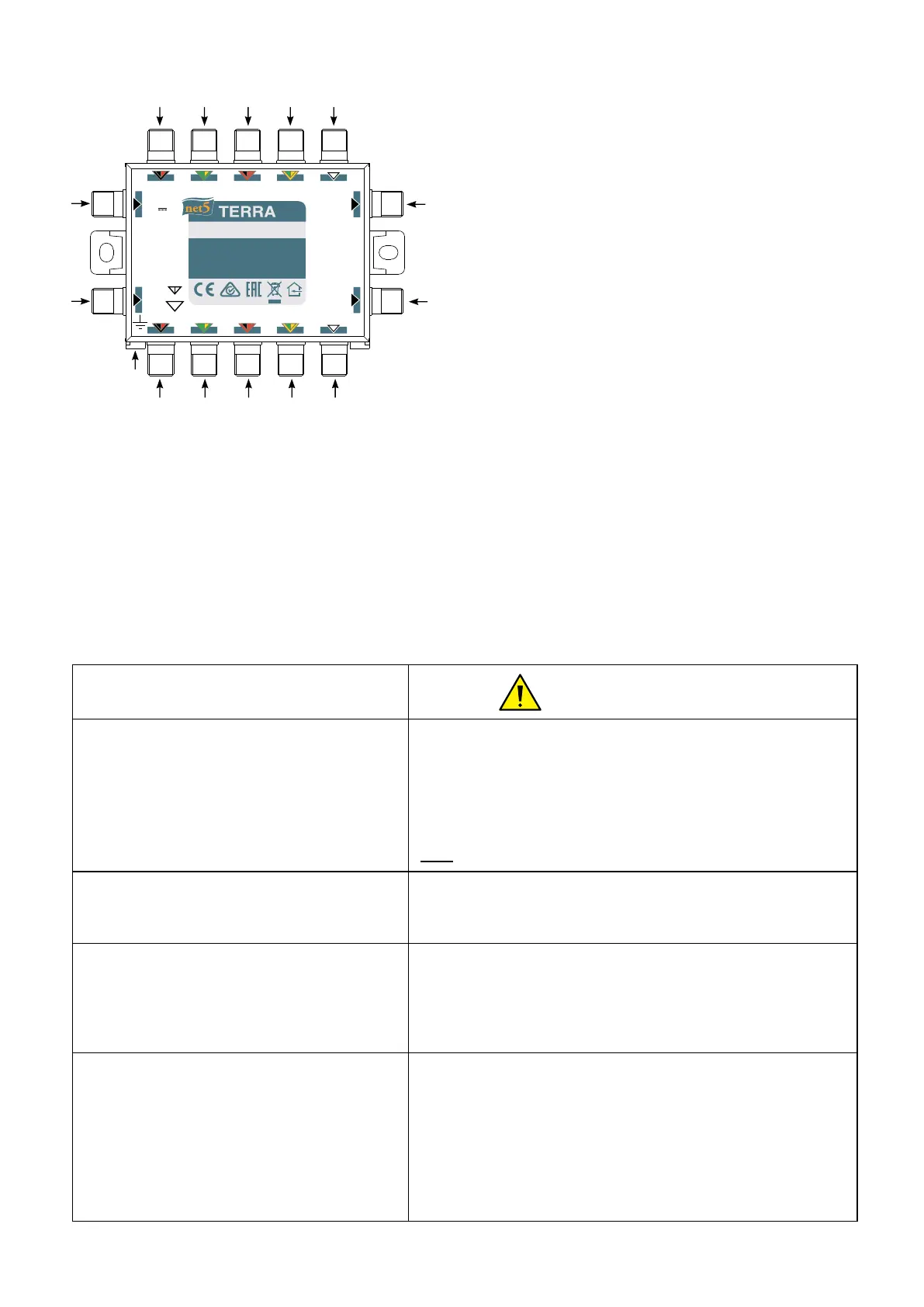
Fit multiswitch on mounting place and connect it (pay attention to the multiswitch inputs and Wideband or Quattro LNBs
outputs marking), connect the isolated 75 Ω loads to the unused RF output F sockets, power on multiswitch using one of 4
powering modes (see Table 1).
1 - V SAT A trunk input (SAT A V, Lo trunk input in Quattro LNB
IF frequency range input mode)
2 - H SAT A trunk input (SAT A H, Lo trunk input in Quattro LNB
IF frequency range input mode)
3 - V SAT B trunk input (SAT A V, Hi trunk input in Quattro LNB
IF frequency range input mode)
4 - H SAT B trunk input (SAT A H, Hi trunk input in Quattro LNB
IF frequency range input mode)
5 - Terrestrial TV trunk input
6 - DC 20 V power input
7 - dSCR1 output
8 - dSCR2 / Legacy output
9 - V SAT A trunk output (SAT A V, Lo trunk output in Quattro LNB
IF frequency range input mode)
10 - H SAT A trunk output (SAT A H, Lo trunk output in Quattro
LNB IF frequency range input mode)
11 - V SAT B trunk output (SAT A V, Hi trunk output in Quattro
LNB IF frequency range input mode)
12 - H SAT B trunk output (SAT A H, Hi trunk output in Quattro
LNB IF frequency range input mode)
13 - Terrestrial TV trunk output
14 - Functional grounding clamp
15 - Conguration input (see chapter “Conguration”)
All sockets are “F” type.
Figure 1. External view of the multiswitch
External view
1 2 3 4 5
9 10 11 12 13
6
7
8
14
H
DC
DC
H
DC
DC
H
H
V SAT A SAT B
V
V
V
Terr.TV
Terr.TV
dSCR1
DC IN
dSCR2
Legacy
Open:
Wideb.
Load:
Quatro
dSCR multiswitch SRM522
Frequency SAT TV
range Terr. TV
SAT/Terr. loss
290-2350 MHz
5-862 MHz
3/4 dB
DC IN
20V 2A
15
Table 1
Powering mode
Warnings and notes
1. Multiswitch is powered from local PSU
(20 V) via DC input (see Figure 1, pos. 6) and
pass DC to H trunk lines.
(Recommended for use is PS202F 20V PSU).
Recommended as rst choice.
WARNING: Don’t overload PSU via H trunk lines – check total
system power consumption of multiswitch and from H trunk lines
(including all other equipment connected).
Check all other system equipment connected to H lines if it can
accept 20 V. SERIOUS DAMAGE OF IT CAN OCCUR!
Note: All trunk lines have DC bypassing.
2. Multiswitch is powered from H trunk lines:
- build new SCR/dSCR system (18 V -20 V)
- upgrading old legacy systems (15 V - 18V)
WARNING: Don’t exceed the current capability of system power
supply.
SERIOUS DAMAGE CAN OCCUR IF OVERLOADED!
3. Multiswitch is powered from dSCR1/DC IN
or dSCR2/Legacy outputs (subscriber) (see
Figure 1, pos. 7, 8).
Multiswitch and equipment connected to H trunk
lines powered directly from STB’s.
WARNING: MULTISWITCH WILL DRAW CURRENT AND
POWER FROM OUTPUT WITH HIGEST VOLTAGE!
STB’s connected to tap outputs must ensure supply sucient
power for multiswitch and all equipment connected to H trunk
lines. If not see below.
4. Multiswitch is powered from dSCR1/DC IN
output via dSCR power inserter
(see Figure 1, pos. 7).
(Recommended for use is PI012).
This mode is similar to 1 mode.
Multiswitch and equipment connected to H trunk lines powered via
dSCR power inserter with 22 kHz bypass connected to any dSCR
output. Use dSCR1 output if Legacy STB is connected to dSCR2/
Legacy output.
WARNING: Don’t exceed the current capability of power inserter
and dSCR outputs (800 mA max.).
SERIOUS DAMAGE CAN OCCUR IF OVERLOADED!


 To Next Page
 Loading...