2322
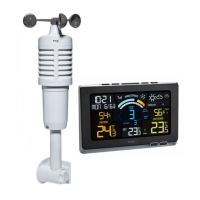
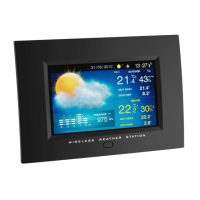
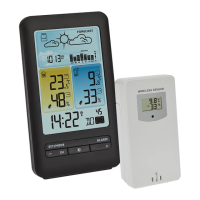
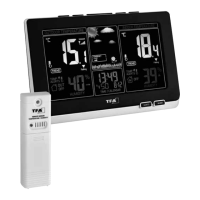
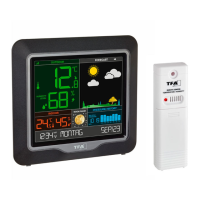
SPHERE – Wireless weather station
6. Getting started
• Place the base station and the transmitter on a table at a distance of about 1.5 meters from each other. Avoid being close to
possible sources of interference such as electronic devices and radio equipment.
• Open the transmitter's battery compartment.
• Insert two new AA 1,5 V batteries, polarity as illustrated.
• Close the battery compartment carefully.
• Connect the attached power adapter to the base station. Insert the adapter into the base station jack and connect the power
adapter into a mains socket. Important! Make sure that your household voltage is no more than 230V! Otherwise your
device may be damaged.
• All segments will be displayed briefly and subsequently the version number of the software.
• The indoor temperature and humidity appear on the base station display.
• Open the base station battery compartment and insert two new AA 1.5V batteries. Make sure the polarity is correct. Close
the battery compartment again.
• The batteries will operate as a backup power source in case of power failure and maintain operation so that no new setting
has to be made.
6.1 Outdoor values reception
• The base station will scan the outdoor values of the transmitter. The reception symbol flashes. If the reception is success-
ful, the outdoor temperature and humidity appear on the base station display.
• If the reception of the outdoor values fails, “- -” appears on the base station display. Check the batteries and try it again.
Check if there is any source of interference.
• As soon as the base station receives the radio-controlled time, you can start the manual initialization of the transmitter.
Press and hold the MODE button for 3 seconds.
6.2 Radio-controlled time reception
• After the base station has completed the search for the transmitter, the device starts scanning the DCF signal (radio signal)
and the DCF reception symbol flashes.
• When the time code is successfully received after 2-12 minutes, the radio-controlled time and the DCF symbol will be
shown steadily on the display.
SPHERE – Wireless weather station
• The clock receives the signal twice a day (2:00 and 3:00 am). If the reception fails, scanning stops and will be repeated
every hour. If the reception is not successfully received until 6:00 o'clock, the next DCF reception attempt will happen at
2:00 o'clock in the following morning.
• If the clock cannot detect the DCF-signal (e.g. due to interference, transmitting distance, etc.), the time can be set manual-
ly. The DCF reception symbol disappears and the clock will then work as a normal quartz clock (see: Manual settings).
• There are three different reception symbols:
Symbol flashing – reception is active
Symbol solid – reception is very good
No symbol – reception is deactivated/turned off
6.3 Note on radio-controlled time
The time base for the radio-controlled time is a caesium atomic clock operated by the Physikalisch Technische Bundesanstalt
based in Braunschweig (Brunswick), Germany. It has a time deviation of less than one second in one million years. The time
is coded and transmitted from Mainflingen near Frankfurt via the frequency signal DCF-77 (77.5 kHz) and has a transmitting
range of approximately 1,500 km. Your radio clock receives the signal, converts it and always shows the exact time. The
adjustment to Daylight Saving Time (summer/winter time) is automatic. The reception quality depends mainly on geographic
location. Normally there should be no reception problems within a 1,500 km radius around Frankfurt.
Therefore, please note the following steps:
• The recommended distance to any interfering sources like computer screens or TV sets is at least 1.5 - 2 meters.
• Within concrete walls (reinforced with steel) such as basements, the received signal is naturally weakened. In extreme cases,
please place the unit close to a window to improve reception.
• During night-time, the atmospheric interference is usually less severe and reception is possible in most cases. A single daily
reception is adequate to keep the accuracy deviation under 1 second.
7. Operation
• Important: Please do not press any keys during signal reception of DCF time and transmitter.
• Press and hold the MIN/MAX + button in setting mode for fast mode.
• The device will automatically quit the setting mode if no button is pressed for 15 seconds.
• With the SELECT SET/DISP button you can toggle the display in normal mode:
Time / indoor humidity - date / indoor humidity - time / seconds
TFA_No. 35.1148_Anleitung 09.10.2017 17:18 Uhr Seite 12


 To Next Page
 Loading...