2120
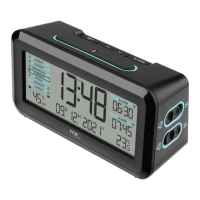
Radio-controlled alarm clock with thermometer
Radio-controlled alarm clock with thermometer
7. Operation
• The instrument will quit automatically the setting mode, if there
is no button used within 30 seconds.
• By holding ▼ or ▲ button, you will enter fast mode.
7.1 Manual setting of the clock and calendar
• Hold MODE/SET button in normal mode. The hour digit is flash-
ing. Press ▼ or ▲ button to adjust hours.
• Press MODE/SET button and the setting sequence is shown as
follows: Minutes, seconds, year, month/day or day/month
sequence, month, date, time zone and day-of-week language.
Press ▼ or ▲ button to make the desired settings.
• Confirm with MODE/SET button.
• Display of date day/month (DM) or month/day (MD): In “month/
day sequence” the two different date displays can be selected:
Month/date (M/D, American version) or date/month (D/M), Euro-
pean version).
• The time zone (+12/-12) is used for countries where the DCF sig-
nal can be received but the time zone is different from the DCF
time (e.g. +1=one hour later).
• Day-of-week language: German (GER), Netherlands (NET), Polish
(PL), Czech (CZ) and English (ENG).
6.1 Radio-controlled time reception
The time base for the radio-controlled time is a caesium atomic
clock operated by the Physikalisch Technische Bundesanstalt Braun-
schweig. It has a time deviation of less than one second in one mil-
lion years. The time is coded and transmitted from Mainflingen
near Frankfurt via frequency signal DCF-77 (77.5 kHz) and has a
transmitting range of approximately 1,500 km. Changeover from
summer time or winter time is automatic. In Daylight Saving Time
“DST” is shown on the LCD. The quality of the reception depends
mainly on the geographic location. Normally there should be no
reception problems within a 1,500 km radius around Frankfurt.
Please take note of the following:
• The recommended distance to any interfering sources like com-
puter monitors or TV sets is at least 1.5 - 2 metres.
• Inside ferro-concrete rooms (basements, superstructures), the
received signal is naturally weakened. In extreme cases, please
place the unit close to a window to improve the reception.
• During nighttime, the atmospheric interference is usually less
severe and reception is possible in most cases. A single daily recep-
tion is adequate to keep the accuracy deviation under 1 second.
• After the reception of the radio-controlled time you can set the
alarm time (see: Setting of the alarm time).
TFA_No. 60.2503 Anleitung_04_13 12.04.2013 10:03 Uhr Seite 11


 To Next Page