HERE’S HOW
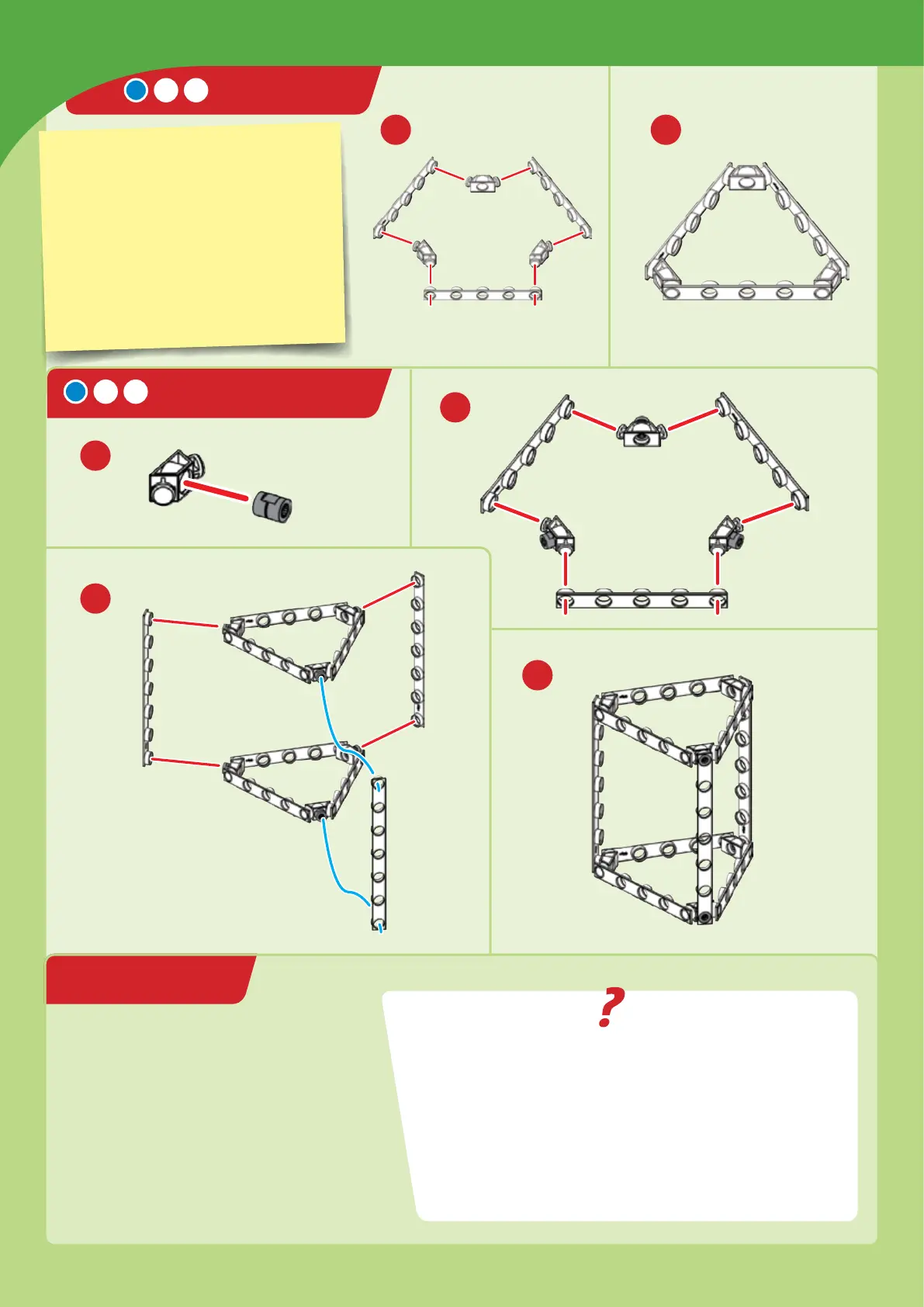
Hold the top triangle in one hand and the
boom triangle in the other. Gently twist the
prism by rotating the triangles in opposite
directions. Try bending and compressing the
prism. What do you notice?
Prisms
1 2
Done!
Done!
1
3
4
2
TRIANGLE
TRIANGULAR PRISM
x
x
WHAT’S HAPPENING
You made two triangles into a prism. A prism is a 3D geometric
figure whose two end faces are similar, equal, and parallel
shapes, and whose sides are parallelograms — in other words,
sides formed with parallel lines. The triangle prism is prone to
twisting, bending, and compressing. The triangles at the ends
may be stable, but the rectangles in the middle are not as
strong. Nevertheless, countless buildings are built using
shapes like this, and due to the strength of the materials they
are made of, they are strong enough to stay standing.
Now, let’s investigate form. Form is a
very commonly used word in
architecture — it basically just means
the shape and configuration of a
building. The opposite of form is space.
The space is the empty area defined by
the forms of a building. Together, form
and space make up all buildings. Let’s
build some forms.





 To Next Page