Engineering Design Challenges
1. Using only the materials in this kit,
build the tallest tower possible. The
tower must be able to remain
standing on its own. You can make
the challenge more difficult by
adding other requirements, such as
that the tower must withstand the
flow of air from a hair dryer, or the
shaking of the table, or must hold a
certain amount of weight.
2. Using only the materials in this kit,
build the largest dome possible. It
must support its own weight and not
collapse.
3. Using only the materials in this kit,
build the longest span (bridge)
possible. It must support its own
weight and not fall down.
Some engineering constraints that you
may need to consider in your designs
include the materials available, height,
weight of the structure and occupants,
location, time, and the strength and
stability needed to resist loads such as
“earthquakes” (the shaking of the
table) and “wind” (the air flow from the
hair dryer).
HERE’S HOW
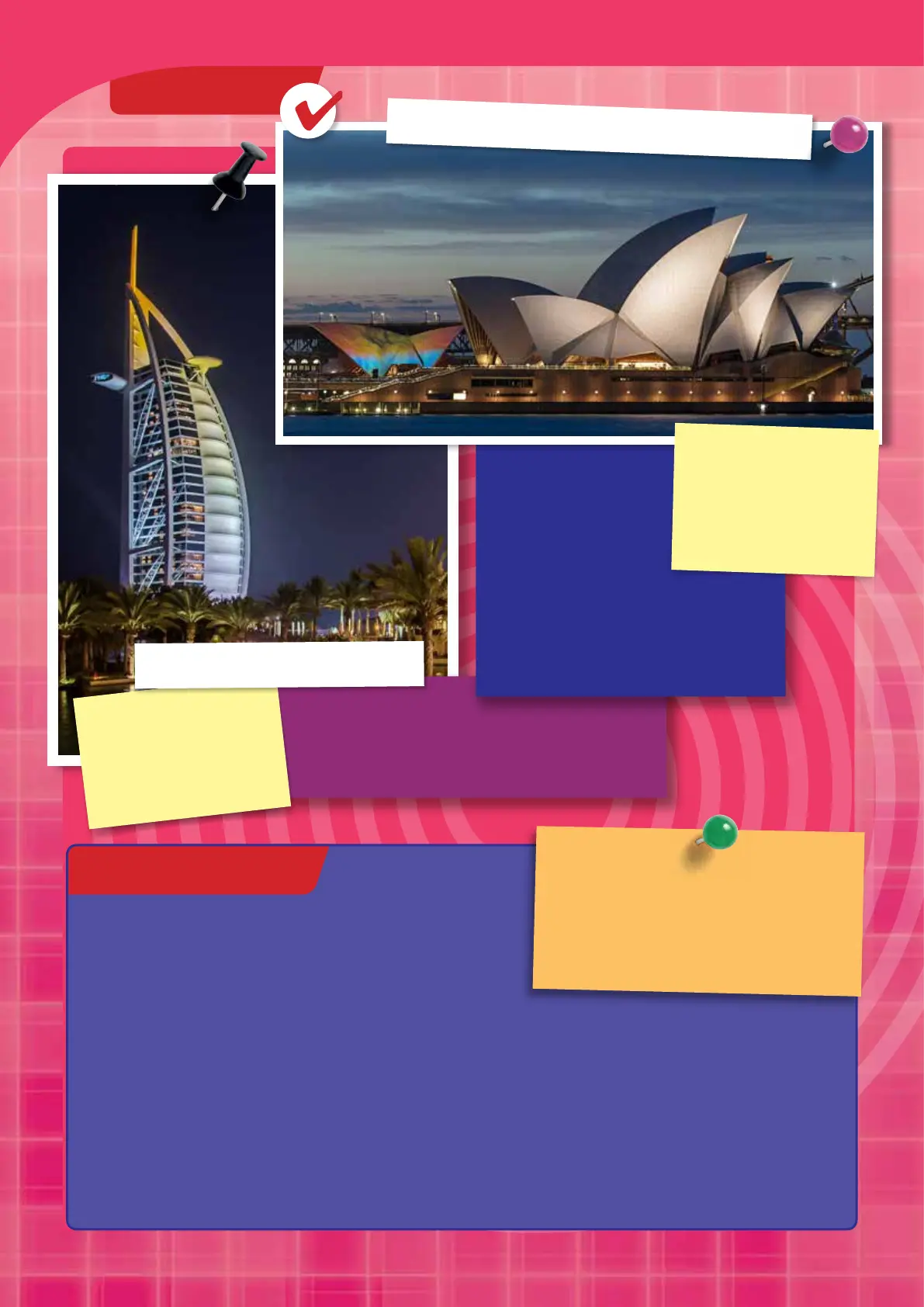
SYDNEY OPERA HOUSE
This building is one of the tallest hotels in the world. It
was built on a man-made island and was designed to
look like the sail of a racing sailboat. There is a helicopter
landing pad on the roof, 689 feet above the ground.
The Sydney Opera House
actually houses six
different performance
spaces. It is home to a
theatre company, a
symphony orchestra, and,
of course, an opera
company. It was
constructed in three phases over a
period of more than ten years. Each shell is a
section of a perfect sphere. This regularity
allowed the same concrete molds to be used
again and again, saving time and cost.
Location: Dubai, United
Arab Emirates
Year Completed:
Height: , ft.
Material: Steel, concrete,
and glass
Location: Sydney,
Australia
Year Completed:
Height: ft.
Length: ft.
Material: Precast concrete
shells, steel, and glass
CHECK IT OUT
BURJ AL ARAB
A crucial task of an engineer is to identify
and understand constraints in order to
develop a solution. An engineer has to
balance many different trade-offs. Some
trade-offs an engineer may face include
available resources, cost, productivity, time,
quality, and safety.




 To Next Page