17
17
17
17
17
17
17
17
17
17
17
17
19
4
Done!
19
21
20
FERRIS WHEEL
HERE’S HOW
Spin the finished Ferris wheel with your
hand and observe. Does it spin all the way
around? Remove the passenger cars from
one half of the wheel. Spin the wheel again.
What happens this time?
Remove the flexible rods that hold the base
up (assembly 4). What happens?
Ferris wheel tests
WHAT’S HAPPENING
When you remove the passenger cars from half of the wheel, the wheel is
no longer balanced. The side of the wheel with the cars is heavier than
the other side. This causes the wheel to turn so the side with the cars is
at the boom, because its center of mass is below the pivot point at the
center.
When you remove the flexible rods that are holding up the base, the
base no longer stands up. You can easily see how the flexible rods are
pulling the base structure in the opposite direction as the weight of
the wheel when they are aached. This type of structure is called a
cantilever. A cantilever is a rigid structural element, like a beam or
plate, that is anchored at one end and protrudes out into open space
where its other end is unsupported.
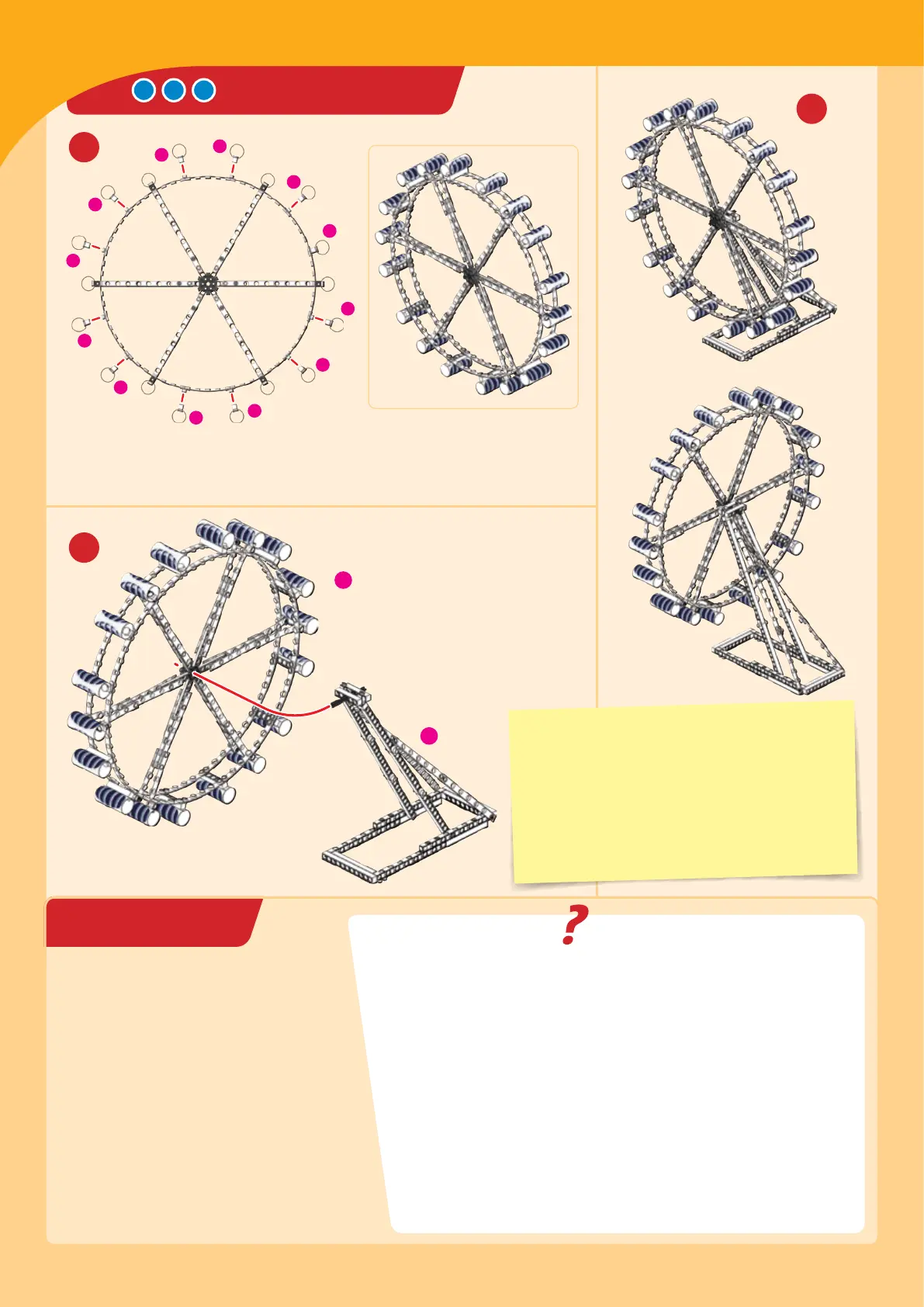
Perform step 18 a total of twelve times,
until a total of 18 passenger cars are
aached to the wheel as shown.
x
Follow the general tips
for model refinements
on the inside back cover
to finish your model.
IMPORTANT NOTE!
If you let the assembled ferris wheel model sit
for a number of days, you will notice that the
wheel may distort over time. You can simply
bend it back into a smooth curve again. If you
rotate the model 180 degrees every few days,
the distortion will be minimized.



 To Next Page