EasyManua.ls Logo

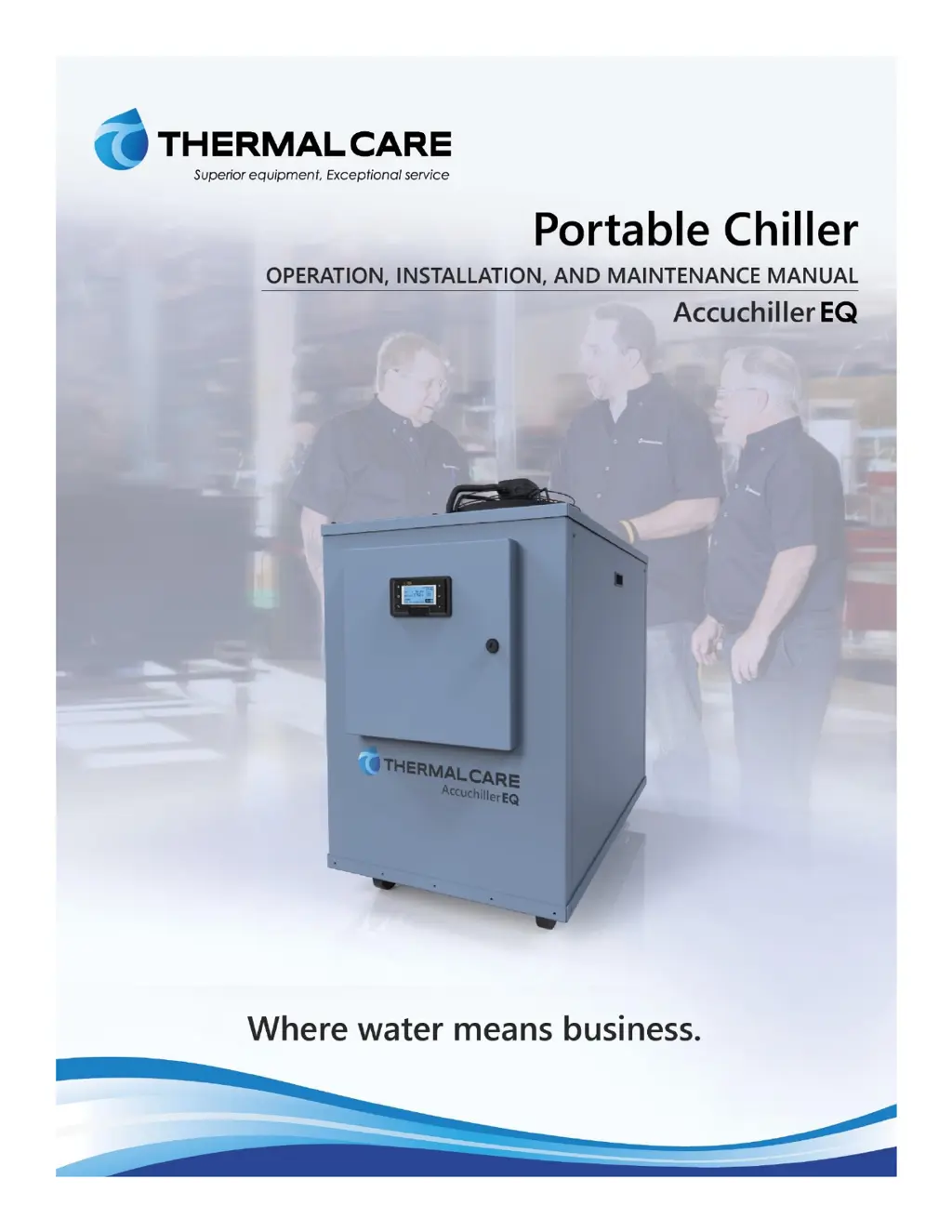
Thermal Care ACCUCHILLER EQ - User Manual

Thermal Care ACCUCHILLER EQ
28 pages
Print Icon
To Next Page IconTo Next Page
Loading...

Questions and Answers

  • T
    Tommy GordonAug 17, 2025
    What to do if my Thermal Care Chiller has insufficient cooling?
    • N
      Natasha ChangAug 17, 2025
      If your Thermal Care chiller isn't cooling effectively and the temperature keeps rising, it could be due to several reasons. The process load might be too high, so check if the chiller is properly sized. Coolant flow through the evaporator could be too high or too low; adjust it to the correct level. Other potential causes include a faulty temperature sensor (replace it). For issues related to insufficient condenser cooling, refer to the section on “High Refrigerant Pressure”. For problems with the refrigeration circuit or a hot gas bypass valve stuck open, contact a refrigeration service technician.
  • E
    elizabeth76Aug 21, 2025
    How to troubleshoot a Thermal Care ACCUCHILLER EQ Chiller compressor that won't start?
    • J
      James CruzAug 21, 2025
      If the compressor on your Thermal Care chiller won't start, it could be due to a compressor overload. Check the supply voltage, the amperage of each leg, the contactor and wiring, and the overload set point. It could also be a faulty compressor contactor, in which case you should replace it. If it is a compressor failure, contact Customer Service for assistance.
  • E
    Erica HernandezAug 25, 2025
    Why is the temperature control erratic on my Thermal Care ACCUCHILLER EQ?
    • P
      probinsonAug 25, 2025
      Erratic temperature control in a Thermal Care chiller can be caused by several factors. Check for low coolant flow through the evaporator and adjust the flow to the proper level. Also, intermittent overloading of chiller capacity can be a cause, so make sure the chiller is properly sized for the process load. A faulty temperature sensor can also lead to erratic control, so replace it if necessary. For issues with the hot gas bypass valve, contact a refrigeration service technician.
  • E
    erinschmidtAug 27, 2025
    What causes low refrigerant pressure in a Thermal Care ACCUCHILLER EQ?
    • V
      vickie90Aug 27, 2025
      Low refrigerant pressure in your Thermal Care chiller could be due to a low refrigerant charge or a refrigerant leak; in either case, contact a refrigeration service technician. It could also be caused by a faulty low refrigeration pressure sensor, so check for proper range and replace it if necessary.
  • S
    Sean RossAug 30, 2025
    What causes high pump discharge pressure in a Thermal Care ACCUCHILLER EQ Chiller?
    • J
      Jeremy RamirezAug 31, 2025
      High pump discharge pressure in your Thermal Care Chiller can be caused by several factors: * Closed valves in the process piping (open the valves). * Obstruction in the piping or process (remove the obstruction). * Clogged Y-strainer (clean the strainer). * Faulty pressure gauge (replace it).
  • V
    varmstrongSep 3, 2025
    How do I fix a Thermal Care ACCUCHILLER EQ pump that won't start?
    • J
      jesse73Sep 3, 2025
      If the pump on your Thermal Care chiller isn't starting, the issue might be a pump overload. Check the supply voltage, amperage of each leg, contactor and wiring, and the overload set point. Another potential cause is a faulty pump contactor, which should be replaced. If the pump has failed, replace it.
  • T
    Tracy SampsonSep 6, 2025
    What to do for low pump discharge pressure on Thermal Care Chiller?
    • D
      David WoodsSep 6, 2025
      Low pump discharge pressure in your Thermal Care chiller can be caused by a pump running backwards; switch two legs of the incoming power. It could also be due to a faulty pump pressure gauge, which should be replaced. Other possible causes are pump failure (replace the pump if faulty) or excessive flow (reduce the flow).
  • G
    Gabrielle DavisSep 9, 2025
    How to troubleshoot the freezestat on a Thermal Care ACCUCHILLER EQ Chiller?
    • D
      David MayoSep 10, 2025
      A freezestat issue with your Thermal Care chiller could be due to low flow through the evaporator; adjust the flow to the proper level. It may also be caused by the freezestat control module; check for the proper setting (Protected Setting). Another potential cause is a faulty freezestat sensor, which should be replaced.
  • M
    Mary LeonNov 13, 2025
    Why is the refrigerant pressure high in my Thermal Care ACCUCHILLER EQ?
    • W
      William BakerNov 13, 2025
      High refrigerant pressure in Thermal Care chillers can stem from several factors. For air-cooled units, check for dirty air filters (clean them), airflow obstructions (ensure proper installation), high ambient air temperature (reduce below 110°F), faulty condenser fan motor (replace it), or condenser fan cycling control issues (confirm proper operation, replace if faulty). For water-cooled units, inspect for plugged condensers (clean tubes), insufficient condenser water flow (ensure proper installation), high condenser water temperature (reduce below 100°F), or a faulty condenser water regulating valve (check setting, replace if faulty). Other potential causes include a refrigerant circuit overcharge (contact a refrigeration service technician) or a faulty high refrigerant pressure sensor ...

Summary

Safety Guidelines

Safety Symbol Explanations

Explains common safety symbols used in the manual, including warnings and mandatory actions.

Safety Precautions

General Warnings and Hazards

Critical warnings on equipment misuse, electrical hazards, refrigerant risks, and sharp/hot surfaces.

Operational Safety Requirements

Essential safety measures for installation, maintenance, and operation, including PPE and power control.

Installation - Chiller

Unit Storage Requirements

Guidelines for protecting the unit during storage to prevent damage.

Foundation and Location

Specifies requirements for the mounting pad, leveling, and unit placement for optimal operation.

Rigging and Piping

Covers safe rigging methods and considerations for chilled process fluid and condenser water piping.

Installation - Remote Condenser

Remote Condenser Location and Lifting

Details on outdoor placement, ventilation, and safe lifting procedures for the remote condenser.

Mounting Legs and Ventilation

Instructions for attaching mounting legs and ensuring adequate airflow for the condenser.

Refrigerant Piping Design

Interconnecting Piping

Covers the required piping between the chiller and remote condenser and design considerations.

Piping Design Guidelines

Specifies general considerations for refrigerant line sizing, length, and elevation.

Line Sizing Calculations

Equivalent Length Determination

Steps to calculate equivalent pipe length for accurate line sizing.

Liquid Line Sizing

Guidance on sizing liquid lines for optimal pressure drop and refrigerant charge.

Discharge Line Sizing

Hot Gas Riser Design

Details on upflow riser traps and oil management for discharge lines.

Discharge Line Pitching and Riser Systems

Covers pitching requirements and recommendations for double riser systems for oil return.

Refrigerant and Oil Charge

Calculating System Charge

Method for determining the total refrigerant and oil charge for the system.

Condenser Fan Control

Electrical Installation

Wiring and Voltage Checks

Compliance with codes, voltage verification, and phase sequence checks for electrical setup.

Controller Operation

Controller Interface and Boot-Up

Describes the controller's initial boot sequence and the function of its interface buttons.

Controller Menus - User & Main

User Menu Navigation and Functions

How to navigate the User Menu for ON/OFF, Info, and SET parameters.

Main Menu Structure and Access

Accessing the Main Menu via PRG button, covering Process, HGBP, Alarms, and Settings.

User Menu Parameter Details

Start;Stop, Compressor, and HGBP Status

Displays status for unit start/stop, compressor, and Hot Gas Bypass valve.

Process, I;O, and Running Hours

Shows status for process parameters, Universal/Digital I/O, and unit running hours.

Setpoint, Remote Control, and Modbus

Covers setpoint adjustment, remote control, and Modbus communication settings.

Power On AutoStart

Configuration option for automatic unit startup after power restoration.

Main Menu Setup - User & Manufacturer

Antifreeze, Condenser, and Fluid Settings

Configuration for antifreeze setpoint, condenser type, and fluid temperature options.

Fan, Phase, Alarm, and Makeup Options

Settings for fan overload, phase monitor, alarm outputs, and automatic fluid makeup.

Process Control and Remote Setpoint

Options for Return Fluid Temperature control and enabling Remote Setpoint functionality.

Main Menu Setup - Service & Process

Flow, Setpoint Limits, and Run Hours

Adjustments for flow alarms, setpoint limits, and resetting component run hours.

Hot Gas Bypass and PID Settings

Configuration for HGBP control mode, setpoint, and PID loop parameters.

Alarm Logs and System Settings

Functions for exporting alarms, setting date/time, unit of measure, and Modbus parameters.

Initialization and Logout

Parameter management and exiting password-protected settings.

Modbus RTU Communications

Modbus Parameter Register Map

Detailed table of registers for Modbus RTU communication with the controller.

Alarms and Fault Logic

Alarm Status and Navigation

Understanding alarm indicators, accessing logs, and identifying active alarms.

Alarm Type and Reset Definitions

Table detailing alarm types, fault logic, reset locations, and reset types.

Initial Start-Up Procedures

Power Connection and Coolant Filling

Steps for connecting main power, checking phase sequence, and filling the coolant circuit.

Water Chemistry Requirements

Guidelines for ensuring proper water quality for the coolant system to prevent issues.

Cooling Water Management

Water Quality Impacts

Discusses unwanted effects of improper water quality and key properties.

Water Chemistry and Glycol Tables

Lists fill water chemistry limitations and recommended glycol solutions for freeze protection.

Start-Up Component Checks

Condenser, Valve, and Freezestat Verification

Procedures for checking the condenser, refrigerant valves, and setting the freezestat.

Power, Flow, and Initial Operation

Steps for turning on control power, establishing coolant flow, and initial unit temperature control.

Preventive Maintenance Schedule

Weekly Maintenance Tasks

Routine checks for condenser coils, set point temperature, and pump discharge pressure.

Monthly and Quarterly Tasks

Electrical connection checks, voltage verification, and technician inspections.

General Troubleshooting Guide

Compressor and Pump Troubleshooting

Diagnosing and resolving issues with compressor and pump operation.

Pressure and Temperature Control Problems

Addressing low/high refrigerant pressure and erratic temperature control issues.

Troubleshooting and Drawings

Insufficient Cooling Diagnosis

Identifying causes for inadequate cooling performance.

Reference Drawings

Information on accessing custom unit drawings for installation and service.

Thermal Care ACCUCHILLER EQ Specifications

General IconGeneral
BrandThermal Care
ModelACCUCHILLER EQ
CategoryChiller
LanguageEnglish

Related product manuals