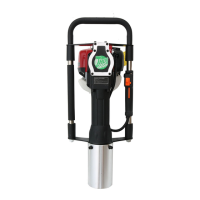
The THOR Post Driver is a lightweight, hand-held gasoline-powered pile driver designed to reduce operator effort and provide simple, comfortable operation. It is an efficient tool for completing various jobs quickly and with less physical strain. The portable design makes it suitable for a wide range of applications, including driving steel posts, t-posts, sign posts, u-channel posts, guide posts, grounding rods, and even tent stakes for party tent projects.
Function Description:
The THOR Post Driver operates by using a gasoline engine to generate impact energy, driving posts into the ground. The device is designed for ease of use, with features aimed at minimizing recoil force and enhancing user comfort during operation.
Important Technical Specifications:
The manual references two specific models: MS-PD1002 and MS-PD1004.
Fuel type: Qualified 86 Octane unleaded gasoline or higher.
Fuel Mixture (for model MS-PD1002): 25 to 1 Fuel Mixture.
Impact Cylinder Lubrication: Requires 50g of special lubrication after 50 accumulated hours of work.
Usage Features:
- Ergonomics: The operating handle is made of rubber/plastic sponge, which significantly reduces recoil force. A two-way damping spring is also installed to further enhance comfort during use.
- Safety Precautions:
- Operators must wear slip-resistant safety shoes, protective clothing (including goggles and a helmet), and earplugs for extended operation.
- Maintain body balance during operation; the user should stand in front of the air filter.
- Avoid one-handed operation after starting the machine.
- When lifting the machine, be careful not to pull the throttle switch; carry it only at idle speed.
- Keep non-staff away from the operating area to prevent injury.
- Operate the pile driver at medium speed.
- Keep the handle dry and clean, free from greasy oil or fuel mixture.
- Turn off the engine if operation is stopped midway for any reason.
- Before use, ensure all fastening screws of the connector are properly tightened.
- Pure gasoline (without two-stroke engine oil) is prohibited; use the recommended fuel ratio.
- Refuel in a well-ventilated environment with the engine turned off.
- Do not overfill oil; it should not exceed the neck of the fuel tank's oil filler. If fuel spills, wait until it completely volatilizes before restarting.
- During work, regularly check the fuel tank for damage or leaks and ensure the oil lid is tightened. Replace immediately if damage is found.
- Remove hazardous materials (oil containers, gas cans, open flames) from the work area.
- When used in enclosed areas (tunnels, trenches, deep grooves), ensure adequate air circulation to prevent gas fume poisoning.
- Avoid quick acceleration or braking to prevent machine damage.
- Empty the fuel tank before transport to prevent leakage and accidental fires.
- Non-professional maintenance is prohibited to avoid structural damage and shortened service life.
- Starting Procedure:
- Before starting, repeatedly press the transparent, semi-circle fuel bubble until the carburetor is filled with fuel.
- If the engine is cold, close the air door (open it after starting).
- Set the machine upright. Hold the upper part of the handle tightly with one hand and quickly pull the starter grip with the other (extend the cord sufficiently). Do not let the starter grip snap back freely; hold it tightly to prevent injury.
- Start the gasoline engine, then open the air door completely. After 5 minutes of idle operation, begin normal work.
- Operation:
- After starting, idle the engine for 5 minutes to warm up.
- Press the throttle handle to the appropriate regulatory position based on the required impact energy.
- For new gasoline post drivers, operate mainly at low or medium speed for the first 20 hours to extend service life; avoid maximum throttle.
- The optimal operating speed is medium speed.
- High-speed operation during non-piling is prohibited.
- Turning Off:
- Release the throttle handle and allow the engine to idle for 3-5 minutes.
- Pull the stop switch to the "off/flame-out" position.
Maintenance Features:
- Air Filter:
- Check regularly. Soot deposits reduce engine power and service life.
- Clean heavily soiled filters with warm water and detergent, then wipe dry.
- Replace damaged filters.
- Shorten maintenance cycles in dirty environments.
- Fuel Filter:
- A blocked fuel filter reduces speed and impact energy.
- To clean: Open the tank lid, remove the fuel filter with a metal hook, and clean it. Clean the fuel tank at the same time.
- Carburetor:
- Residual oil in the fuel tank and carburetor can become greasy, blocking the oil line and preventing starting if the device is unused for over a week.
- Completely drain fuel if not used for more than one week.
- Method: Pull out the oil inlet pipe, repeatedly press the rubber bubble of the carburetor to discharge oil, then press the oil inlet pipe back into position when the fuel bubble and oil return pipe are empty.
- Spark Plug:
- Ensure proper spark plug gap for normal engine operation.
- Remove sediment with a wire brush.
- Muffler:
- Regularly remove dirt from the inlet and outlet, or clean with detergent.
- Gearbox Lubrication:
- Open the gear box cover and regularly lubricate the driving gear to ensure full lubrication.
- Cylinder Heat Sink:
- Regularly remove dust to ensure proper cylinder cooling, as the gasoline post driver is air-cooled. Dust accumulation can directly influence cooling and lead to cylinder failure.
- Impact Cylinder Lubrication:
- After 50 accumulated hours of work, fill the impact cylinder with 50g of special lubrication.
- Troubleshooting: The manual provides a detailed troubleshooting guide for common issues like starting difficulties, slow speed, weak power, abnormal sound, and low work efficiency, along with corresponding analyses and actions.
- Maintenance Schedule: A comprehensive schedule outlines maintenance tasks (outlook check, cleaning, replacement, tightening, adding oil, checking/adjusting) and their frequencies (before work, after work (every day), after filling oil, every week, every month, temporary failure, if necessary). This schedule covers the whole machine, control handle/stop button, air filter, fuel filter, gas tank/gas tank cover, gear box/cylinder, silencer, cylinder cooling fin, spark plug, and screws/nuts. The maintenance cycle should be shortened under harsh working conditions (e.g., thick dust, long hours).


 To Next Page
 General