4 - Operation of the 4-20mA SYSTEM
INTRODUCTION
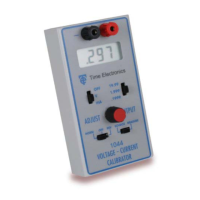
A common use of the 1044 would be to simulate a transducer or measure
the current flow in a transducer loop. The following brief explanation, which
is intended as a guideline only, may help when operating the 1044 in a 4-
20mA system.
THE 4-20mA SYSTEM
The basic requirement for any transducer with remote display is:
A) To use as few wires as possible.
B) That errors are not introduced into the signal from the transducer by
the effects of interference due to lead resistance.
C) To supply power to the transducer to enable amplifiers to be built into
the transducer when the signal produced by the sensing element is
too small to be transmitted without amplification.
In the 4-20mA system the transducer is supplied with D.C. power from the 2
wire line. The transducer takes the current from the line proportional to the
stimulus (i.e. pressure, temperature, etc.). By measuring the current flowing
in the line, the output of the transducer can be monitored.
Since the signal is transmitted as a current, lead resistance and voltage drop
do not affect the accuracy. The basic requirements are therefore fulfilled us-
ing just two wires - the minimum possible.
To enable a certain amount of standardisation, and to compensate for volt-
age drop or variation in the supply, transducers are designed to operate over
a wide voltage range, usually between 15 and 30 volts, and to take a ‘zero’
current of 4mA and a full scale current of 20mA.
The simplest 4-20mA current loop system consists of 3 part, although often
2 parts are incorporated into the same unit. The 3 main parts are -
1) D.C. Power supply usually 24V.
2) 4 - 20mA current meter/recorder.
3) The transducer.
10


 To Next Page