2
1. Introduction to the DSP-9
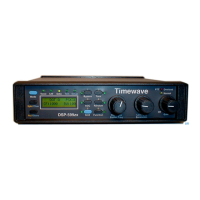
The DSP-9 is an audio noise filter for amateur radio voice and CW operation. The DSP-
9 filters and reduces noise and interference to improve radio reception. The DSP-9 uses
digital signal processing technology to implement algorithms that perform three basic
filter functions: 1) Random noise reduction, 2) Adaptive multi-tone notch filtering
(Tone noise reduction) and 3) Bandpass filtering. Push-button switches permit
simultaneous selection of the three functions.
RANDOM/TONE NOISE REDUCTION
The noise reduction functions of the DSP-9 operate by examining a characteristic of signals and
noise called correlation, and dynamically filtering out the undesired signals and noise. The
degree of correlation is relative. Random noise such as white noise or static is uncorrelated.
Speech is moderately correlated. Repetitive noise such as a heterodyne is highly correlated.
The DSP-9 measures correlation and filters out signals and noise that are outside its correlation
thresholds. There is little degradation of the desired speech signal. The amount of noise
reduction varies according to the correlation characteristics of the noise. Typical noise reduction
ranges from 5 dB to 20 dB for random noise and up to 50 dB for heterodynes.
BANDPASS FILTERS
The DSP-9 has bandpass filters that are used in voice and CW modes. In a typical example of a
voice mode application, a bandpass filter can improve a signal with a poor signal-to-noise ratio.
A bandpass filter removes the high and low audio frequency components that do not contribute
significantly to the speech intelligibility, thus improving signal qualitity. Another common
voice mode example is the improvement of a SSB signal corrupted by adjacent channel
interference (QRM). The steep skirts of the bandpass filters allow the interference to be
eliminated with minimal effect on the desired signal. In the voice mode, two front panel push
buttons select one of three voice bandpass filter bandwidths from two sets of filters. An internal
jumper behind the back panel selects the filter set, either 1.6, 2.0, and 2.4 kHz., or 1.8, 2.4, and
3.1 kHz.
CW signals require Bandpass filters with steep skirts and linear phase response. Linear phase
response maximizes the usable signaling rate for a given bandwidth and minimizes ringing often
heard on extremely sharp filters. The DSP-9 has six different CW filters with skirts so steep that
a signal literally falls off the edge of the pass band as you tune through a CW signal. The
bandwidths of these filters range can be selected at either 500, 200 or 100 Hz. The center
frequency for the CW Bandpass filters can be either 600 or 750 Hz. The narrow filters are
useful for trying to dig out extremely weak signals from the noise and QRM. The wider filters
allow easy tuning and listening to multiple CW signals simultaneously.



 To Next Page
 Loading...