4
3. Installation
To install a DSP-9 in a station, an operator must provide power to the DSP-9 and make
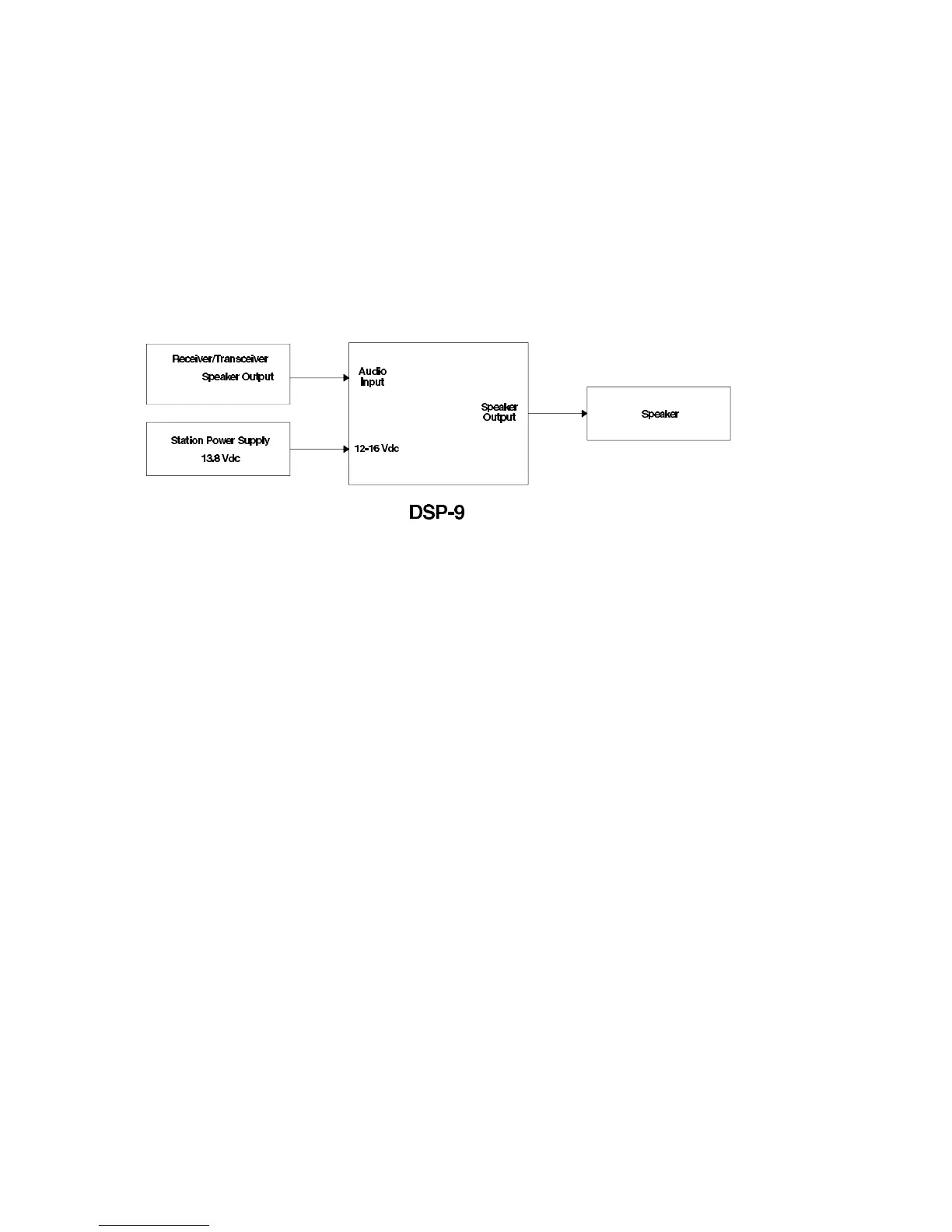
audio input and output connections to the DSP-9. A typical DSP-9 installation is shown
below in Figure 3.1.
Figure 3.1
POWER SUPPLY
The DSP-9 requires a power source of 12 to 16 Volts dc. at 1.0 Amperes.
The center pin
of the power connector is POSITIVE (+).
Acceptable power sources include:
• 13.8 volt dc. transceiver power supply (recommended power source for the DSP-9
because it is better regulated than most plug-in wall outlet supplies). Note that some
transceivers with internal power supplies have accessory power jacks with insufficient
current output.
• Radio Shack 273-1653 12 V.d.c. @ 1 Ampere plug-in wall supply
Switching power supplies are generally
not
recommended.
Connecting Cables
Shielded coaxial cables with RCA phono connectors should be used to minimize the
possibility of RF interference to the DSP-9. Timewave recommends coaxial video cables
with metal adapters to match the connectors on transceivers and speakers.
The center pin
on the DSP-9 audio input connector must not be connected to the transceiver speaker
ground.
AUDIO INPUT
The audio input of the DSP-9 is an RCA phono connector on the rear panel of the DSP-9.
Matching the output level of the radio to the input level of the DSP-9 is necessary to take



 To Next Page