5
maximum advantage of the wide dynamic range of the DSP-9. The best way to make
these levels match is to use an adjustable audio output of the radio (typically the speaker
output) as the input to the DSP-9. After connecting the DSP-9 to the radio, follow this
simple procedure to match the audio levels. First, tune the radio to a strong signal after
setting the radio output level gain control to a convenient midrange position. Then, adjust
the output level control on the radio so the
Overload
indicator LED on the front panel of
the DSP-9 rarely flashes and the
Normal
indicator LED always flashes with the normal
audio input levels. Proper adjustment ensures optimum signal-to-noise ratio and minimum
distortion. Adjust the radio output level only to maintain the proper input level to the
DSP-9. Use the
Gain
control on the DSP-9 to control the listening volume.
The factory default input impedance of the DSP-9 is 22 ohms. This impedance is
appropriate for most radios when driven by the speaker output of the radio. The DSP-9 can
be configured for a high input impedance by removing a shorting jumper (position 1).
This jumper is accessed by removing the back bezel and the back panel of the DSP-9.
AUDIO OUTPUT
The DSP-9 has two audio outputs:
1) On the lower left hand corner of the DSP-9 front panel is a 3.5 mm headphone jack
connected for stereo headphones.
Use of mono-headphones requires a stereo-to-
monaural adapter.
The DSP-9 speaker output is muted when a headphone plug is
inserted.
2) The Speaker Output RCA phono jack on the rear panel of the DSP-9 provides adequate
output to drive a 4 or 8 Ohm speaker. The front panel gain control adjusts the audio level
from this output. The maximum output power is approximately 3.2 watts into a 4 Ohm
speaker, or 1.6 watts into an 8 Ohm speaker.
4. Operation
Introduction
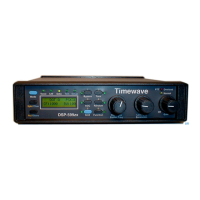
One knob and six push-button switches on the front panel control the DSP- 9. The knob
controls power and sets the audio output level of the DSP-9. Two of the push buttons
select the operating mode of the DSP-9. The remaining four push buttons select the
operational parameters of the DSP-9.
Power Switch/Gain Adjust Control
The
Gain
knob on the front panel of the DSP-9 is the power switch/gain adjust control.
Rotate the
Gain
control clockwise to turn on the DSP-9 and increase the volume. Rotate
the
Gain
control counter-clockwise to turn off the DSP-9 and decrease the volume.
Selecting the mode
The two leftmost push buttons on the DSP-9 select one of three operating modes for the
DSP-9. Depressing the
Bypass
push-button places the DSP-9 into a bypass mode. In the
bypass mode, the audio input of the DSP-9 is digitized by the analog-to-digital converter
and then looped back to the digital-to-analog converter. The loopback through the


 To Next Page
 Loading...