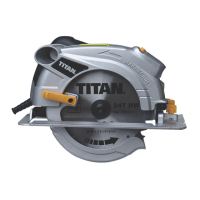
The TITAN TTB911CSW is a 1500W Circular Saw designed for straight cuts in wood and similar materials like MDF and chipboard. It is intended for use in an upright position with the base plate flat on the workpiece and should not be used upside down or as a stationary product on a workbench. The saw features a built-in laser for assistance with marked cutting lines. The supplied saw blade is specifically for cutting wood and should not be used on other materials.
Users must read all safety warnings, instructions, illustrations, and specifications provided in the manual to prevent electric shock, fire, and serious injury. All warnings and instructions should be saved for future reference. The term "power tool" refers to both mains-operated (corded) and battery-operated (cordless) power tools.
Work Area Safety:
- Keep the work area clean and well-lit to avoid accidents.
- Do not operate power tools in explosive atmospheres (flammable liquids, gases, or dust) as sparks can ignite fumes.
- Keep children and bystanders away to prevent distractions and loss of control.
Electrical Safety:
- Power tool plugs must match the outlet and should never be modified. Do not use adapter plugs with earthed (grounded) power tools to reduce the risk of electric shock.
- Avoid body contact with earthed or grounded surfaces (pipes, radiators, ranges, refrigerators) as this increases the risk of electric shock.
- Do not expose power tools to rain or wet conditions, as water increases the risk of electric shock.
- Do not abuse the cord; keep it away from heat, oil, sharp edges, or moving parts. Damaged or entangled cords increase the risk of electric shock.
- When operating outdoors, use an extension cord suitable for outdoor use to reduce the risk of electric shock.
- If operating in a damp location is unavoidable, use a residual current device (RCD) protected supply to reduce the risk of electric shock.
Personal Safety:
- Stay alert, watch what you are doing, and use common sense. Do not operate the tool when tired or under the influence of drugs, alcohol, or medication, as inattention can lead to serious injury.
- Always wear eye protection and other personal protective equipment such as a dust mask, non-skid safety shoes, hard hat, or hearing protection, as appropriate for the conditions.
- Prevent unintentional starting by ensuring the switch is in the off-position before connecting to a power source or battery pack, picking up, or carrying the tool.
- Remove any adjusting key or wrench before turning the power tool on to prevent personal injury.
- Do not overreach; maintain proper footing and balance for better control in unexpected situations.
- Dress properly: avoid loose clothing or jewelry, and keep hair and clothing away from moving parts.
- If dust extraction and collection facilities are provided, ensure they are connected and properly used to reduce dust-related hazards.
- Do not become complacent from frequent tool use; careless actions can cause severe injury.
- Do not force the power tool; use the correct tool for the application.
- Do not use the power tool if the switch does not turn it on and off; it must be repaired.
- Disconnect the plug from the power source or remove the battery pack before making adjustments, changing accessories, or storing the tool to prevent accidental starting.
- Store idle power tools out of reach of children and untrained users.
- Maintain power tools and accessories; check for misalignment, binding, breakage, or any other condition affecting operation. Have damaged tools repaired.
- Keep cutting tools sharp and clean for better control and to reduce binding.
- Use the power tool, accessories, and tool bits according to instructions, considering working conditions and the task.
- Keep handles and grasping surfaces dry, clean, and free from oil and grease for safe handling.
Service:
- Have power tools serviced by a qualified repair person using identical replacement parts to maintain safety.
Circular Saw Safety Warnings - Cutting Procedures:
- DANGER: Keep hands away from the cutting area and the blade. Keep the second hand on the auxiliary handle or motor housing.
- Do not reach underneath the workpiece; the guard cannot protect from the blade below.
- Adjust cutting depth to the workpiece thickness; less than a full tooth of the blade should be visible below.
- Never hold the workpiece in hands or across the leg; secure it to a stable platform to minimize body exposure, blade binding, or loss of control.
- Hold the power tool by insulated gripping surfaces when cutting where the tool may contact hidden wiring or its own cord.
- When ripping, use a rip fence or straight edge guide for accuracy and to reduce blade binding.
- Use blades with correct size and shape (diamond versus round) of arbor holes.
- Never use damaged or incorrect blade washers or bolts.
- Kickback is a sudden reaction to a pinched, jammed, or misaligned saw blade, causing the saw to lift up and out of the workpiece toward the operator.
- Maintain a firm grip with both hands and position arms to resist kickback forces. Position your body to either side of the blade, not in line with it.
- If the blade binds or a cut is interrupted, release the trigger and hold the saw motionless until the blade stops. Do not remove the saw or pull it backward while the blade is in motion.
- When restarting a saw in the workpiece, center the blade in the kerf so teeth are not engaged.
- Support large panels to minimize blade pinching and kickback; place supports under the panel on both sides, near the cut line and edge.
- Do not use dull or damaged blades; they cause narrow kerf, friction, binding, and kickback.
- Blade depth and bevel adjusting locking levers must be tight before cutting.
- Use extra caution when sawing into existing walls or blind areas, as protruding blades can cause kickback.
Safety Instructions for Circular Saws with Inner Pendulum Guard - Lower Guard Function:
- Check the lower guard for proper closing before each use. Do not operate if it doesn't move freely and close instantly. Never clamp or tie it open.
- Check the operation of the lower guard spring; if not operating properly, service before use.
- The lower guard may be retracted manually only for "plunge cuts" and "compound cuts." Release it as soon as the blade enters the material. For other sawing, it should operate automatically.
- Always ensure the lower guard covers the blade before placing the saw down. An unprotected, coasting blade will cause the saw to walk backward.
Additional Circular Saw Safety Warnings:
- Do not use abrasive wheels.
- Use only blades with diameters in accordance with markings and technical specifications.
- Follow blade changing procedures.
- Check all blade guard operations.
- Only cut materials listed in the intended use.
- Use a dust collection system.
- Clean the product and guarding system properly and regularly.
Saw Blade Safety Warnings:
- Only use saw blades if you know how to use and handle them.
- Pay attention to the maximum rotational speed marked on the blade.
- Do not use cracked saw blades; repairing them is not permitted.
- Clean clamping surfaces to remove dirt, grease, oil, and water.
- Do not use loose rings or sleeves to "make up" bore sizes.
- Ensure fixed rings for securing saw blades have the same diameter and are parallel.
- Handle saw blades with care; store them in original packaging or special boxes. Wear gloves.
- Ensure all guards are correctly fixed before use.
- Before use, ensure the saw blade complies with technical requirements and is correctly fixed.
- Only use manufacturer-recommended saw blades conforming to EN 847-1 for wood and analogous materials.
- Avoid overheating blade tips and melting plastic workpieces during long periods of use. Take 15-minute breaks regularly to cool blade tips.
Laser Safety Warnings:
- Protect yourself and the environment from accidents through appropriate precautions.
- Do not stare directly into the laser beam without eye protection; it can cause permanent retinal damage.
- Do not stare directly into the laser with other optical instruments (e.g., a magnifier).
- Do not direct the laser beam at persons or animals or onto reflecting surfaces; it can cause blindness or irritation. Even a low-power laser can damage the eye.
- Caution: executing processes different from those described can lead to dangerous radiation exposure.
- Never open or manipulate the laser module; it might cause unexpected radiation exposure.
Vibration and Noise Reduction:
To reduce noise and vibration emission, limit operating time, use low-vibration and low-noise modes, and wear personal protective equipment.
- Use the product as intended.
- Ensure the product is in good condition and well-maintained.
- Use correct cutting attachments in good condition.
- Keep a tight grip on handles/gripping surfaces.
- Maintain the product as per instructions and keep it well lubricated.
- Plan work schedules to spread high vibration tool use across longer periods.
Emergency:
- Familiarize yourself with the manual and safety directions.
- Be alert to recognize and handle risks early.
- Switch off and disconnect from power supply if malfunctions occur; have the product checked and repaired by a qualified professional.
Residual Risks:
Even with safety requirements met, risks remain:
- Health defects from vibration emission if used for long periods or not properly maintained.
- Injuries and property damage from broken cutting attachments or sudden impact of hidden objects.
- Injury and property damage from flying objects.
- WARNING: This product produces an electromagnetic field. Persons with medical implants should consult their doctor and implant manufacturer before operating.
Additional Safety Warnings for Construction Dust:
The COSHH Regulations (1st October 2012) aim to reduce risks from silica, wood, and gypsum dusts. Construction workers are at risk from breathing in Respirable Crystalline Silica (RCS) from materials like sand, sandstone, granite, concrete, and mortar during cutting, drilling, and grinding. Breathing in fine particles can lead to lung cancer, silicosis, and Chronic Obstructive Pulmonary Disorder (COPD). Wood dust can cause Asthma.
- To protect lungs, the COSHH Regulations set a Workplace Exposure Limit (WEL).
- Reduce dust by using optimal building product sizes, less powerful tools (e.g., block cutter instead of angle grinder), or different methods (e.g., nail gun instead of drilling).
- Always work with approved safety equipment, such as dust masks designed to filter microscopic particles, and use dust extraction.
- WARNING: Some dust particles contain chemicals known to cause cancer, birth defects, or other reproductive harm. Examples include lead from lead-based paints, crystalline silica from masonry products, and arsenic/chromium from chemically treated timber.
- Reduce exposure by working in well-ventilated areas and using approved dust masks.
Vibration:
The European Physical Agents (Vibration) Directive helps reduce hand-arm vibration syndrome injuries. Manufacturers provide indicative vibration test results.
- See technical specifications for vibration levels.
- The declared vibration emission value should be used as a minimum level and with current guidance.
- WARNING: Actual vibration values can differ based on usage. Adopt measures to protect against vibration exposure, considering the whole work process (including idle and off times). Measures include regular maintenance, keeping hands warm, periodical breaks, and proper work planning.
- Poor MAINS conditions can cause voltage drops when starting the equipment. If MAINS-IMPEDANCE Zmax < 0.42 OHM, disturbances are not expected.
Health Surveillance:
Employees should be part of an employer's health surveillance scheme to identify vibration-related diseases early, prevent progression, and help them stay in work.
Technical Specifications:
- General:
- Rated voltage, frequency: 220-240 V~, 50 Hz
- Rated power input: 1500 W
- Rated no load speed n₀: 5000 min⁻¹
- Protection class: ||
- Weight: approx. 4.0 kg
- Cutting capacity:
- Cutting angle: 0-45°
- at 90°: 66 mm
- at 45°: 45 mm
- Saw blade:
- Type: TCT
- Outer diameter: Ø 190 mm
- Bore diameter: Ø 16 mm
- Thickness: 2.4 mm
- Teeth number: 24 T
- Max. speed nmax: 7000 min⁻¹
- Cutting material: wood
- Laser:
- Class: 2
- Standard: EN 60825-1:2014
- Wave length λ: 650 nm
- Energy output P₀: ≤ 1mW
- Sound values:
- Sound pressure level LₚA: 94.8 dB(A)
- Sound power level LwA: 105.8 dB(A)
- Uncertainty KₚA, KwA: 3 dB(A)
- Hand arm vibration values:
- Cutting wood ah,w: 2.173 m/s²
- Uncertainty K: 1.5 m/s²
- The sound intensity level for the operator may exceed 80 dB(A), requiring ear protection.
Usage Features:
- Unpacking and Setup:
- Unpack all parts on a flat, stable surface.
- Ensure all contents are complete and undamaged.
- WARNING: Packaging is not a toy; keep away from children due to choking/suffocation risk.
- Required items: suitable personal protective equipment, parallel guide (14), saw blade (16), hex key (24).
- WARNING: Product must be fully assembled before operation. Do not connect to power supply until fully assembled.
- Check saw blade for damage and wear before each use. Use only suitable saw blades; no abrasive wheels.
- Attaching the Saw Blade:
- Place the product on a flat surface.
- Lock the spindle by pressing the spindle lock lever (8).
- Loosen the locking bolt (17) anticlockwise with the hex key (24).
- Remove the locking bolt (17) and locking flange (18). Do not remove the backing flange (19).
- Open the lower guard (15) with the retracting lever (20).
- Place the saw blade (16) on the spindle, ensuring rotational direction matches the housing.
- Carefully move the retracting lever (20) back to close the lower guard.
- Secure the saw blade with the locking flange (18) and locking bolt (17), tightening clockwise with the hex key (24).
- Turn the saw blade by hand to check for smooth rotation.
- Switch on and run idle for one minute to confirm proper installation. If abnormal vibration or noise occurs, re-fit the blade.
- Replacing the Saw Blade:
- Place the product on a flat surface.
- Lock the spindle with the spindle lock lever (8) and loosen the locking bolt (17) anticlockwise with the hex key (24).
- Remove the locking bolt (17), locking flange (18), saw blade (16), and backing flange (19).
- Clean the locking bolt, locking flange, backing flange, spindle, and inside from dust.
- Replace the backing flange (19) to the spindle.
- Attach an appropriate saw blade.
- Depth Adjustment:
- WARNING: Switch off and disconnect from power supply before adjustments.
- Always use the correct blade depth setting: no more than a full tooth of the blade teeth below the material.
- Place the product on a flat surface.
- Loosen the fixation lever (22a) and lift the housing to the desired depth using the depth scale (22b).
- Tighten the fixation lever (22a) to secure the depth.
- Bevel Angle Adjustment:
- WARNING: Switch off and disconnect from power supply before adjustments.
- Place the product on a flat surface.
- Loosen the fixation knob (11a) and tilt the housing to the desired angle using the scale (11b).
- Tighten the fixation knob (11a) to secure the angle.
- Parallel Guide:
- Attach the parallel guide (14) from the right side for parallel cuts.
- Loosen the parallel guide fixation knob (10) anticlockwise.
- Align and insert the parallel guide (14) to the support.
- Use the scale (14a) to adjust width.
- Fix the parallel guide by tightening the fixation knob (10) clockwise.
- Dust Extraction:
- WARNING: Always attach a dust extraction device and wear a dust mask. Dust can be harmful, especially from treated wood.
- Attach a suitable vacuum cleaner to the dust extraction outlet (2).
- Connection to Power Supply:
- Ensure the on/off switch (4) is in the off position.
- Connect the power plug (1) to a suitable socket.
- WARNING: Check voltage compliance with the rating label.
- Switching On/Off:
- Press and hold the lock-off button (21).
- Press the on/off switch (4) to switch on.
- Release the on/off switch (4) to switch off.
- Laser Use:
- Use the laser (9) as a guide for cutting on marked lines.
- Switch the laser on/off by pressing the laser on/off switch (7).
- WARNING: Do not stare into the beam (class 2 laser product).
- General Cutting Operation:
- Check product, power cord, plug, and accessories for damage before each use.
- Hold the product on its main handle (3) and front handle (6).
- Ensure air vents (23) are unobstructed.
- Switch off immediately if disturbed.
- Take regular breaks.
- WARNING: Fine dust will be generated; some dusts are highly inflammable and explosive. Do not smoke, keep heat sources and open flames away. Wear a dust mask.
- NOTE: Check lower guard function before each use; it should move freely.
- Cut in the direction of the wood grain to avoid jamming and fraying.
- Consider the cutting edge; do not cut directly on the line, but next to it.
- Ensure the workpiece is free of obstacles like nails or screws.
- Check for sufficient clearance for the saw blade under the workpiece.
- Never hold the workpiece with hands or across the leg; secure it with clamps.
- Hold the product with one hand on the rear handle (3) and the other on the front handle (6).
- Switch on and wait for full speed before placing on the workpiece.
- Lead the product carefully, placing the front of the base plate (12) flat and pushing forward at an even speed.
- WARNING: Ensure the base plate lays flat on the workpiece. Do not make cuts holding the product by hand.
- Apply only necessary pressure to keep the product flat.
- Keep the product moving to avoid grooves.
- Lift the product from the workpiece before switching off.
- WARNING: If the attachment gets stuck, switch off, let it stop, and disconnect from power supply before freeing it.
- Parallel Cutting:
- Attach the parallel guide (14) and adjust width.
- Switch on and wait for full speed.
- Place the product laterally to the workpiece and guide along the edge.
- NOTE: Apply light pressure against the workpiece for an even result.
- Bevel Cutting:
- Adjust the cutting angle and ensure the fixation knob (11a) is tightened.
- Switch on and wait for full speed.
- Place the base plate (12) flat on the workpiece and push forward at an even speed.
- Laser Guided Cutting:
- Mark the cutting line.
- Switch on and wait for full speed.
- Place the base plate (12) flat and switch the laser (9) on.
- Align the laser beam with the marked line and move forward at an even speed.
- WARNING: Switch the laser off after each cut, before placing the product down, and after operation to avoid staring into the beam.
- After Use:
- Switch off, disconnect from power supply, and let it cool down.
- Check, clean, and store as described.
Maintenance Features:
- Golden Rules for Care:
- WARNING: Switch off, disconnect from power supply, and let cool before inspection, maintenance, and cleaning.
- Keep the product clean; remove debris after each use.
- Regular cleaning ensures safe use and prolongs life.
- Inspect for worn/damaged parts before each use. Do not operate if broken.
- WARNING: Only perform repairs and maintenance as per instructions; further work by a qualified specialist.
- General Cleaning:
- Clean with a dry cloth; use a brush for hard-to-reach areas.
- Clean air vents (23) after every use.
- Remove stubborn dirt with high-pressure air (max. 3 bar).
- NOTE: Do not use chemical, alkaline, abrasive, or aggressive detergents/disinfectants.
- Check for worn/damaged parts; replace or contact an authorized service center.
- Power Cord:
- If damaged, it must be replaced by the manufacturer or service agent.
- UK Plug:
- If replacing the fitted plug, follow instructions: Blue wire to N (Neutral/black), Brown wire to L (Live/red).
- WARNING: Never connect live or neutral wires to the earth terminal (E).
- Fit an approved BS 1363 or BS 1363/A plug and correctly rated BS 1362 13 Amp fuse. Consult an electrician if in doubt.
- NOTE: If a moulded plug is removed, destroy it to prevent engaging into a socket.
- Repair:
- This product contains no consumer-repairable parts. Contact an authorized service center.
- Storage:
- Switch off and disconnect from power supply.
- Clean the product.
- Store in a dark, dry, frost-free, well-ventilated place, inaccessible to children. Ideal temperature: 10 °C to 30 °C.
- Use original packaging or a suitable cover to protect against dust.
- Transportation:
- Switch off and disconnect from power supply.
- Attach transportation guards if applicable.
- Carry by the rear handle (3).
- Protect from heavy impact or strong vibrations.
- Secure the product to prevent slipping or falling.

 Need help?

 To Next Page
 General