42
TTCSP49
In more detail . . .
WARNING! Never climb into a tree to limb or prune! Do not stand on ladders,
platforms, logs, or in any position which may cause you to lose the balance or
control of the saw! When pruning trees, it is important not to make the ush cut
next to main limp or trunk until you have cut off the limb further out to reduce
the weight! This prevents stripping the bark from the main member!
WARNING! If the limbs to be pruned are above chest height, hire a professional
to perform the pruning!
Cutting spring poles
A spring pole is any log, branch, rooted stump, or sapling which is bent under tension
by other wood so that it springs back if the wood holding it is cut or removed.
On a fallen tree, a rooted stump has a high potential of springing back to the upright
position during the bucking cut to separate the log from the stump. Watch out for spring
poles, they are dangerous.
Bucking a log
Bucking is cutting a log into lengths. It is important to make sure your footing is rm and
your weight is evenly distributed on both feet. When possible, the log should be raised
and supported by the use of limbs, logs or chocks.
1.
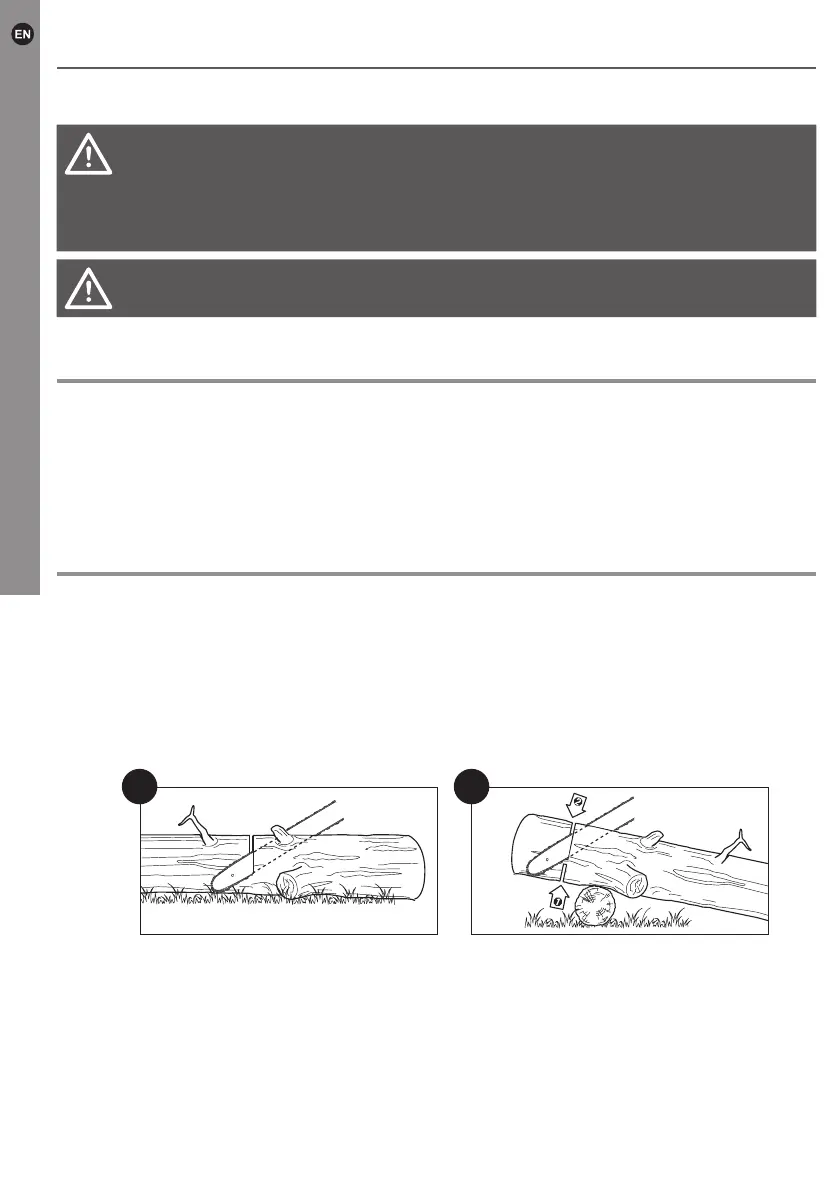
Follow the simple directions for easy cutting. When the log is supported along its
entire length (Fig. 33), it is cut from the top (overbuck).
2.
When the log is supported on one end (Fig. 34), cut 1/3 the diameter from the
underside (underbuck). Then make the nished cut by overbucking to meet the rst cut.
33 34
Operation


 To Next Page