EasyManua.ls Logo

Toro 03661 - User Manual

Toro 03661
20 pages
Print Icon
To Next Page IconTo Next Page
Loading...
FormNo.3362-857RevB
8and11BladeDPACuttingUnits
with5inchReels
Reelmaster
®
5210&5410TractionUnits
ModelNo.03661—SerialNo.310000001andUp
ModelNo.03695—SerialNo.310000001andUp
ToregisteryourproductordownloadanOperator'sManualorPartsCatalogatnocharge,gotowww.Toro.com.OriginalInstructions(EN)

Questions and Answers

  • S
    Sarah RichSep 3, 2025
    Why is the traction response sluggish on my Toro Lawn Mower?
    • D
      Debra HarrisonSep 3, 2025
      If the traction response on your Toro Lawn Mower is sluggish, identify and correct the causes affecting traction response. This may be due to low charge pressure, very cold hydraulic oil, the parking brake dragging or binding, a loosened traction pump bypass valve, a damaged flushing valve in the traction pump, a damaged piston pump charge relief valve, a damaged piston pump check relief valve, or a worn or damaged piston pump.
  • T
    Thomas HinesSep 1, 2025
    What to do if the cutting units raise but will not remain in the raised position on my Toro Lawn Mower?
    • V
      Victor ThomasSep 2, 2025
      If the cutting units on your Toro Lawn Mower raise, but will not remain in the raised position, inspect and repair the lift cylinder and check valves. This can happen if the lift cylinder leaks internally, the check valve in the lift control manifold (CV1, CV4, CV5 and CV23) and solenoid valve (SV1 and SV3) leaks, or the pilot piston in the lift control manifold is stuck and is preventing the check valve from seating.
  • J
    Justin McguireAug 31, 2025
    Why won't the front cutting unit motors operate on my Toro Lawn Mower, but the rear ones will?
    • M
      Mrs. Allison OrtegaAug 31, 2025
      If the front cutting unit motors on your Toro Lawn Mower will not operate but the rear cutting unit motors will operate, test and replace solenoid valve MSV2 if necessary, ensure the mow/backlap lever is fully rotated, and check for electrical issues. This issue may arise if solenoid valve MSV2 on the mow control manifold is faulty, the mow/backlap lever for the front cutting units (MR2) is not rotated fully, an electrical problem exists that prevents the MSV2 solenoid coil on the mow control manifold from being energized, the front cutting reel(s) is binding, or gear pump section (P2) is worn or damaged.
  • V
    Vincent GarciaAug 29, 2025
    Why won't the rear cutting unit motors operate on my Toro 03661 Lawn Mower, but the front ones will?
    • J
      John AdamsAug 29, 2025
      If the rear cutting unit motors on your Toro Lawn Mower will not operate but the front cutting unit motors will operate, test and replace solenoid valve MSV1 if necessary, ensure the mow/backlap lever is fully rotated, and check for electrical issues. This problem may occur if solenoid valve MSV1 on the mow control manifold is faulty, the mow/backlap lever for the rear cutting units (MR1) is not rotated fully, an electrical problem exists that prevents the MSV1 solenoid coil from being energized, the rear cutting reel(s) is binding, or gear pump section (P1) is worn or damaged.
  • C
    Crystal SloanAug 27, 2025
    What to do if none of the cutting units will raise or lower on my Toro 03661?
    • K
      Kim ReedAug 28, 2025
      If none of the cutting units on your Toro Lawn Mower will raise or lower, locate the cause of the trouble and correct it. This could be due to a low oil level in the hydraulic reservoir, the MR1 and/or MR2 in the lift control manifold being in the backlap position, a faulty solenoid valve SVRV on the lift control manifold, an electrical problem preventing the SVRV solenoid coil from being energized, or a worn or damaged gear pump section.
  • J
    Jill ContrerasAug 27, 2025
    Why is the hydraulic fluid foaming in my Toro Lawn Mower?
    • L
      Lisa HernandezAug 27, 2025
      If the hydraulic fluid in your Toro Lawn Mower is foaming, correct the oil level, check the type of oil, and fix any air leaks in the pump suction line. This issue may arise if the oil level in the hydraulic reservoir is low, the hydraulic system has the wrong kind of oil, or the pump suction line has an air leak.
  • C
    Charles HendricksAug 25, 2025
    Why is the steering inoperative or sluggish on my Toro 03661 Lawn Mower?
    • L
      Lisa ParksAug 25, 2025
      If the steering on your Toro Lawn Mower is inoperative or sluggish, identify and correct the causes affecting steering operations. Possible causes include worn or binding steering components, a binding steering cylinder, low oil level in the hydraulic reservoir, a stuck or damaged steering relief valve, internal leaks in the steering cylinder, a worn or damaged steering control valve, or a worn or damaged gear pump section.
  • D
    daniellezhangAug 22, 2025
    What to do if there is no traction in either direction on my Toro 03661 Lawn Mower?
    • E
      Eric RiosAug 23, 2025
      If you have no traction in either direction with your Toro Lawn Mower, locate the cause of the trouble and correct it. Potential causes include the parking brake dragging or binding, misadjusted or damaged traction control linkage, low oil level in the hydraulic reservoir, a loosened traction pump bypass valve, a damaged flushing valve in the traction pump, a damaged piston pump check valve, low charge pressure, or worn or damaged wheel motor(s) and/or piston pump.

Overview

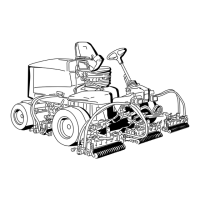
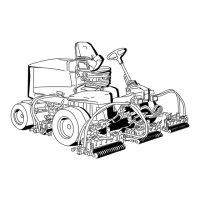
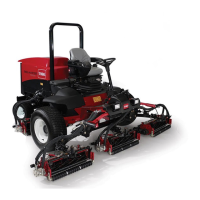
The Toro 8 and 11 Blade DPA Cutting Units with 5-inch Reels are designed for use with Reelmaster 5210 and 5410 Traction Units. These cutting units are primarily used for mowing turf, offering precision cutting capabilities for various grass types and conditions.

Function Description

The cutting unit's core function is to precisely cut grass using a reel and bedknife system. The dual knob bedknife-to-reel adjustment system simplifies the adjustment procedure, allowing for optimal mowing performance. This design enables a continual self-sharpening action, maintaining sharp cutting edges and reducing the need for routine backlapping. The cutting unit's aggressiveness of cut, which refers to the angle of the bedknife relative to the ground, significantly impacts its performance. This setting can be adjusted to suit different turf conditions and desired results, with less aggressive settings generally preferred for warm-season grasses and more aggressive settings for cool-season grasses.

The turf compensation spring transfers weight from the front to the rear roller, helping to reduce wave patterns or "marcelling" in the turf. The location of the lift arm chain attachment determines the rear roller pitch angle, further influencing the cutting unit's interaction with the turf.

Usage Features

The cutting units are designed for ease of setup and adjustment. Upon removal from the box, users should inspect the reel for grease, ensure all nuts and bolts are tightened, and verify that the carrier frame suspension operates freely. A kickstand is provided to prop up the rear of the cutting unit when tipping it for bedknife/reel exposure, preventing damage to the bedbar adjusting screws.

The rear shield can be adjusted to optimize grass dispersion. For most conditions, a closed rear shield (front discharge) provides the best dispersion. However, in heavy or wet conditions, the shield can be opened by loosening a cap screw, rotating the shield to the open position, and retightening the screw.

Counterweights are mounted to the cutting unit, and their position can be adjusted based on the specific cutting unit and reel motor configuration.

Daily adjustments are crucial for maintaining optimal cutting performance. Before each mowing session, the bedknife-to-reel contact must be checked. This involves lowering the cutting units onto a hard surface, shutting off the engine, and removing the ignition key. The reel is then slowly rotated in reverse, listening for contact with the bedknife. If no contact is evident, the bedknife adjusting knobs are turned clockwise, one click at a time, until light contact is felt and heard. The adjustment knobs have detents, with each click corresponding to a precise bedknife movement. Light contact is always preferred to ensure the bedknife/reel edges self-sharpen effectively. Excessive contact can accelerate wear and lead to uneven wear.

The height of cut (HOC) is adjusted by loosening locknuts on the height-of-cut brackets and setting the adjusting screw to the desired HOC. The rear roller brackets are adjusted to the desired HOC range by positioning spacers below the side plate mounting flange. The front roller is adjusted to contact the gauge bar, ensuring the entire roller is parallel to the bedknife.

Maintenance Features

Regular lubrication is essential for the longevity of the cutting unit. Each unit has six grease fittings that require regular lubrication with No. 2 General Purpose Lithium Base Grease. Lubrication points include the front roller, rear roller, and reel bearings. Lubricating immediately after washing helps purge water from bearings and extends bearing life.

The reel bearings should be periodically checked for end play to ensure long life. This involves loosening the reel to bedknife contact, holding a reel blade with a padded glove, and attempting to move the reel assembly side to side. If end play exists, the external set screw securing the bearing adjusting nut is loosened, and the nut is slowly tightened until no end play remains. Over-tightening the bearing adjuster nut should be avoided as it can damage the reel bearings.

Servicing the bedbar involves backing off the bedknife from the reel by turning the bedbar adjuster screws counterclockwise. The spring tension nut is loosened until the washer is no longer tensioned against the bedbar. Locknuts securing the bedbar bolt on each side of the machine are loosened, and the bedbar bolts are removed, allowing the bedbar to be pulled downward. When reassembling, the bedbar is positioned with its mounting ears between the washer and bedbar adjuster, secured with bedbar bolts and washers, and the spring tension nut is tightened until the spring is collapsed, then backed off by half a turn.

The bedknife service limits are provided in charts, indicating when the bedknife needs replacement. Operating with a bedknife below the service limit can lead to poor after-cut appearance and reduced structural integrity. The recommended top and front bedknife grind angle is 3 to 7 degrees. Over time, a slight burr may appear on the front cutting edge of the bedknife, which can be removed with a file to improve cutting. A lead-in chamfer on the right end of the bedknife is designed to last for a portion of the bedknife's life and may need regrinding.

Roller rebuild kits and tool kits are available for servicing the roller. These kits include all necessary bearings, bearing nuts, inner seals, and outer seals, along with installation instructions.


Toro 03661 Specifications

General IconGeneral
Deck MaterialSteel
Start TypeRecoil
Starter TypeRecoil
EngineBriggs & Stratton
Engine Type4-Cycle
Cutting Width22 inches
Drive SystemRear-wheel drive
Wheel Size (Front)8 inches
Wheel Size (Rear)11 inches
Weight80 lbs

Related product manuals