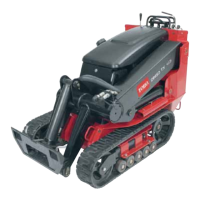
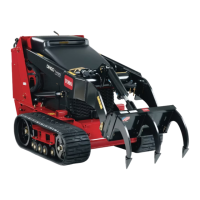
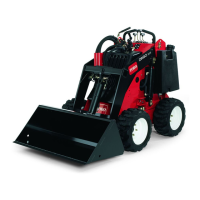
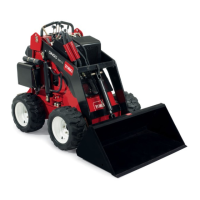
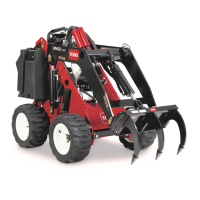
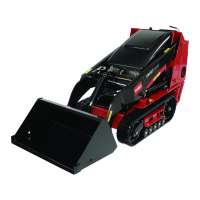
The device described in this manual is the TX 1000 Turbo Compact Tool Carrier, a compact tool carrier designed for various earth and materials moving activities in landscaping and construction work. It is engineered to operate a wide variety of specialized attachments. The manual covers models 22587, 22587G, 22588, and 22588HD, all with serial numbers 400000000 and up.
Function Description:
The TX 1000 Turbo Compact Tool Carrier is a versatile machine capable of performing a range of tasks when equipped with appropriate attachments. Its primary function is to transport and operate different tools for landscaping and construction. The machine features a robust design with tracks for enhanced traction and stability on various terrains. It is equipped with a powerful engine and a hydraulic system to drive both the machine and its attachments. The operator controls the machine from a platform, utilizing a reference bar, traction control, and loader arm/attachment-tilt lever for precise operation.
Important Technical Specifications:
The manual provides detailed specifications for different models:
-
Models 22587, 22587G:
- Width: 89 cm (35 inches)
- Length: 211 cm (83 inches)
- Height: 140 cm (55 inches)
- Weight: 1320 kg (2,911 lb)
- Rated Operating Capacity: 454 kg (1,000 lb) (calculated with a standard bucket and 75 kg (165 lb) operator, per ISO 14397-1)
- Wheelbase: 99 cm (39 inches)
- Dump Height (with standard bucket): 152 cm (60 inches)
- Reach—Fully Raised (with standard bucket): 89 cm (35 inches)
- Height to Hinge Pin (with standard bucket in highest position): 206 cm (81 inches)
-
Models 22588, 22588HD:
- Width: 102 cm (40 inches)
- Length: 211 cm (83 inches)
- Height: 140 cm (55 inches)
- Weight: 1282 kg (2,826 lb)
- Rated Operating Capacity: 454 kg (1,000 lb) (calculated with a standard bucket and 75 kg (165 lb) operator, per ISO 14397-1)
- Wheelbase: 99 cm (39 inches)
- Dump Height (with standard bucket): 152 cm (60 inches)
- Reach—Fully Raised (with standard bucket): 89 cm (35 inches)
- Height to Hinge Pin (with standard bucket in highest position): 206 cm (81 inches)
Engine Oil Specifications:
- Oil Type: API service category CD, CF, CF-4, CI-4; ACEA service category E3, E-4, E-5; JASO service category DH-1.
- Crankcase Capacity: 3.6 L (3.8 US qt) with the filter.
- Recommended viscosity varies with ambient temperature, ranging from SAE 10W-30/15W-40 for moderate temperatures to SAE 5W-30 for colder conditions.
Fuel System Specifications:
- Fuel Tank Capacity: 39.7 L (10.5 US gallons).
- Recommended Fuel: Clean, fresh diesel fuel or biodiesel fuels with low (<500 ppm) or ultra low (<15 ppm) sulfur content, minimum cetane rating of 40. Biodiesel blends up to B20 (20% biodiesel, 80% petrodiesel) are acceptable, provided the biodiesel portion meets ASTM D6751 or EN14214, and the blended fuel meets ASTM D975 or EN590.
- Operating Temperature: -18 to 38°C (0 to 100°F).
Hydraulic System Specifications:
- Hydraulic-System Capacity: 37.8 L (10 US gallons).
- Recommended Hydraulic Fluid: Toro PX Extended Life Hydraulic Fluid.
- Alternative Hydraulic Fluids: High Viscosity Index/Low Pour Point Anti-wear Hydraulic Fluid, ISO VG 46, meeting specific material properties (Viscosity, ASTM D445: 44 to 48 cSt @ 40°C (104°F); Viscosity Index ASTM D2270: 140 or higher; Pour Point, ASTM D97: -37°C to -45°C (-34°F to -49°F)) and industry standards (Eaton Vickers 694 (I-286-S, M-2950-S/35VQ25 or M-2952-S)).
Cooling System Specifications:
- Capacity: 4.4 L (4.6 US quarts).
- Type: 50/50 solution of water and permanent ethylene-glycol antifreeze.
Usage Features:
- Controls: The machine features a control panel with a key switch (OFF, RUN, START), throttle switch (HIGH IDLE, LOW IDLE, or incremental speed adjustment), traction control (forward, rearward, right, left, stop), auxiliary hydraulic flow speed, power socket, and InfoCenter display.
- Reference Bar: Used as a handle and leverage point for controlling traction and auxiliary hydraulics, ensuring smooth operation.
- Auxiliary-Hydraulics Lock Pedal: Allows continuous forward or reverse hydraulic flow, freeing the operator's hand for other controls.
- Parking Brake: Engaged by rotating a lever to the left, released by rotating to the right.
- InfoCenter Display: An LCD display providing operating status, diagnostics, and other machine information. It includes various icons for functions like engine speed, battery voltage, hour meter, warnings, transport speed, fast/slow modes, auxiliary lock, high engine idle disabled, auxiliary hydraulics disabled, cold start, parking brake, engine, glow plugs, and engine-coolant temperature. The InfoCenter also provides access to menus for faults, service information, diagnostics, settings, and machine details (model, serial, software).
- Smart Power® Traction: This function senses the engine load and adjusts maximum traction speed to optimize performance with powered attachments, maintaining engine speed. It can be activated by engaging attachment hydraulics and slowly moving the traction control.
- Attachment Installation/Removal: The machine is designed for quick and secure attachment of Toro-approved accessories using quick-attach pins. Hydraulic hoses are connected for hydraulic attachments, with precautions for relieving pressure.
- Cold Weather Starting: The machine's software may limit engine RPM and disable auxiliary hydraulics if the coolant is extremely cold, preventing damage. Operators should wait for cold-start warnings to disappear before increasing throttle or engaging hydraulics.
- Hauling and Lifting: The manual provides instructions for safely loading the machine onto a trailer using full-width ramps and tie-down points, and for lifting the machine using designated lift points, ensuring a maximum 20-degree lift angle.
Maintenance Features:
- Maintenance Schedule: A detailed schedule includes daily checks (greasing, air-filter indicator, engine oil, tracks, cooling system, debris, fasteners), and interval-based tasks (every 25, 50, 100, 250, 400, 500, 1,000, 1,500 hours/2 years, yearly, yearly or before storage).
- Pre-Maintenance Procedures: Emphasizes safety, including removing the key, allowing the machine to cool, cleaning spills, and using cylinder locks when loader arms are raised.
- Cylinder Locks: Essential for securing loader arms in a raised position during maintenance to prevent crushing hazards.
- Accessing Internal Components: Instructions for opening the hood, removing the rear cover, bottom plate, front cover, front access plate, and side screens to access internal components for maintenance.
- Lubrication: Daily greasing of the machine with general-purpose grease.
- Engine Maintenance:
- Air-Cleaner Service: Daily checks of the air-filter-service indicator, cleaning debris from the cover every 25 hours, and replacing air filters every 500 hours. Emphasizes not cleaning the primary filter with compressed air and only replacing it when the indicator shows red.
- Engine Oil Service: Daily checks of the engine-oil level, and changing the engine oil and filter every 250 hours. Instructions for draining oil, replacing the filter, and refilling.
- Fuel System Maintenance:
- Water Separator: Draining water and contaminants every 50 hours, and replacing the filter every 500 hours.
- Fuel Lines and Connections: Checking for deterioration, damage, or loose connections every 400 hours/yearly.
- In-Line Fuel Filter: Replacing every 500 hours.
- Bleeding the Fuel System: Procedure for bleeding the fuel system after initial startup, running out of fuel, or fuel system maintenance.
- Fuel Tank(s): Draining and cleaning by an Authorized Service Dealer every 2 years.
- Electrical System Maintenance:
- Battery Service: Checking battery condition every 50 hours.
- Battery-Disconnect Switch: Used to energize/de-energize the machine electrically.
- Battery Removal/Installation: Detailed steps for safe removal and installation, emphasizing disconnecting negative cable first and connecting positive cable first.
- Battery Charging: Instructions for charging the battery, including precautions against overcharging and explosive gases.
- Battery Cleaning: Cleaning terminals and case to extend battery life, coating posts with grease to prevent corrosion.
- Jump-Starting: Detailed safety warnings and procedures for jump-starting, including precautions against cracked/frozen batteries and loose connections.
- Fuses: Layout and location of fuses protecting the electrical system.
- Drive System Maintenance:
- Track Tension: Checking and adjusting track tension after the first 8 hours, every 50 hours, and every 50 hours thereafter. The target gap between the road wheel lip and track is 19 mm (3/4 inch).
- Track Cleaning: Daily cleaning of tracks, road wheels, front wheel, rear wheel, and drive sprocket, with warnings against high-pressure washing on other machine parts.
- Track Replacement: Detailed steps for removing and installing tracks, including supporting the machine with jack stands.
- Cooling System Maintenance:
- Radiator Screen: Daily cleaning of the radiator screen with compressed air.
- Coolant Level: Daily checks of the coolant level in the expansion tank, ensuring it's at or above the mark.
- Cooling System Hoses: Checking every 100 hours.
- Engine Coolant: Changing yearly by an Authorized Service Dealer.
- Controls System Maintenance: Adjusting traction control alignment, neutral position, and tracking in full forward position by an Authorized Service Dealer.
- Storage: Procedures for preparing the machine for storage, including cleaning, servicing air cleaner, greasing, changing engine oil, charging battery, checking track tension, tightening fasteners, painting scratched surfaces, and disconnecting the battery.
The manual also includes important safety warnings, such as those related to buried utility lines, operating capacity, slopes, hot surfaces, high-pressure fluids, crushing hazards, and electrical systems. It also provides California Proposition 65 Warning Information regarding chemicals known to cause cancer and reproductive harm.

 Need help?
 General

 To Next Page