
 Need help?
Do you have a question about the Toro Greensmaster eFlex 1018 and is the answer not in the manual?
This document is a comprehensive operator's manual for the Toro 18in and 21in, 11-Blade and 14-Blade EdgeSeries Cutting Unit, designed for use with Greensmaster® Flex™ or eFlex™ 1018 or 1021 Traction Units. It provides detailed instructions for setup, operation, and maintenance, ensuring safe and effective use of the cutting unit.
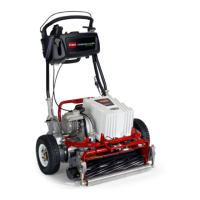
The Toro EdgeSeries Cutting Unit is specifically engineered for precision cutting of turf on golf course greens and small fairways. Its primary function is to deliver a clean, consistent cut, which is crucial for maintaining high-quality playing surfaces. The cutting unit operates by utilizing a reel and a bedknife to shear grass blades. Depending on the model, it features either 11 or 14 blades, allowing for different clip rates and cutting qualities. The unit is designed to be attached to a compatible Toro Greensmaster Flex or eFlex traction unit, which provides the power and mobility for operation. The manual emphasizes that the cutting unit is only a complete machine when installed on a traction unit, highlighting the integrated nature of the system.
The cutting unit's design incorporates features that allow for adaptability to various turf conditions. For instance, the cut-off bar can be adjusted to optimize clippings discharge, whether the turf is dry or wet. The bedknife-to-reel contact is a critical aspect of its function, influencing both cutting performance and energy consumption, especially for eFlex units. The manual stresses the importance of maintaining light contact to ensure self-sharpening of the blades and prevent accelerated wear.
The manual outlines several key usage features that contribute to the cutting unit's performance and versatility. The height-of-cut (HOC) is adjustable, allowing operators to achieve desired turf lengths. This adjustment involves setting the rear roller height and using a height-of-cut gauge for precise calibration. The manual provides guidance on positioning spacers on the rear roller brackets to accommodate different HOC ranges, from very low cuts suitable for greens to higher cuts for fairways.
Another important usage feature is the ability to adjust the clip rate, which is determined by the reel speed of the traction unit and the position of the reel-drive pulleys. The cutting unit comes with both 22-tooth and 24-tooth pulleys, offering high and low positions to fine-tune the clip rate according to turf conditions and desired finish. This flexibility allows operators to optimize the cut for different grass types and growth rates.
The manual also details the process of adjusting the bedknife-to-reel contact, a daily procedure essential for maintaining cutting quality. This adjustment involves slowly rotating the reel and turning bedbar adjusting screws until a light contact is felt and heard, ensuring the bedknife and reel work together effectively. The use of cutting performance paper is recommended to verify that the reel is properly cutting.
Maintenance is a significant focus of the manual, with detailed procedures to ensure the longevity and optimal performance of the cutting unit. Regular maintenance includes accessing the cutting unit, checking the reel-driveshaft grease point, adjusting the bedknife-to-reel contact, performing HOC adjustments, and servicing the bedbar and bedknife.
Accessing the cutting unit for maintenance can be done either by propping up the rear of the unit when removed from the traction unit or by lowering the traction unit handle to the ground when attached. The reel-driveshaft grease point requires yearly inspection and lubrication to prevent wear.
Adjusting the bedknife after grinding, backlapping, or disassembly is a more involved procedure than the daily adjustment. It requires careful shimming and precise turning of the bedbar adjusting screws to establish light contact between the reel and bedknife. The manual provides specific instructions for both the right and left sides of the cutting unit to ensure uniform contact.
Servicing the bedbar involves removing it from the cutting unit, which requires backing off the bedknife, loosening spring-tension nuts, and removing bedbar bolts. The manual provides steps for both removal and reinstallation, emphasizing the importance of proper torque specifications for fasteners. Similarly, servicing the bedknife includes cleaning, applying anti-seize compound, and torquing screws in a specific sequence to ensure proper attachment to the bedbar.
The manual also covers preparing the reel for grinding and relief-grinding the reel, providing specifications for new reel diameter, service limits, blade relief angle, and land width. These procedures are critical for restoring the reel's sharpness and maintaining cutting efficiency. Checking the top grind angle of the bedknives using an angle indicator is also detailed, ensuring that the grinder produces the correct angle for optimal performance. Finally, backlapping the cutting unit is mentioned as a method to sharpen the reel and bedknife, with a reference to a specific backlap kit and its instructions.
 General
| Power Source | Battery |
|---|---|
| Number of Blades | 1 |
| Blade Type | Reel |
| Clip Frequency | Adjustable |
| Battery Voltage | 56V |
| Deck Type | Steel |
| Cutting Width | 18 inches (45.7 cm) |
| Drive Type | Electric |
| Warranty | 2 years |



 To Next Page