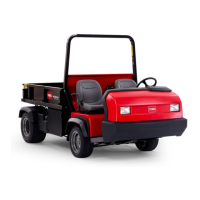
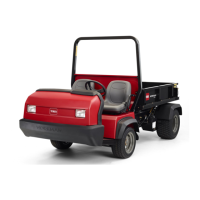
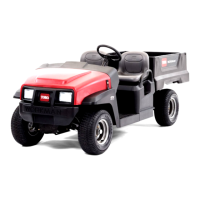
This document is the Operator's Manual for the Workman® GTX EFI Utility Vehicle, Model No. 07059LT, with Serial No. 407200000 and Up. It provides instructions for operation, maintenance, and safety.
Function Description
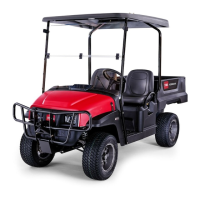
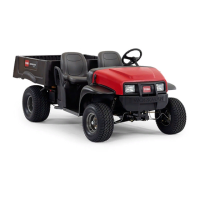
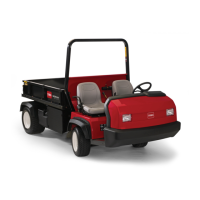
The Workman® GTX EFI Utility Vehicle is primarily intended for off-highway use to transport people and material loads. It is designed for utility purposes, and using it for other purposes could be dangerous. The machine is capable of pulling trailers and has a cargo bed for carrying materials.
Important Technical Specifications
- Base Weight: 397 kg (875 lb)
- Rated Capacity (on level ground): 544 kg (1,200 lb) total, including 90.7 kg (200 lb) operator and 91 kg (200 lb) passenger, load, accessories, and attachments
- Gross Vehicle Weight (GVW)—on level ground: 941 kg (2,075 lb) total, including all listed weights
- Maximum Cargo Capacity (on level ground): 363 kg (800 lb) total, including rear-mounted accessories
- Maximum Rear Cargo-Bed-Accessory Mount Capacity: 45 kg (100 lb) total
- Tow Capacity:
- Tongue weight: 91 kg (200 lb)
- Gross trailer weight (GTW): 680 kg (1,500 lb)
- Overall Width: 119 cm (47 inches)
- Overall Length: 302 cm (119 inches)
- Overall Height: 127.5 cm (50-3/16 inches)
- Ground Clearance:
- Front: 21.6 cm (8-1/2 inches) at the front with no load or operator
- Rear: 14 cm (5-1/2 inches) at the rear with no load or operator
- Wheel Base: 220 cm (86-5/8 inches)
- Wheel Tread (center line to center line):
- Front: 119 cm (47 inches)
- Rear: 119 cm (47 inches)
- Cargo Bed Length:
- Inside: 102 cm (40 inches)
- Outside: 114.3 cm (45 inches)
- Cargo Bed Width:
- Inside: 98 cm (38-1/2 inches)
- Outside of molded fenders: 107.3 cm (42-1/4 inches)
- Cargo Bed Height: 28 cm (11 inches) inside
- Engine Speed:
- Low idle: 1,250 to 1,350 rpm
- High idle: 3,650 to 3,750 rpm
- Maximum Forward Speed: 26 km/h (16 mph)
- Fuel Tank Capacity: Approximately 18.9 L (5 US gallons)
- Recommended Fuel: Unleaded gasoline (87 US or 91 research octane outside US), no more than 10% ethanol by volume, no methanol, less than 15% MTBE (methyl tertiary butyl ether). Do not add oil to fuel.
- Engine Oil Specifications:
- Crankcase Capacity: 1.0 L (1.1 US qt)
- Oil Type: API service class SJ or higher detergent oil
- Viscosity: SAE 5W-30, 10W-30, SAE 30 (depending on temperature)
- Spark Plug Type: Champion RC12LC4
- Spark Plug Air Gap: 0.76 mm (0.03 inch)
- Transaxle Fluid Type: SAE 80W-90 (API MT-1) or SAE 80W-90 (API GL-5)
- Transaxle Fluid Capacity: 1.6 L (1.7 US qt)
- Brake Fluid Type: DOT 3
- Battery Voltage: 12 V with 300 A (cold-cranking) at -18°C (0°F)
- Tire Pressure: Front and rear tires: 165 to 207 kPa (24 to 30 psi)
Usage Features
- Controls: The machine features a steering wheel, gear-shift indicator, gear-shift lever, horn button, key switch, USB power point, parking-brake lever, choke control, brake pedal, and accelerator pedal.
- Starting the Engine: Two modes are available: Pedal Start (key to ON, press accelerator) or Key Start (key to START, engine runs until key is OFF).
- Cargo Bed: The cargo bed can be raised to a dump position or a service position using a prop rod. It is crucial to remove any load before raising the bed and to operate the machine only when the bed is down.
- Tailgate: The tailgate can be opened by raising it and lowered until it is flush with the cargo bed bottom.
- Rear Cargo Bed Accessory Mount: Allows attachment of accessories to the rear of the machine, with a capacity of 45 kg (100 lb).
- Loading the Cargo Bed: Guidelines are provided for safe loading, emphasizing even weight distribution and adherence to weight limits, especially on hills or rough terrain.
- Top Speed Reduction: Spacers can be added or removed from the clutch to adjust the top speed from 16 mph (standard) down to 4 mph.
- Passenger Handholds: Located on the outside of each seat for passenger safety.
- Hour Meter: Tracks total engine hours, functioning when the key switch is in ON or START position, or when the engine is running.
- Light Switch: Controls headlights.
Maintenance Features
- Recommended Maintenance Schedule: A detailed schedule outlines daily, every 5, 8, 50, 100, 200, 300, 400, 800, 1,000 hours, and yearly maintenance tasks.
- Daily Checks: Include brake and parking brake operation, gear shift/neutral operation, fuel level, engine-oil level, brake-fluid level, transaxle-fluid level, air filter inspection, engine-cooling fins inspection, unusual engine/operating noises, tire pressure, fluid leaks, instrument operation, accelerator operation, washing, and paint touch-up.
- Engine Oil: Checking and changing engine oil at specified intervals (first 5 hours, then every 50/100 hours depending on conditions).
- Spark Plug: Checking and replacing the spark plug every 100 hours/yearly.
- Fuel System: Inspecting fuel lines and connections, and replacing the fuel filter every 400 hours/yearly.
- Carbon Canister: Checking and cleaning the air filter for the carbon canister every 50/200 hours.
- Battery: Servicing, disconnecting, removing, installing, and charging the battery. Fuses are located beneath the seat assembly.
- Headlights: Replacing and adjusting headlights.
- Tires: Inspecting condition and torqueing wheel-lug nuts every 100 hours.
- Steering and Suspension: Inspecting components for looseness or damage every 100 hours.
- Front Wheel Alignment: Checking camber and toe-in every 100 hours/yearly, with instructions for adjustment.
- Transaxle Fluid: Checking fluid level every 100 hours and changing fluid every 800 hours/yearly.
- Neutral Gear-Shift Position: Checking and adjusting the neutral position every 100 hours.
- Primary Drive Clutch: Maintaining the clutch every 400 hours/yearly, including cleaning.
- Cooling System: Cleaning engine-cooling areas every 100 hours (more often in dirty conditions).
- Brakes: Checking parking brake, adjusting parking brake, checking brake-fluid level, inspecting brakes every 100 hours. Replacing service and parking-brake pads every 400 hours. Changing brake fluid every 1,000 hours.
- Drive Belt: Checking condition every 8 hours/200 hours and replacing as needed.
- Starter-Generator Belt: Adjusting tension every 8 hours/200 hours.
- Chassis: Adjusting cargo-bed latches.
- Cleaning: Washing the machine daily or as needed, with warnings against power-washing and using brackish water.
- Storage: Procedures for preparing the machine for storage, including fuel system preparation, spark plug treatment, battery removal and charging, and general inspection.
The manual includes numerous safety warnings and cautions, indicated by the safety-alert symbol (▲) and words like Danger, Warning, or Caution. Key safety points include:
- Reading and understanding the manual before operation.
- Using full attention while operating.
- Keeping hands and feet away from moving parts.
- Operating only with all guards and safety devices in place.
- Keeping bystanders and children away.
- Stopping the machine and removing the key before servicing or fueling.
- Specific warnings for fuel handling, battery charging, operating on slopes, loading/dumping, and towing.
- Emphasis on proper maintenance to prevent system failures and injury.
- California Proposition 65 Warning regarding chemicals in engine exhaust and battery components.

 Need help?
 General





 To Next Page