| English
24
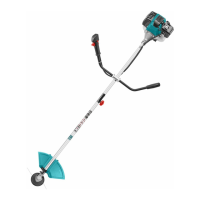
d. Using the brush cutter
Be sure that you have installed the correct accessory.
Do not use the brush cutter for cutting trees.
Do not cut with dull, cracked or damaged meal blade.
Before cutting growth, inspect for obstructions such as boulders, metal stakes
or strands of wire from broken fences. If an obstruction cannot be removed,
mark its location so that you can avoid it with the blade. Rocks and metal will
dull or damage a blade. Wire can catch on the blade head and flap around or
be thrown into the air.
Use the shoulder harness at all times adjust both harness and harness clamp
on the unit so that the unit hangs a few inches above ground level. The cutting
head and the debris shield should be level in all directions. Harness the unit on
the right side of your body.
Cut only with the side of the blade that the debris is moving away from you.
If kickback occurs, the blade may be dull, or the material so thick and hard that
you should use other tool instead of this machine.
Do not force the blade to cut. Do not change the angle of cut after into the wood.
Avoid using any pressure or leverage which could cause the blade to bind or
crack.
Scything weeds
This is cutting by swinging the blade in a level arc. It can quickly clear areas of field
grass and weeds. Scything should not be used to cut large, tough weeds or woody
growths.
Scything can be done in both directions, or just in one way which results in the
debris being thrown away from you.
That is using the side of the blade that it is rotating away from you. Tilt down the
blade slightly on this same side. You will be hit by some debris if you scythe in both
directions.
Using the hedge trimmer
When using the machine on lawns, hold the scythe at an angle of 30 ° and perform
semi-circular movements by sweeping the ground from left to right.
The best results are obtained when the grass is 15 cm high. When the grass is
higher, we recommend repeating the mowing several times.



 To Next Page