This document is a Quick Reference Guide for the 2012 Toyota Avalon Navigation System. It provides an overview of the system's basic operation, destination input methods, Bluetooth phone connectivity, voice recognition features, additional navigation settings, NavTraffic functionalities, and a comprehensive list of voice commands. The guide emphasizes that it is not a substitute for the full Navigation Owner's Manual and encourages users to consult the manual for a complete understanding of the system's capabilities and limitations.
Function Description:
The Toyota Avalon Navigation System is designed to assist drivers with route guidance, provide information on points of interest (POIs), facilitate hands-free phone calls via Bluetooth, and offer real-time traffic updates through NavTraffic. Its core function is to help users reach their desired destinations efficiently and safely.
Usage Features:
Basic Operation:
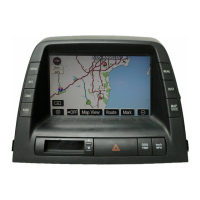
The system features a main display with various buttons for navigation, audio, and setup. Key controls include:
- NORTH-UP OR COMPASS MODE Icon: Allows users to change the map display between North-up and Head-up perspectives.
- AUDIO Button: Adjusts radio station presets, balance, and tone controls.
- ZOOM IN/ZOOM OUT Icons: Magnifies or reduces the map scale.
- DISPLAY Button: Adjusts contrast, brightness, or turns off the screen.
- SETUP Button: Accesses preferences for General settings, Clock, Voice, Navigation, Phone, Audio, and Vehicle Maintenance.
- CURRENT VEHICLE POSITION Mark: Indicates the current position of the vehicle and its directional heading.
- DESTINATION Button: Initiates destination input using various methods.
- MAP/VOICE Button: Repeats the last voice guidance prompt, cancels the map scrolling feature, or displays the current position.
- INFO/PHONE Button: Accesses Phone, Map Data, and Calendar functions.
The system offers multiple ways to input a destination:
-
By Address (Manual Input):
- Press the "DEST" button on the faceplate.
- Touch "Address" on the screen.
- Select "City" or "Street Address" to begin. Users can change the "Search Area" if needed.
- Input the city name using the on-screen keyboard.
- Input the street name. A quick tip suggests entering the street name without prefixes (like "North" or "N") as the system will display the base street name.
- Input the house number.
- Touch "Go to" to view the route.
- Select desired "Route Preferences" (Quick, Short, Alternate) by touching "Edit Route" and "Preferences."
- Touch "OK" to start route guidance.
-
By Address (Voice Recognition):
- Press the "TALK" button on the steering wheel and say "Destination."
- After the beep, say "Address."
- Say the city name or "Change state" to search in another state.
- Say the street name.
- Say the house number. A quick tip advises saying street address numbers as single digits (e.g., "One two five" for 125).
- After the beep, say "Enter" to confirm the destination.
- Touch "OK" to start route guidance.
- Tips for Using Voice Recognition: A large "TALK" icon indicates when to speak. Users should have the full and correct address in mind, speak at a normal volume and pace, and pronounce words clearly. Reducing background noise (rolling up windows, setting climate control fan low) improves accuracy. Numbered street names should be spoken out fully (e.g., "First Street" for 1st Street).
-
Point of Interest (POI) by Name:
- Press "DEST" and touch "Point of Interest."
- Touch "Name."
- Input the POI name using the keyboard.
- Scroll through the list and touch the desired destination. A quick tip suggests verifying spelling and search area if a POI isn't found. Touching "Info." next to a POI name displays its address and phone number.
- Touch "Go to" and select route preferences.
- Touch "OK" to start guidance.
-
Point of Interest (POI) by Category (Manual Input):
- Press "DEST" and touch "Point of Interest."
- Touch "Category."
- Select a search location (Near Here, Along My Route, Near City Center, Near a Destination).
- Touch the desired category icon (e.g., "Hotels," "Groceries"). A list of all categories is available.
- Scroll and touch the desired point of interest.
- Touch "Go to" and select route preferences.
- Touch "OK" to start guidance.
-
Point of Interest (POI) by Category (Voice Recognition):
- Press the "TALK" button and say "Destination."
- After the beep, say "Point of Interest."
- After the beep, say "Near Here."
- After the beep, say the category (e.g., "Hotels"). The guide lists recognized POI categories.
- After the beep, say the number corresponding to the desired destination.
- After the beep, say "Enter" to confirm.
- Touch "OK" to start guidance.
Set Home:
- Press "SETUP" and touch "Navi."
- Touch "Home."
- Touch "Set Home."
- Touch "Address."
- Select "City" or "Street Address" and ensure the correct "Search Area" is selected.
- Input the city name.
- Input the street name.
- Input the house number.
- Touch "Enter" to confirm the location.
- Touch "Edit" next to "Icon" to choose a home icon.
- Touch "OK" to save.
- Tip: For security, use a point close to your home instead of the actual address.
Connect a Bluetooth Phone:
- Press the "INFO/PHONE" button and touch "Phone."
- Touch "Yes" when prompted to connect a phone.
- Input the passcode (displayed on the screen) into your Bluetooth cell phone.
- The system will confirm a successful connection.
- Quick Tip: Up to 4 Bluetooth phones can be paired, but only one can be used at a time. Refer to the phone manufacturer's user guide for pairing difficulties.
Calling by Voice Recognition:
-
Dial by Number:
- Press the "TALK" button and say "Phone."
- After the beep, say "Dial by Number."
- After the beep, say the phone number digits individually without pausing (e.g., "Three, one, zero, four...").
- After the beep, say "Dial" or press the "TALK" button.
- To end the call, press the "ON/OFF" button on the screen or the "TALK" button on the steering wheel.
- Quick Tip: A noisy environment can hinder voice recognition. Reduce background noise for better accuracy.
-
Dial by Name:
- Press the "TALK" button and say "Phone."
- After the beep, say "Dial by Name."
- After the beep, say the name from the contact list. If multiple numbers exist, follow the prompt.
- After the beep, say "Dial" or press the "TALK" button.
- To end the call, press the "ON/OFF" button on the screen or the "TALK" button on the steering wheel.
- Note: For successful "Dial by Name," the phone book must be transferred, and the name must be spoken exactly as entered in the phone.
Additional Navigation Features:
- Search Area: Allows users to specify the geographic area for address searches, improving accuracy.
- Route Preferences: After inputting a destination, users can select "Quick," "Short," or "Alternate" routes. They can also customize route features to allow/disallow freeways, toll roads, restricted roads, seasonal roads, ferries, and border crossings.
- 3 Routes: Displays three route options (Quick, Alt, Short) with estimated distance and time.
- Screen Preferences: Offers seven screen viewing options, including Single Map, Dual Map, Compass, and Freeway Information. Some are available only during route guidance.
- Beep Setting: Turns the system's beep sound On or Off (General Settings > Beep).
- Voice Volume: Adjusts the Voice Guidance volume level (Voice Settings > Voice Volume).
- Language: Selects the system language (English, French, Spanish) (General Settings > Language).
- Clock Settings: Adjusts Time Zone and Daylight Saving Time options (Clock Settings).
- Auto Screen Change: When switched off, the audio screen will remain without reverting to the map display (General Settings > Auto Screen Change).
- Voice Recognition Guidance: Disables system guidance for voice commands, leaving only on-screen guidance (Voice Settings > Voice Recognition Guidance).
- Estimated Distance and Time (Driving Speeds): Allows customization of driving speeds for Residential, Main Streets, and Freeways to match driving habits, affecting the estimated time of arrival (ETA).
- Operation of Vehicle Emergency Screen: Accessed via "DEST" > "Emergency," this feature provides quick access to nearby Police Stations, Dealers, Hospitals, and Fire Stations. In motion, only nearby locations are shown.
NavTraffic:
- Function: Integrates with the navigation system to display continuously updated traffic information for 100 markets. New Avalon owners receive a 90-day complimentary trial subscription from SiriusXM.
- Show NavTraffic Information:
- Press "MAP" and touch "Show on Map."
- Touch "Traffic Information." Traffic flow is displayed by colored lines: green for free flow, yellow for moderate, and red for heavy congestion.
- Auto Avoid Traffic:
- Press "SETUP" and touch "Navi."
- Touch "Detailed Navi. Settings."
- Select "On" for "Auto Avoid Traffic."
- Touch "Save." The system will automatically select another route if moderate or heavy traffic is detected.
- Traffic Voice Guidance:
- Press "SETUP" and touch "Voice."
- Select "On" for "Traffic Voice Guidance."
- Touch "Save." This enables voice notification of traffic events within 20 miles along the current route.
- Show Free Flowing Traffic:
- Press "SETUP" and touch "Navi."
- Touch "Detailed Navi. Settings."
- Select "On" for "Show Free Flowing Traffic."
- Touch "Save." Free flowing traffic is illustrated by arrows on the map.
- SiriusXM Subscription: XM services require a subscription after the trial period. Plans auto-renew unless canceled.
Voice Commands:
A comprehensive list of voice commands is provided for:
- Audio Mode: Radio, AM, FM, Satellite Radio (1, 2, 3), CD, CD Changer, Bluetooth Audio, iPod, USB-Audio.
- Audio Function: Audio On/Off, Seek Up/Down, Type Up/Down, Track Up/Down, Previous Track, Disc Up/Down.
- Navigation Mode - Screen Preferences: Map, Dual Map, Single Map, Compass Mode, Arrow Mode, Turn List Mode, Freeway Mode, Intersection Mode.
- Navigation Mode - Map Operation: Zoom In/Out, Right Map Zoom In/Out.
- Navigation Mode - Map Orientation: North Up, Heading Up, Map Direction, Right Map North Up/Heading Up/Direction.
- Navigation Mode - Change Route: Quick Route, Short Route, Alternate Route, Detour, Detour Entire Route.
- Navigation Mode - Guidance Help: Route Overview, Next/First/Second/Third/Fourth/Fifth/Final Destination Map, Pause/Resume Guidance, Repeat Guidance.
- Navigation Mode - Volume: Louder, Softer.
- Navigation Mode - Destination: Previous Start Point, Mark This Point, Delete Next/Final/All Destinations.
- Navigation Mode - Traffic: Traffic Information.
- Telephone Mode - Calling: Dial by Number, Dial by Name, Select Phone.
- POI Categories: A detailed list of recognized POI categories for destination input, including Attractions, Emergency/Medical, Food, Retail & Dept. Stores, Travel, Automotive, Other, Banks, City Centers, and Groceries.
Maintenance Features:
The Quick Reference Guide does not explicitly detail maintenance features for the navigation system itself. However, it implicitly suggests that proper usage, such as reducing background noise for voice recognition, contributes to optimal performance. For any issues or advanced settings, the guide consistently directs users to consult the full Navigation Owner's Manual, which would likely contain information on troubleshooting, software updates, or other maintenance-related procedures. The mention of SiriusXM subscription management also implies a user responsibility to maintain service for NavTraffic functionality.

 Need help?
 General







 To Next Page