Need help?
Do you have a question about the Toyota 7FBEST 13 and is the answer not in the manual?
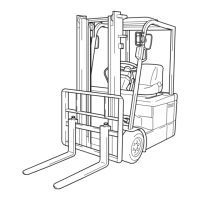
Visual identification of the forklift's external components.
Details on different forklift models, capacity, and control methods.
Information on identifying the vehicle's frame and serial number.
Instructions on how to use the manual and explanation of presentation methods.
Detailed steps for dismantling, inspecting, and reassembling components.
Definitions of important terms and a list of abbreviations used in the manual.
Explanation of the International System of Units (SI) and unit conversion methods.
Essential advice for safe and efficient operation and general handling guidelines.
Specifies correct points for safely jacking up the vehicle.
Instructions and safety precautions for lifting the vehicle using appropriate methods.
Lists component weights and provides instructions for safely towing the forklift.
Guidelines and procedures for inspecting electrical components and systems.
Important considerations and precautions related to the SAS (System of Active Stability).
A comprehensive table of specified tightening torques for various screws and bolts.
This document is a service manual for a Toyota 7FBEST 10-15 series forklift, providing comprehensive information for its operation, maintenance, and repair. It is structured to guide users through various aspects of the vehicle, from general information to specific component details.
The manual begins with a "General" section (0-1) that introduces the vehicle and outlines how to effectively use the manual itself. It covers essential topics such as vehicle exterior views, models, and frame numbers, which are crucial for identifying the specific forklift model and its characteristics. The "How to Use This Manual" subsection (0-5) explains the methodology for presenting operating procedures, distinguishing between pattern A (each step with its own illustration) and pattern B (step numbers in one illustration followed by cautions, notes, and point operations). This structured approach ensures clarity and ease of understanding for maintenance and repair tasks.
The manual also defines important terminology, cautions, notes, standards, and limits, which are vital for safe and effective operation and maintenance. A list of abbreviations is provided to help users understand the shorthand used throughout the document.
A significant portion of the general section is dedicated to "SI Units" (0-7), explaining the International System of Units adopted in the manual. This includes a detailed table of new units, conventional units, and conversion rates for various measurements like force, torque, pressure, revolving speed, spring constant, volume, power, heat quantity, and specific fuel. This standardization is crucial for international technical communication and ensures accuracy in measurements and calculations during service.
"Operating Tips" (0-8) provides critical guidelines for safe and skillful operation. It emphasizes safety precautions such as supporting the vehicle with wooden blocks or rigid stands after jacking, using appropriate wire ropes for hoisting heavy components, and disconnecting the battery plug before working on electrical parts. For skillful operation, it advises preparing necessary tools and measuring instruments, checking cable colors and wiring states, arranging parts neatly during overhauls, using clean tools for precision parts, following specified procedures, replacing gaskets and self-locking nuts, using genuine Toyota parts, and observing specified tightening torques. It also includes instructions for protecting functional parts in battery-operated vehicles, checking for defects before disassembly, and proper waste fluid disposal.
The "Jack-Up Point" (0-9) and "Lifting the Vehicle" (0-10) sections provide visual and textual instructions on how to safely lift and support the forklift, highlighting critical points and methods to prevent accidents. These sections are particularly important for any maintenance or repair work that requires the vehicle to be elevated.
"Member Weights" (0-11) lists the weights of various components, including the battery, drive motor, pump motor, rear axle, counterweight, mast, and the overall vehicle weight. This information is useful for planning lifting operations and understanding the load distribution of the forklift.
"Towing the Vehicle" (0-11) provides specific cautions and steps for safely towing the forklift, such as lifting the rear wheels, not exceeding the forklift's maximum traveling speed, setting the key switch to OFF and the direction switch to neutral, and removing or securing the forks to prevent ground contact.
"Electrical Parts Inspection" (0-12) outlines procedures for inspecting electrical components, emphasizing the importance of disconnecting the battery plug and handling electronic parts with care to avoid damage from impact, high temperatures, moisture, or static electricity. It also differentiates between analog and digital circuit testers and their respective applications and measurement results.
"Notes on SAS" (0-13) provides specific instructions related to the System of Active Stability (SAS), emphasizing the need for proper matching during repair or replacement of SAS-related components, careful operation of the vehicle, cleaning hydraulic parts, and using genuine Toyota electrical parts to prevent vehicle failure.
The "Tightening Torque Table" (0-14, 0-15) provides detailed torque values for screws and bolts with ISO metric coarse and fine threads, which are essential for ensuring proper assembly and preventing loosening or damage to components.
The manual's structure inherently supports maintenance activities by providing detailed, step-by-step instructions for disassembly, inspection, and reassembly of various components. The "General" section (0-1) includes "Recommended Lubricant Quantity and Types" (0-15), "Periodic Maintenance Table" (0-17), and "Lubrication Chart" (0-22). These sections are fundamental for routine maintenance, ensuring the longevity and optimal performance of the forklift.
The "Periodic Maintenance Table" (0-17) would typically detail the intervals and specific tasks for regular checks, adjustments, and replacements, such as oil changes, filter replacements, and inspections of various systems. The "Lubrication Chart" (0-22) would visually indicate lubrication points and the types of lubricants to be used, which is crucial for preventing wear and tear on moving parts.
The detailed instructions for "Disassembly, Inspection, and Reassembly" (0-5) for various components, as exemplified by the pump cover illustration, guide technicians through the precise steps required for repair. This includes making match marks, measuring dimensions (e.g., bushing inside diameter), and applying specific tightening torques. The emphasis on using genuine Toyota parts and following specified procedures ensures that repairs are performed to factory standards.
While the provided excerpts do not delve into detailed functional descriptions of each system, the index (page 1) clearly outlines the major functional blocks of the forklift:
The inclusion of sections like "Electrical Parts Inspection" and "Notes on SAS" indicates that the forklift incorporates advanced electronic and stability control systems, suggesting a modern design focused on safety and efficiency. The "Tightening Torque Table" is critical for ensuring that all bolted connections are secured to the correct specifications, which is vital for the structural integrity and safe operation of the machine.
In summary, this manual serves as an indispensable resource for anyone involved in the service, maintenance, or repair of the Toyota 7FBEST 10-15 forklift, providing a structured and detailed approach to understanding and working with the vehicle.
 General
| Model | 7FBEST 13 |
|---|---|
| Category | Forklifts |
| Power Type | Electric |
| Rated Load | 1300 kg |
| Load Capacity | 1300 kg |
| Load Center Distance | 500 mm |
| Lift Height | 3000 mm |
| Overall Width | 1070 mm |
| Battery Voltage | 48 V |


 To Next Page