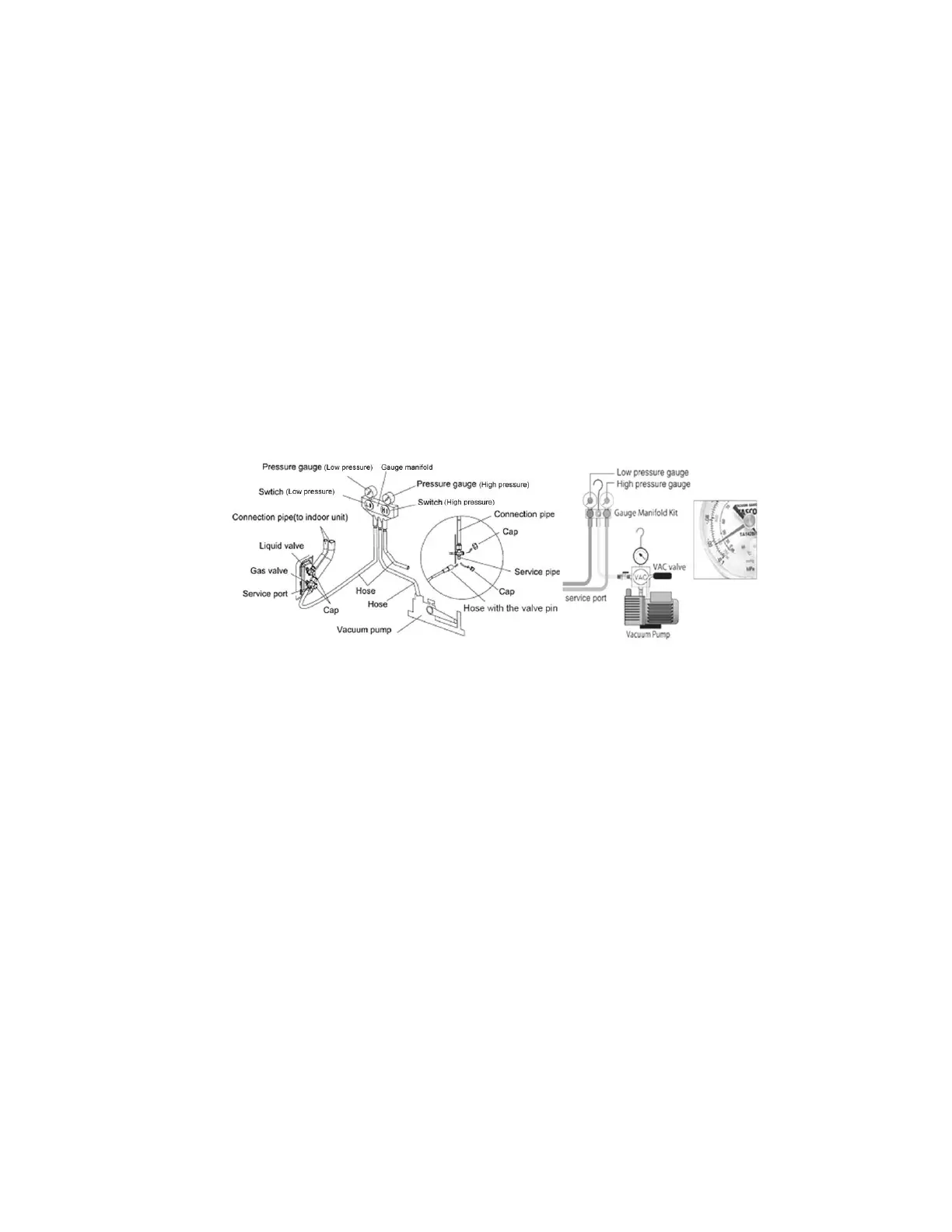
4.4.1 Vacuum
1. Remove the caps of the liquid valve, gas valve and also the service port.
2. Connect the hose at the low pressure side of the manifold valve assembly to the service port
of the units gas valve. The gas and liquid valves should be kept closed in case of refrigerant
leakage.
3. Connect the hose used for evacuation to the vacuum pump.
4. Evacuate until the micron gauge reads no higher than 350 microns.
Important:
Do not open
the service valves until the refrigerant lines and indoor coil leak check and evacuation are
complete.
5. Observe the micron gauge. Evacuation is complete if the micron gauge does not rise above
500 microns in one (1) minute.
6. When evacuation is complete blank off the vacuum pump and micron gauge, and close the
valves on the manifold gauge set
7. Open the liquid valve slightly and let some refrigerant go to the connection pipe to balance the
pressure inside and outside of the connection pipe, so that air will not come into the
connection pipe when removing the hose. Note that the gas and liquid valve can be opened
fully only after the manifold valve assembly is removed.
8. Put the caps back on the liquid valve, gas valve, and service port.
Fig. 4.19
Note:
The larger units have a service port for both the gas valve and the liquid valve. During
evacuation, it is possible to connect hoses from the manifold valve assembly to each of the service
ports for faster evacuation.



 To Next Page