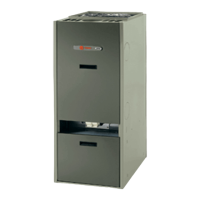
This document is an installer's guide for an oil-fired central furnace, covering various models including Highboy, Lowboy Front Flue, Lowboy Rear Flue, and Downflow/Horizontal configurations. It provides comprehensive instructions for installation, setup, and maintenance, emphasizing compliance with national, state, and local codes.
Function Description
The device is an oil-fired central furnace designed to provide heating for residential or commercial buildings. It operates by burning No. 2 distillate fuel oil to generate heat, which is then distributed throughout the building via a duct system. The furnace is available in multiple configurations to suit different installation requirements:
- Highboy (THV1M087A936, 948, 9V3, 9V5SA): A vertical flue model, typically installed in utility rooms or basements where vertical space is available.
- Lowboy Front Flue (TLF1M087A936, 948, 9V3, 9V5SA): A compact model with a front flue, suitable for installations with limited vertical clearance, often in crawl spaces or low-ceiling basements.
- Lowboy Rear Flue (TLR1M087A936, 948, 9V3, 9V5SA): Similar to the front flue lowboy but with the flue located at the rear, offering flexibility in ductwork and chimney connections.
- Downflow/Horizontal (TDF1M087A936, 948, 9V3, 9V5SA): A versatile model that can be installed in either a downflow (vertical) or horizontal configuration, making it adaptable for various spaces, including attics, crawl spaces, or utility closets.
The furnace is designed to operate within a specific temperature-rise range and external static pressure, ensuring efficient and safe heat distribution. It requires an adequate supply of combustion and ventilation air, and its combustion products must be discharged outdoors through an approved vent system.
Usage Features
The guide details several key usage features and installation considerations:
- Installation Location: The furnace should be positioned near a chimney or vent and centralized with respect to the air distribution system for optimal performance. For utility room installations, the entrance door must be wide enough for the furnace and other appliances. In residential garages, the burner must be installed at least 18 inches above the floor and protected from physical damage.
- Mounting: Highboy and lowboy models must rest on sturdy, stable, and level surfaces. The downflow/horizontal model can be mounted on a level surface or suspended from an overhead structure, with specific instructions for supporting the furnace from the bottom casing surface at three points. An optional combustible surface-mounting base (BAYSUB10ABASEAA) is available for vertical downflow installations directly on combustible materials.
- Clearances: Strict minimum clearances from furnace casing surfaces to combustible materials are mandated (e.g., 3 inches from sides and rear, 8 inches from front casing to closet door, 9 inches from flue pipe/vent connector). These clearances are crucial for fire safety. Accessibility clearances (typically 24 inches recommended at the front and rear) are also important for service and maintenance.
- Horizontal Configuration Setup: For downflow/horizontal models installed horizontally, the oil burner may need to be repositioned to an upright position, which involves cutting a threaded mounting stud and using a machine bolt for secure attachment. The high limit and fan control thermostat must also be relocated to the upper position on the casing to prevent overheating.
- Air for Combustion and Ventilation: Relief openings on the furnace casing must not be obstructed, as they supply combustion and ventilation air. The guide warns against the presence of chloride, fluoride, iodide, and bromide-bearing compounds in the combustion air, as these can cause severe corrosion of the heat exchanger and venting system. Detailed instructions are provided for ensuring adequate airflow in confined spaces (utility rooms) and unconfined spaces (full basements), including requirements for permanent openings and ducting.
- Chimney and Venting: The furnace must be connected to an adequate chimney or approved vent system. The guide provides criteria for chimney inspection, sizing, and height, emphasizing the importance of a sealed and lined chimney capable of producing a specific flue draft. It also details the construction and installation of the vent connector pipe, including material requirements (24 gauge or thicker corrosion-resistant steel), slope, and support. The use of a barometric-type draft regulator is supplied to stabilize chimney draft.
- Oil Burner and Nozzle Installation: The furnace uses a specific R.W. Beckett Corp. model AF burner. The guide provides instructions for adjusting the heating capacity by changing the oil burner nozzle, checking for proper alignment of the burner air tube with the combustion chamber, and ensuring correct insertion depth to prevent damage or sooting.
- Fuel System Installation: Instructions cover single-pipe and two-pipe fuel supply systems, depending on the oil storage tank's elevation relative to the burner. It recommends using continuous lengths of heavy wall copper tubing with flare fittings and installing high-quality shutoff valves and a high-efficiency oil filter (10 to 20 micron diameter or smaller). The use of ultra-low or low sulfur No. 2 fuel oil is recommended to reduce blockages, corrosion, and emissions.
- Electrical Connections: The furnace is pre-wired, requiring only the connection of building electrical service lines to the fan center junction box. Specific instructions are provided for low voltage wiring, including diagrams for single-stage heat/cool with RH/RC circuit and 24V relay, and variable speed oil furnace connections for single-stage and two-stage/step cooling.
- Duct Work and Air Conditioning: Air duct systems should be installed according to industry standards (ACCA Manual D, NFPA 90). If used with summer air conditioning, the furnace should be installed in parallel with or upstream of the evaporator coil to prevent water vapor condensation. A minimum 3-inch transition is required between the furnace supply air outlet and the evaporator coil supply air inlet to prevent overheating of the drain pan.
- Air Filter Mounting: Lowboy furnaces come with cleanable air filters located above the blower compartment. Highboy furnaces ship with an external filter rack and cleanable filter. Downflow/horizontal furnaces do not include an air filter or filter rack, and the installer must supply and mount one in the return air plenum.
Maintenance Features
The guide highlights several aspects related to maintenance and safety:
- Pre-Installation Inspection: Before installation, the furnace should be thoroughly inspected for missing parts, defective materials, or poor workmanship. Any issues should be reported to the seller using the model and serial numbers from the rating label.
- Concealed Damage Report: If the furnace is damaged during transit, a concealed damage report must be filed with the transportation company immediately to facilitate claims.
- Chimney Cleaning: If needed, the chimney should be cleaned before installing the furnace, and any accumulation of dirt or debris at the bottom of the flue should be removed.
- Condensation Prevention: The guide provides extensive information on preventing chimney condensation, which can lead to property damage, injury, or loss of life. It emphasizes maintaining the internal chimney wall temperature above the dew point, potentially requiring a flue liner, insulation, or proper sizing.
- Regular Servicing: The document stresses that all installations and services must be performed by qualified service personnel. Initial firing of the burner, adjustment of combustion air, and fuel pump pressure require calibrated combustion test instruments to ensure safe and reliable operation.
- Filter Replacement/Cleaning: While not explicitly detailed as a maintenance feature, the mention of cleanable filters and the need to position the filter rack for easy access implies regular cleaning or replacement is expected.
- Avoidance of Corrosive Chemicals: A warning is issued against storing or using chloride, fluoride, iodide, and bromide-bearing compounds near the furnace, as these can cause accelerated corrosion of the heat exchanger. If such chemicals must be present, the area should be well-ventilated, and containers sealed.
- Construction Heater Warning: The furnace should not be used as a "Construction Heater" during the finishing phases of construction, as condensate in the presence of construction chemicals can cause rapid deterioration of the heat exchanger.
The guide underscores the importance of proper installation and ongoing maintenance to ensure the safe, efficient, and long-term operation of the oil-fired central furnace.

 Need help?
 General

 To Next Page