to operate the the Blast. At distance, once again test for complete
radio control. Never attempt to run the Blast if the radio appears
to be malfunctioning in any way.
Centering your Servos
Whenever your radio system has been removed for service or
cleaning, the steering servo must be re-centered prior to installing
the radio system in the model. If the radio system is already
installed in the boat, disconnect the servo horn from the servo.
Connect the steering servo to channel 1 on your receiver and the
electronic speed control to channel 2. The white wire on the servo
cable is positioned towards the crystal. Nothing connects to the
“batt” terminal on the receiver.
Place fresh “AA” batteries in the transmitter and turn the power
switch on. Slide the throttle and steering trim adjustments to the
center position. Connect a fresh 7.2V battery pack to the electronic
speed control and turn the power switch to the ON position. The
servo will automatically jump to its center position.
Turn off the electronic speed control switch followed by the
transmitter. The servo is now ready to be installed. Be careful not to
move the servo shaft when installing the steering linkage.
Piloting the Blast
Your new Traxxas Blast is designed with water-resistant features
to protect the electronics in the model (receiver, servo, electronic
speed control). This gives you the freedom to have fun piloting your
Blast. Though highly water resistant, the Blast should not be treated
as though it is submersible or totally, 100% waterproof. Water
resistance applies only to the installed electronic components.
Additional care and maintenance is required when water contacts
the mechanical and electrical components to prevent corrosion of
metal parts and maintain their proper function.
Precautions
• Without proper care, some parts of your model can be seriously
damaged due to contact with water. Know that additional
maintenance procedures will be required after running in order to
maintain the performance of your model.
• Not all batteries can be used in wet environments. Consult your
battery manufacturer to see if their batteries can be used in wet
conditions. Do not use LiPo batteries in wet conditions (Note: the
Nautica ESC is not LiPo compatible).
• The Traxxas transmitter is not water resistant.
• Do not operate your model during a rain storm or other
inclement weather where lightning may be present.
• Do NOT allow your model to come in contact with salt water
(ocean water), brackish water (between fresh water and ocean
water), or other contaminated water. Salt water is highly
conductive and highly corrosive. Use caution if you plan to run
your model on or near a beach.
• Select a body of water (at least 10 inches deep) which is clear of
moss and grass. Do not drive the Blast in rough, choppy water or
in high wind (more than 15 mph). These conditions could cause
your Blast to flip over.
• The Blast’s steering is very sensitive, a slight input on the steering
control will have a large effect on the boat. When the boat is in
open water, adjust the steering trim on the transmitter until the
boat travels in a straight line on its own. (Note: The Blast will only
travel in a straight line on its own when it is heading straight into
or away from the wind. Crosswinds will require constant steering
input to maintain a straight course.)
• To prevent spin outs, avoid sharp turns at high speed.
• Always be ready to reduce the throttle if the Blast appears to be
unstable or “chine walking” (rocking violently from side-to-side).
Always reduce the throttle when turning, especially in rough
water. Jumping the Blast or towing anything with it should not
be attempted.
• Return the Blast to shore at the first sign of weak batteries (Blast
will begin to slow and the controls will become sluggish).
Cavitation
If the Blast is running at full throttle but is only barely moving
forward then the propeller is cavitating. Try advancing the throttle
slowly to get the Blast on plane. If you are having trouble with
cavitation, check the propeller for nicks or tangled debris. The
Blast’s propeller is specially designed for its application, therefore,
it’s very sensitive to any changes or modifications. If the prop is
damaged it should be replaced.
Before Running Your Blast
1. Consult the section “After Running Your Blast” before
proceeding. Make sure you understand the maintenance
required .
2. Confirm that the RX box O-ring and cover are installed correctly
and secure. Make sure the screws are tight and the blue O-ring is
not visible protruding from the edge of the cover.
3. Confirm that your batteries can be used in wet conditions.
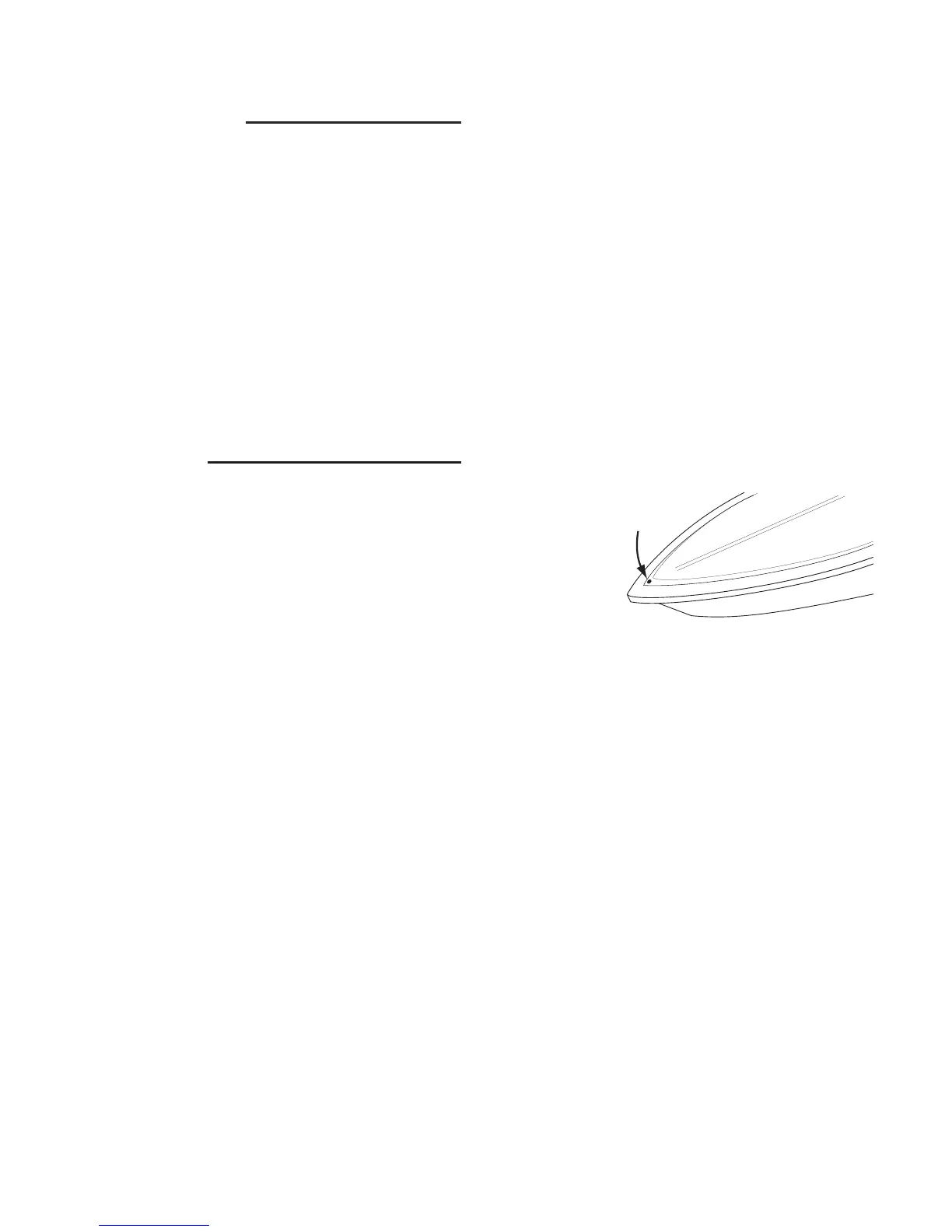
4. Normally, very
little water will
accumulate inside
the boat. Empty
any standing water
out of the boat
between runs. Drill
a small hole (
1
/
16 in.
)
in the front of the
boat to drain the water. Do not drain the water out of the back
of the boat (near the radio system).
5. Check the wiring for any frayed wires or loose connections.
6. Check the tightness of the set screws in the collars on the
steering linkages and in the universal joint yokes (connecting
the outdrive to the driveshaft and the driveshaft to the motor).
Threadlocking compound can be applied to these screws to
prevent them from loosening.
7. Check the mounting of the receiver and servos.
8. Check the rubber driveshaft seal for cuts and tears. Do not
attempt to run the Blast if this seal is damaged.
9. Check the tightness of the propeller. Hold the u-joint and turn
the propeller clockwise until it’s fingertight. Visually inspect the
prop for nicks, dings and warpage. Replace if damaged.
10. Check the operation of the radio system, especially the
condition of the batteries.
11. Visually inspect the hull for any cracks, damage or
possible leaks.
12. Check for deterioration of the rubber band which holds the
top hatch.
After Running Your Blast
1. Spray all the bearings, drivetrain, and fasteners with WD-40® or
similar water displacing light oil.
2. Let the boat stand or blow it off with compressed air.
Removing the hatch and placing the boat in a warm sunny
spot will aid drying.
3. As a precautionary step, remove the sealed receiver box


 To Next Page
 Loading...