Transmitter - The hand-held radio unit that sends throttle and
steering instructions to your Blast.
Trim - The fine-tuning adjustment of the neutral position of the
servos, made by turning the throttle and steering trim knobs on the
face of the transmitter.
Electronic Speed Control -
Controls the speed of the boat. Fully
digital-proportional for precise throttle control at all speeds.
Preparing to Run
Opening the Hatch
The top hatch is held secure with a rubber band. To open the
top hatch, pull it up and rotate it. This will provide access to the
battery compartment and on/off switch. For full access to the radio
compartment, unhook the rubber band from the top hatch.
Installing Transmitter Batteries
Your transmitter uses 8 “AA” size batteries. They should be
alkaline dry cells, or NiCad rechargeable batteries. The battery
compartment is located in the back of the transmitter. To remove
the battery door, push down and slide in the direction of the
arrow. Be sure that the switch is turned off before installing the
batteries. Insert the batteries into the battery compartment
making careful note of the polarity. Now, slide the battery door
back in place.
Setting Up the Antenna
You must install the antenna mast (tube) before you operate your
Blast. You’ll find the plastic antenna tube and tip in the bag with your
manuals and documentation.
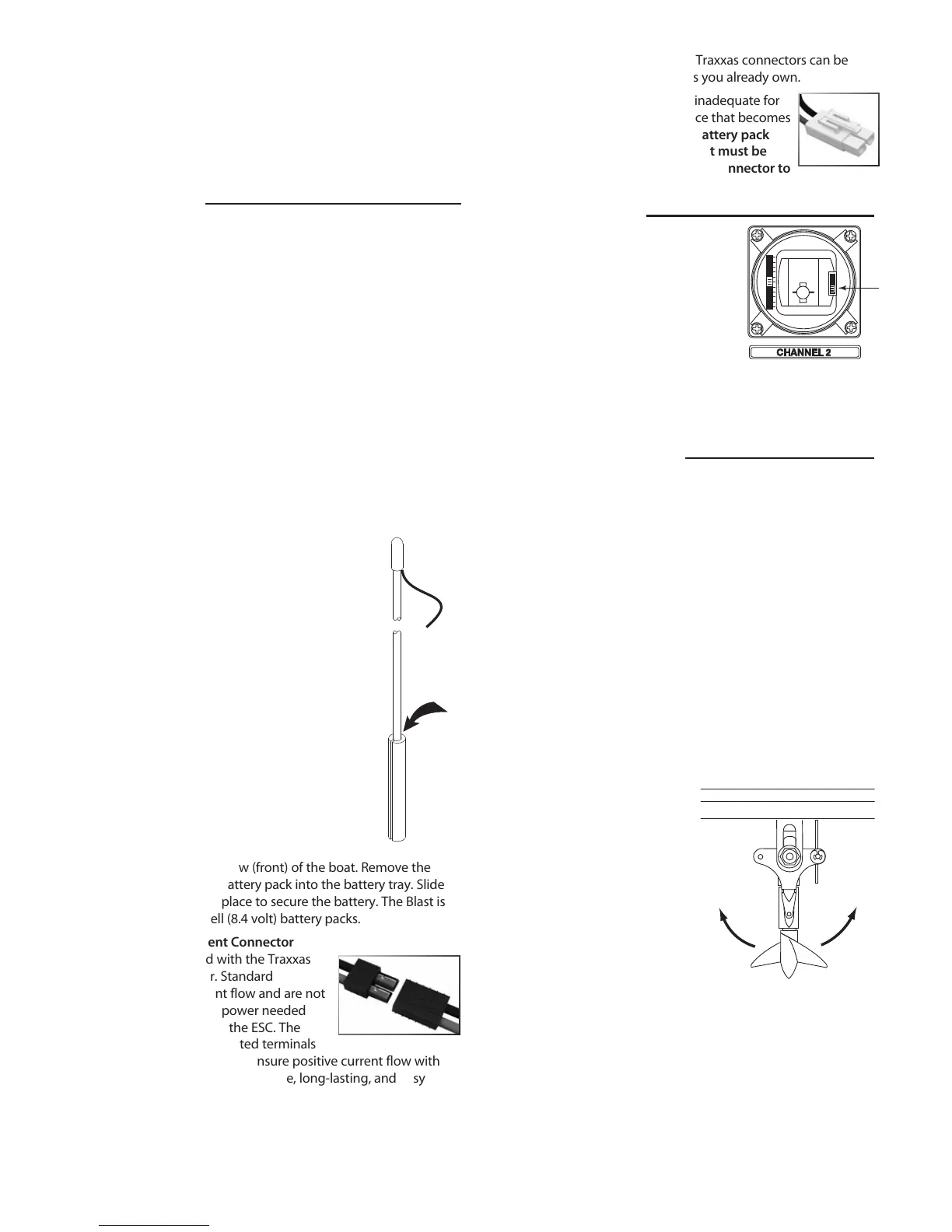
1. Locate the black antenna wire that exits the
receiver cover.
2. Pull the wire straight with your fingers and
then insert the end of the wire into one end
of the antenna tube. Push the wire all the way
through the antenna tube.
3. Pull the remaining wire through the antenna
tube, and then insert the base of the antenna
tube into the molded post on top of the
receiver cover.
4. Fold the remaining antenna wire over the top
of the tube and secure it with the antenna tip.
5. On the transmitter, always fully extend the
telescoping antenna when running your Blast.
Make a habit of holding the transmitter so that
the antenna points straight up.
Installing the Battery Pack
The battery installs in the bow (front) of the boat. Remove the
foam block and slide the battery pack into the battery tray. Slide
the foam block back into place to secure the battery. The Blast is
not designed to use 7-cell (8.4 volt) battery packs.
The Traxxas High-Current Connector
Your model is equipped with the Traxxas
High-Current Connector. Standard
connectors restrict current flow and are not
capable of delivering the power needed
to maximize the output of the ESC. The
Traxxas connector’s gold-plated terminals
have large contact surfaces to ensure positive current flow with
the least amount of resistance. Secure, long-lasting, and easy to
grip, the Traxxas connector is engineered to extract all the power
your battery has to give.
To run this model, your batteries must be equipped with Traxxas
High-Current Connectors. Batteries can either be purchased new
with Traxxas connectors installed or Traxxas connectors can be
purchased to install on battery packs you already own.
The typical Molex style connector is inadequate for
use in your model. It creates resistance that becomes
a bottleneck to current flow. If your battery pack
is equipped with a Molex connector, it must be
replaced with a Traxxas High-Current Connector to
mate with the electronic speed control.
Transmitter Controls
Throttle Neutral Adjust - A switch (located
to the right of the throttle stick (channel
2)) that controls the amount of desired
forward and reverse travel of the throttle
trigger. It should stay in the down position
as shown in the drawing (right). If you
change this adjustment, your transmitter
throttle trim will have to be reset.
Throttle Trim/Steering - Adjust the throttle trim control so
that the motor in the Blast does not run after the battery pack is
plugged in. Adjust the steering trim so that the Blast will drive
straight without veering to the left or right.
Radio System Adjustment
Your radio system was pre-adjusted before it left the factory
however, the adjustment should be checked prior to running the
Blast. These instructions are for Traxxas radio systems only. If you
installed your own radio, refer to your radio system’s instructions.
•
Each time you prepare to run your Blast, you must clear your
frequency to be sure no one else in the area is using the same
channel as you.
•
There are six possible channels, numbered 1 through 6. Each is
represented by a color. Look at the crystal plugged into the back
of your transmitter to determine which channel your boat is assigned to.
•
Always turn your transmitter on first and off last. This procedure will
help to prevent your Blast from receiving stray signals from another
transmitter, or other source, and running out of control.
• Turn “on” the switch on your transmitter. Turn “on” the switch
inside the boat. The steering servo should jump and move to
its idle (neutral) position. Keep fingers and obstacles away from
the propeller.
• Operate the steering control on
the transmitter (channel 1).
Check for rapid operation of the
steering servo and that none of
the steering mechanism is loose
or binding. If the servo operates
slowly, check for weak batteries.
Adjust the “steering trim” control
on the transmitter to adjust the
servo so that the outdrive is
pointing straight out from the
back of the boat. Also, check to
be sure that the outdrive does not turn more in one direction
than in the other. If you cannot align the outdrive, refer to the
section “Centering Your Servos.”
• Operate the throttle trigger on the transmitter to ensure that the
throttle is operating properly. If the propeller is spinning when you
plug in the battery, or it doesn’t seem to reach full speed, then you
may have to adjust the transmitter trim settings.
• The radio system should be range-tested before each session of
running. With the radio system on, have a friend carry the boat
away from you a distance equal to the maximum range you plan


 To Next Page
 Loading...