Need help?
Do you have a question about the Traxxas RUSTLER 4X4 BRUSHLESS and is the answer not in the manual?
Provides contact information and support options for the model.
Outlines procedures to get the model running quickly.
Instructions for registering the product online for customer service.
Explains icons used for warnings, hints, and cross-references.
Provides contact information for Traxxas technical support.
Key safety reminders for operating the model.
Safety precautions for the electronic speed control.
Warnings and precautions for using LiPo batteries.
General safety guidelines for charging all battery types.
Lists tools included with the model.
Lists essential items needed to operate the model.
Lists optional but useful tools and supplies for the toolbox.
Step-by-step guide on how to remove and install the model's body.
A step-by-step guide covering safety, setup, and initial operation.
Instructions for applying optional decals to the model.
Definitions of common terms used in the manual.
Explanations of various technical terms related to the radio system.
Details on the 2-channel system, 2.4GHz spread spectrum, and voltage.
Crucial safety advice for the radio system antenna.
Visual guide showing the wiring connections for the model.
Diagram illustrating the connections between components.
Overview of the transmitter and receiver components.
Step-by-step guide for installing batteries in the transmitter.
Information on choosing compatible batteries and chargers for the model.
Advice on selecting and using the correct batteries.
Explanation of the Traxxas Battery iD feature.
Instructions for installing the battery pack into the model.
Details about the model's high-current connector.
Identifies and explains the controls on the transmitter.
Essential rules for operating the radio system safely.
How to adjust steering trim and reverse channels.
How to use throttle functions and reverse the throttle channel.
Procedures for checking radio system operation and adjustments.
Guide on how to perform radio system range tests.
Advice on maintaining radio range at higher speeds.
Steps for binding the transmitter and receiver.
Explanation of the Failsafe function and its operation.
Explains transmitter and receiver LED indicator lights.
Technical specifications for the BL-2s ESC.
How to adjust Low-Voltage Detection for battery types.
How to reset transmitter settings and calibrate ESC.
How to test the ESC's operation and programming.
How to select different driving profiles (Sport, Race, Training).
Explains ESC LED codes and protection features.
Details on the Training Mode for beginner drivers.
Quick guide to changing between driving modes.
Important safety and operational precautions for driving.
Advice on how to maximize battery run time.
How battery mAh affects power and speed.
Guidelines for operating the model in wet environments.
Preparation steps before driving in wet conditions.
Specific precautions for the motor in wet conditions.
Procedures after running the model in wet conditions.
Further maintenance required after wet operation.
How to maintain the watertight seal of the receiver box.
Instructions for correctly positioning the receiver antenna.
How to set the correct gear mesh for the pinion and spur gears.
How to adjust shock positions for different terrains.
Tips for adjusting shocks for optimal handling.
Chart showing recommended gear ratio combinations.
Steps to re-center the steering servo.
Information on motor gearing and its effects.
How to adjust the slipper clutch for tire spin prevention.
Information on selecting and using aftermarket wheels and tires.
How to tune front and rear differentials with silicone oil.
Steps for removing and refilling the rear differential.
Key points to inspect for damage, wear, and proper function.
Regular maintenance for slipper clutch, chassis, steering, motor, shocks, suspension, and driveline.
Best practices for storing the model when not in use.
Steps to remove front and rear suspension assemblies and slipper clutch.
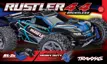
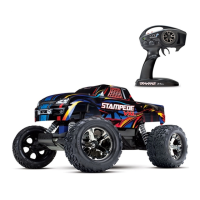
The provided document is an owner's manual for the Traxxas Rustler 4X4 Brushless electric stadium truck, model 67164-4. This manual outlines the operation, maintenance, and adjustment procedures for the vehicle, which is designed for high-speed action and off-road driving.
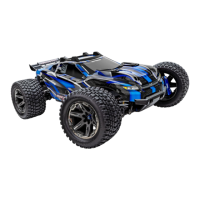
The Rustler 4X4 Brushless is an advanced radio-controlled (RC) vehicle that offers a thrilling driving experience. Its primary function is to provide an engaging hobby for enthusiasts, allowing them to control a powerful electric stadium truck with precision and speed. The vehicle is equipped with a BL-2s™ 3300 kV brushless motor and a smooth BL-2s™ electronic speed control, which are key components for its performance. The pre-installed Extreme Heavy Duty Upgrade Kit, along with heavy-duty suspension arms, contributes to its strength and durability, making it suitable for aggressive driving and various terrains.
For usage, the manual emphasizes a "Quick Start" path for experienced RC enthusiasts to get the model running quickly, while also encouraging a full read-through for comprehensive understanding. Before operation, users are instructed to carefully read all safety precautions, which cover important aspects like avoiding public roads, crowds, and ensuring a safe operating distance due to potential radio interference. The manual highlights that the model is not intended for children under 14 without adult supervision, underscoring the need for responsible operation.
The radio system, a Traxxas TQ 2.4GHz transmitter, is designed for ease of use, automatically locating and locking onto an available frequency to prevent conflicts. Users need to install 4 AA alkaline or rechargeable batteries into the transmitter and a compatible battery pack (NiMH or LiPo) into the model. The manual provides detailed instructions on installing these batteries and connecting the battery pack to the electronic speed control (ESC). A crucial usage feature is the "Battery iD" system, which allows Traxxas iD chargers to automatically recognize and optimize charge settings for compatible battery packs, simplifying the charging process.
The ESC, the BL-2s, has built-in Low-Voltage Detection, which is vital when using LiPo batteries. This feature monitors battery voltage and limits power output or shuts down the motor to prevent over-discharging, thus protecting the battery. Users are guided on how to activate or disable this detection, depending on the battery type (LiPo or NiMH). The ESC also includes "Training Mode," which reduces throttle output by 50%, making it easier for beginning drivers to control the model. This allows for a gradual progression as driving skills improve, eventually transitioning to "Sport" or "Race" modes for full power.
Driving the model involves understanding various radio system controls, such as steering trim and channel reversing, though the latter is typically pre-programmed at the factory. The manual advises turning on the transmitter first and off last to prevent runaway incidents. Range-testing the radio system before each run is recommended to ensure proper operation and prevent signal loss. The vehicle's water-resistant features allow for driving in wet conditions like puddles and wet grass, but it's not fully submersible, and additional care is required for mechanical and electrical components to prevent corrosion.
Maintenance is a significant aspect of owning the Rustler 4X4 Brushless, with the manual providing extensive guidance to ensure longevity and optimal performance. Regular inspection for cracked, bent, or damaged parts, as well as checking wheels, steering, wiring, and screw tightness, is crucial. The slipper clutch, which regulates power to the wheels to prevent tire spin, requires periodic inspection and adjustment. The manual details how to adjust the slipper clutch for optimal performance, including a recommended starting point for tightening and then backing off the adjusting nut.
The sealed gear differentials, both front and rear, can be tuned by changing the viscosity of the silicone oil inside them. This allows users to customize the model's handling characteristics for different driving conditions, such as climbing or racing on low-traction surfaces. The manual provides step-by-step instructions for disassembling and refilling the differentials. Motor maintenance is also covered, recommending cleaning and lubricating the motor bearings every 10-15 runs to ensure smooth operation. Shock absorbers need their oil levels maintained, and the manual suggests using 100% pure silicone shock oil to prolong seal life.
For storage, it's advised to disconnect and remove the battery from the model, and if storing for a long period, to also remove batteries from the transmitter. The manual also provides guidance on gearing compatibility, offering a chart of recommended gear combinations for various driving styles and conditions. This allows users to optimize the model for either acceleration or top speed, depending on their preference and the terrain. The importance of checking battery and motor temperatures to avoid over-gearing is highlighted, ensuring the longevity of these critical components.
 General
| Scale | 1/10 |
|---|---|
| Wheel Diameter | 2.8 inches (71mm) |
| Gear Pitch | 32 Pitch |
| Motor | Velineon 3500 Brushless |
| Drive Type | 4WD |
| Battery Type | 2-3S LiPo or 6-7 cell NiMH |
| Speed Control Type | VXL-3s |
| Differential Type | Sealed, oil-filled |
| Chassis Structure/Material | Composite |
| Steering | Bellcrank |
| Transmitter | TQi 2.4GHz |
| Servo | 2075 |
| Suspension | Independent |
| ESC | VXL-3s |
| Radio System | TQi 2.4GHz |
| Differential | Sealed, oil-filled |




 To Next Page