
 Need help?
Do you have a question about the Traxxas STAMPEDE and is the answer not in the manual?
An overview of procedures to get your model running quickly.
Key safety advice for operating the model and avoiding property damage or injury.
Critical warnings and procedures for safe charging and handling of Lithium Polymer (LiPo) batteries.
Essential precautions for charging, storing, and handling all battery types to prevent fire and damage.
A step-by-step guide to get your model running quickly, referencing other manual sections.
Critical warnings regarding the receiver antenna to maintain radio range.
Procedures for charging the Traxxas NiMH battery pack using the supplied charger.
Essential rules for turning the transmitter and model on/off to prevent runaways.
Procedure to verify the radio system's proper operation at a distance before driving.
Procedures for properly installing the receiver antenna and tube for optimal range.
Description of the built-in fail-safe function and its operation.
How to activate or disable Low-Voltage Detection for NiMH and LiPo batteries.
Instructions for calibrating the ESC and transmitter.
How to operate the speed control and test programming.
How to select between Sport, Race, and Training modes for the ESC.
Step-by-step instructions for selecting Training Mode (Profile #3).
Guidelines for operating the model in wet environments and necessary precautions.
Steps to take before driving the model in wet conditions, including tire modification.
Maintenance procedures required after operating the model in wet conditions.
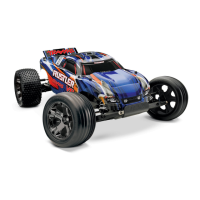
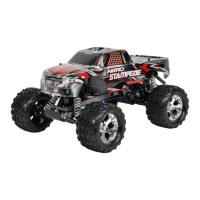
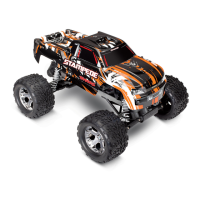
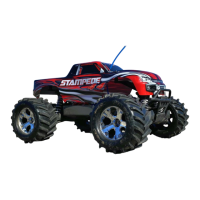
This manual describes the Traxxas electric models: the Rustler stadium race truck, the Bandit buggy, and the Stampede monster truck. These models are designed for high-speed action, featuring a powerful Titan 12T 550 motor and a smooth XL-5 electronic speed control. They incorporate the latest performance and appearance enhancements, including new wheels and tires with advanced tread patterns and rubber compounds for superb driving. Innovative technology, such as the patent-pending Torque-Control slipper, is also integrated.
The models are controlled by a Traxxas TQ 2.4GHz radio system, which automatically locates and locks onto an available frequency, allowing multiple models to be raced together without frequency conflicts. The transmitter has two channels: one for steering and one for throttle. The receiver in the model has three output channels, with one servo and an electronic speed control connected. The radio system is factory-programmed for the models and generally does not require adjustment, though settings can be accessed for maintenance or troubleshooting.
Operating these models requires careful attention to safety. They are not intended for use on public roads or congested areas and should never be operated in crowds due to their high speed and potential for injury. Radio interference can cause momentary losses of control, so a safety margin should always be maintained. The motor, battery, and speed control can become hot during use, requiring caution to avoid burns. Operation at night or when the line of sight is obstructed is not recommended. Good common sense is paramount at all times.
The XL-5 electronic speed control is a powerful device that requires specific precautions to prevent damage. It has a 15-turn modified motor limit for 540 size motors and a 12-turn modified motor limit for 550 size motors with 0 timing. Overheating can occur if the motor or speed control is improperly geared. Exposed wiring should always be insulated to prevent short circuits. The transmitter must be switched on first before the speed control to prevent runaways. For reverse operation, motors must have 0° timing. The XL-5 accepts 4-7 NiMH cells or 2 LiPo cells (2S) only, with a maximum input voltage of 8.4 volts (NiMH) or 7.4 volts (2S LiPo). Factory-installed connectors should be used, and any changes to battery or motor connectors should be done one at a time to prevent mis-wiring. The speed control is not protected against reverse polarity voltage. Three 0.1µF (50V) ceramic capacitors are required on every motor to prevent radio interference, and external Schottky diodes are not compatible with reversing speed controls.
The models can use LiPo batteries, but charging and discharging LiPo batteries carry a risk of fire, explosion, serious injury, and property damage if not handled according to instructions. LiPo batteries are for advanced users only and should not be used or handled by anyone under 14 without adult supervision. LiPo batteries have a minimum safe discharge voltage threshold that should not be exceeded; the electronic speed control's built-in Low-Voltage Detection alerts the driver when this threshold is reached, requiring immediate cessation of use. It is crucial to follow all instructions for safe charging, use, and storage of LiPo batteries. Only LiPo balance chargers with a balance adapter port should be used for LiPo batteries; NiMH or NiCad chargers can damage LiPo batteries and cause fire. LiPo battery packs should never be charged in series or parallel.
Before charging, LiPo batteries must be carefully inspected for any damage, such as loose leads, damaged insulation, fluid leaks, swelling, or deformity. Any damaged battery should not be charged or used and must be disposed of properly. LiPo batteries should not be stored or charged with other battery types. They should be stored and transported in a cool, dry place, away from direct sunlight, and not exposed to temperatures exceeding 140°F (60°C). Disassembling LiPo batteries or building packs from loose cells is prohibited.
For all battery types, the supplied NiMH charger should only be used for the included battery. Charger settings must match the battery type, specification, and configuration. Non-rechargeable batteries, batteries with internal charge/protection circuits, or altered/unidentifiable batteries should not be charged. The maximum manufacturer-recommended charge rate should not be exceeded. Exposed battery contacts or wires should not touch each other to prevent short circuits. Batteries should always be placed in a fire-retardant/fire-proof container on a non-flammable surface during charging or discharging. Batteries should not be charged inside a car or on flammable materials. The charger and battery should never be left unattended while charging. If any malfunction occurs, the charger should be unplugged and the battery disconnected. A Class D fire extinguisher should be nearby. Batteries should be allowed to cool between runs. The charger and battery should always be unplugged when not in use or when the model is stored or transported. The charger should not be disassembled or exposed to water. Children should always have adult supervision when charging and handling batteries. NiMH batteries must be recycled or disposed of properly.
The Quick Start path outlines necessary procedures to get the model running quickly. This includes reading safety precautions, charging the battery pack, installing batteries in the transmitter, installing the battery pack in the model, installing the antenna, turning on the radio system, checking servo operation, range testing the radio system, detailing the model (installing wings and decals), and driving the model.
The TQ 2.4GHz transmitter uses 4 AA batteries. The included Traxxas Battery Charger is a fully featured NiMH charger with 4-amp charge current and advanced peak detection. It is designed for use only with Traxxas NiMH batteries with iD and is not compatible with legacy Traxxas High-Current Connectors. The charging process involves plugging the charger into a 12-volt automotive auxiliary power socket, connecting the battery, and waiting for the LED to indicate a full charge.
The receiver antenna and antenna tube must be properly installed to prevent loss of radio range. The antenna wire should not be kinked, cut, or wrapped, and must extend as far as possible outside the vehicle body, protected by the antenna tube.
The radio system controls include a steering trim knob to adjust the neutral point of the steering channel. Channel reversing allows changing the direction of the corresponding servo, which should only be necessary if a channel direction is accidentally reset. The speed control should be recalibrated before reversing the throttle channel.
Before each running session, the radio system should be range-tested to ensure proper operation. This involves turning on the radio system, elevating the model, plugging in the battery, turning on the speed control, checking steering servo operation, ensuring front wheels are straight, and verifying full forward and reverse throttle operation.
The models feature water-resistant electronics (receiver, servos, ESC) for driving through puddles, wet grass, and snow. However, they are not submersible. Additional care and maintenance are required for mechanical and electrical components to prevent corrosion. The TQ 2.4GHz transmitter is not water resistant and should not be exposed to rain. Operating in salt water or other contaminated water is not recommended. Even casual water contact can reduce motor life, requiring gearing and driving style modifications.
Before running in wet conditions, small holes (3mm or 1/8" diameter) should be cut in the tires to allow water to drain. The RX box O-ring and cover must be correctly installed and secure. Lower gearing (smaller pinion gears, larger spur gears) is recommended for wet conditions to reduce motor load. After wet running, tires should be drained, batteries removed, the truck rinsed with low-pressure water, blown off with compressed air, wheels removed, and bearings, drivetrain, and fasteners sprayed with water-displacing oil. The truck should be allowed to dry thoroughly, and the receiver box cover should be removed during storage to allow air to dry the electronics.
Regular maintenance is crucial for optimal performance. This includes inspecting for cracked, bent, or damaged parts, checking wheels and steering for binding, verifying shock absorber operation, inspecting wiring for fraying or loose connections, checking receiver and servo mounting, tightening wheel nuts, checking radio system battery condition, and inspecting for loose screws in the chassis or suspension. The steering servo saver will wear out and should be replaced if steering becomes loose. Gears should be inspected for wear, broken teeth, or debris. The slipper clutch tightness should be checked.
Other periodic maintenance includes checking slipper clutch pads; if the thickness is 1.8mm or less, the friction disc should be replaced. The chassis should be kept clean. Increased looseness in the steering system may indicate wear in the servo saver, tie rod ends, or bellcrank bushings, which should be replaced as needed. The motor should be removed, cleaned with electric motor cleaning spray, and lubricated with lightweight motor oil every 10-15 runs. Shock oil levels should be kept full, using 100% pure silicone shock oil. Leakage indicates a need for rebuild. The driveline should be inspected for wear, such as worn drive yokes, dirty axle half shafts, or unusual noise/binding.
For storage, the model should be dusted off, and the battery disconnected and removed from the model. If stored for a long time, transmitter batteries should also be removed.
The slipper clutch, built into the spur gear, regulates power to the rear wheels to prevent tire spin. It can be adjusted by removing the rubber slipper clutch plug and using the 4-way wrench to tighten or loosen the adjusting nut. For a good starting point, tighten the nut clockwise until the spring fully collapses, then turn it counter-clockwise one full turn. The model should not be run with the slipper clutch adjusting spring fully compressed.
Toe-in adjustment ensures both wheels are pointing straight ahead and parallel (0° toe-in) for balanced steering. For increased stability, 1°-2° of toe-in can be added to each front wheel using the turnbuckles.
The four shocks greatly influence handling. Changes to pistons, springs, or oil should be made in pairs (front or rear). Two-hole pistons with lightweight oil are recommended. Ride height can be adjusted using clip-on, spring pre-load spacers.
Various aftermarket tires and wheels can be adapted, but Traxxas recommends using wheels with designed offsets and dimensions. Experimentation with different tire types and rubber compounds is recommended based on terrain. Larger tire diameters may require a smaller pinion gear.
The model's transmission offers a wide range of gear ratios. The Titan 12T 550 motor comes with stock gearing for good overall acceleration and top speed. High-speed gearing (more teeth) can be installed for more top speed on hard surfaces, but is not recommended for off-road or repetitive starting/stopping. A smaller optional pinion gear can be used for more acceleration and less top speed. Over-gearing can overheat and damage the motor and/or speed control. The Titan 12T motor has an integrated cooling fan, effective during medium to high-speed operation, and the gearbox is vented to cool the motor. Repetitive starting and stopping can cause excess heat.
The mAh rating of the battery affects top speed performance; higher capacity packs experience less voltage drop under heavy load, allowing increased speed until discharge. To increase run time, use batteries with the highest mAh rating, a high-quality peak-detecting charger, and vary speed. Lowering the gear ratio (smaller pinion gear) reduces power draw. Maintaining the model to prevent binding in the drivetrain and keeping the motor clean and lubricated also helps.
 General
| Scale | 1:10 |
|---|---|
| Drive type | 4-wheel drive (4WD) |
| Engine type | Electric engine |
| Product type | Car |
| Housing color | Black, Red |
| Maximum speed | 50 km/h |
| Frequency band | 2.4 GHz |
| Chassis material | Nylon |
| Construction type | Ready-to-Run (RTR) |
| Protection features | Water resistant |
| Transmitter | Yes |
| Compatible battery sizes | AA |
| Number of batteries (transmitter) | 4 |
 Weight and Dimensions
| Width | 413 mm |
|---|---|
| Length | 241 mm |
| Weight | 1850 g |
| Wheelbase | 270 mm |
| Front wheels diameter | 71 mm |




 To Next Page