The Traynor Small Block 106 & 200H are bass guitar amplifiers designed for both practice and performance. These amplifiers offer a comprehensive set of features for tone shaping, connectivity, and reliable operation, suitable for bass players seeking a versatile and portable solution.
Function Description:
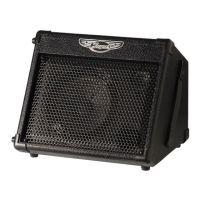
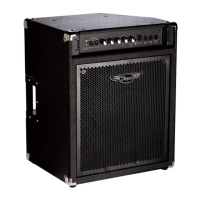
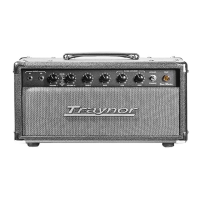
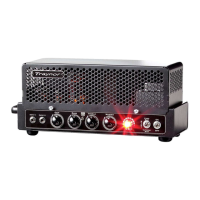
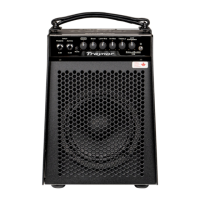
The Traynor Small Block amplifiers serve as a complete solution for bass amplification. They are designed to amplify the signal from a bass guitar, allowing for extensive tonal adjustments and outputting the sound through a speaker or directly to a mixing console. The amplifiers feature both passive and active inputs, accommodating a wide range of bass guitars. A key aspect of their design is the ability to deliver a clear, powerful sound while maintaining a compact and lightweight form factor. The SB200H is a 200-watt head, while the SB106 is a combo amplifier with a 6-inch speaker.
Important Technical Specifications:
- Power Output: The SB200H delivers 200 watts into a 4-ohm load. The SB106 is rated at 106 watts into 4 ohms (internal speaker) or 150 watts into 4 ohms (external speaker).
- Minimum Impedance: Both amplifiers have a minimum speaker load of 4 ohms.
- Inputs: Two inputs are provided: 0dB/Passive and -6dB/Active, optimized for different bass guitar output levels.
- Tone Controls: Four active tone controls (Bass, Low-Mid, Hi-Mid, Treble) offer a wide range of ±15dB adjustment across the audio spectrum.
- Low Expander: This control shapes the bass tone by contouring gain in the mid-frequencies around 400 Hz and expanding low frequencies.
- Connectivity:
- AUX Input: 1/8-inch stereo jack for connecting external sound sources (e.g., digital audio players, smartphones). Stereo sources are summed electronically.
- Phones Jack: 1/8-inch stereo jack for headphones, which mutes the speaker output when in use.
- Tuner Out Jack: 1/4-inch mono jack for connecting an instrument tuner.
- Line Out (XLR): Balanced XLR output for direct connection to a mixing console. Features a Lift/GND switch to reduce ground loop hum.
- Line Out EQ Switch: Selects between Pre-EQ (instrument's original signal) and Post-EQ (amp's tone controls and Scoop circuits applied) for the XLR output.
- Speaker Out: Combi-jack (Speakon™/1/4-inch) for connecting external speaker cabinets.
- LED Indicators: Power ON, Mute, Clip.
- Dimensions (SB200H): 19.1 x 20.35 x 4.5 cm (7.5 x 8 x 1.75 inches).
- Weight (SB200H): 2.375 kg (5.2 lbs).
- Dimensions (SB106): 22.9 x 24.2 x 11.5 cm (9 x 9.5 x 4.5 inches).
- Weight (SB106): 6.8 kg (15 lbs).
- Internal Speaker (SB106): 6-inch speaker.
Usage Features:
- Power Switch and Lamp: A rocker switch turns the amplifier on/off, with an illuminated blue lamp indicating power. The lamp turns red when the mute button is pressed or when the amplifier is in standby.
- 0dB/Passive, -6dB/Active Inputs and Clip: These inputs are designed to accommodate different bass guitar output levels. The 0dB input is for passive basses, while the -6dB input is for active basses or those with higher output. A clip LED indicates when the input signal is too hot, prompting the user to reduce the gain or switch inputs.
- Mute Button: This button silences the preamp signal to the speaker, XLR Line Out, and Tuner Out, useful for tuning or temporary breaks. The power lamp turns red when mute is active.
- Gain Control: Adjusts the input level before the signal reaches the tone controls, influencing the amplifier's tonal 'sensitivity' or 'definition'. Higher gain settings can introduce more 'growl'.
- Tone Controls (Bass, Low-Mid, Hi-Mid, Treble): These active controls allow for precise sculpting of the bass tone. Centering the controls provides a neutral setting. Users are advised to start with centered controls and adjust while playing to achieve the desired sound, noting that tone and EQ circuits are gain-related and may require re-adjustment of the Gain control.
- Low Expander Control: Provides a unique tonal palette by contouring mid-frequencies and expanding low frequencies, offering a different sonic character.
- AUX Input: Allows for practice or jamming along with external audio sources, with stereo signals summed for mono output. The AUX input signal is fed after the tone controls, preserving its original tonality.
- Phones Jack: Enables silent practice or recording by automatically disconnecting the internal speaker when headphones are plugged in. The XLR Line Out, Tuner Out, and Effects Send (if applicable) remain active.
- Tuner Out Jack: Provides a dedicated output for connecting an external instrument tuner, allowing for convenient tuning without affecting the main signal path.
- Line Out EQ Switch: Offers flexibility for the balanced XLR output, allowing users to send either a "Pre-EQ" signal (instrument's original, non-EQ'd sound) or a "Post-EQ" signal (including the amp's tone and Scoop circuits) to a mixing console or recording device.
- Line Out XLR and Lift/GND: The balanced XLR output is ideal for connecting to mixing consoles. The Lift/GND switch helps eliminate ground loop hum by disconnecting Pin 1 of the XLR. If no hum is present, the GND setting provides superior shielding.
- Speaker Out: The combi-jack allows for connecting external speaker cabinets. The amplifier can drive one 4-ohm cabinet or two 8-ohm cabinets in parallel. For the 200-watt head, a 4-ohm cabinet with a program power rating of approximately 250 watts is recommended for optimal performance and handling of "crunch" distortion.
Maintenance Features:
- Safety Instructions: The manual emphasizes critical safety precautions, including warnings about electric shock, proper grounding, and avoiding exposure to moisture. It advises against user-serviceable parts and recommends referring all servicing to qualified personnel.
- Cleaning: The unit should be cleaned with a soft, dry cloth.
- Power Cord: Users are instructed to use the provided power cord and ensure it is properly grounded.
- Fuse Replacement: The fuse is not user-serviceable and requires replacement by qualified personnel.
- Warranty: Traynor offers a two-year transferable warranty, covering manufacturing defects. The warranty requires proof of purchase and excludes damage from misuse, accidents, or natural disasters. It is valid only in Canada and the United States.
- Ventilation: The amplifier requires proper ventilation to prevent overheating. Users are advised not to block ventilation openings or operate the unit in an enclosed space.
- Speaker Connection: Proper speaker impedance matching is crucial to prevent damage to the amplifier. Users are instructed to ensure the total impedance of connected speakers does not fall below the minimum specified load.

 Need help?


 To Next Page
 General