9
EQUALISER
For those not familiar with the difference between a shelving and peaking equaliser, the differences
are as follows. A shelving equaliser boosts (or attenuates) all frequencies equally, above or below a
certain point. The frequency specified for a shelving equaliser circuit is usually at the point where it
effectively reaches its 'shelf' state. A 'high shelf' EQ boosts/cuts high frequencies and a 'low shelf'
type boosts/cuts low frequencies. This type of circuit is very popular in hi-fi systems but is also
actually highly musical, when applied in a recording environment. In contrast, a peaking equaliser is
one that, as its name implies, has a centre frequency that is boosted or attenuated more than others.
The frequency range over which it reaches its peak and then falls down is known as the bandwidth
(or 'Q'). Because this type of design reaches a peak and then falls away, it is possible with this type of
circuit to 'home in' on particular frequencies and make adjustments without affecting those around
them. This can be particularly useful when working with instruments such as bass guitars and snare
drums. By incorporating both shelving and peaking equalisers into the design of the , it
is possible to get the best of both types of design.
Operating the Equaliser
Set the input level in accordance with the procedures detailed in the 'Input Section' section of this
manual. Begin with all boost/cut controls - those with centre detents, set to their mid way ('0')
positions. Adjust the low and high mid frequency sweep controls to their minimum positions (fully
anticlockwise). The 50Hz high pass 'Filter' switch should be in the out position. Set the frequency
select switches controlling the high and low shelving sections, to 120Hz and 12kHz respectively.
Lastly, set the 'EQ' switch to the 'in' position (the associated LED will illuminate).
Rotation of the high frequency shelving control in a clockwise direction emphasises high
frequencies, while turning the control in an anti-clockwise direction from centre attenuates high
frequencies. Operating the 'frequency select' switch in the high frequency section introduces a
subtle change of emphasis to the affected high frequencies, as the shelving 'knee' is changed from
12kHz to 8kHz. Likewise, rotating the low frequency shelving control in a clockwise direction will
emphasise low frequencies, while turning the control in an anti-clockwise direction from centre
attenuates low frequencies. Adjusting the 'frequency select' switch in the low section introduces a
subtle change of emphasis on the affected low frequencies by altering the shelving point from 120Hz
down to 60Hz.
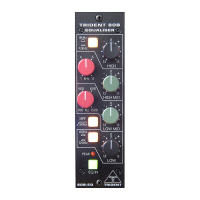
The 'low mid' and 'high mid' equaliser sections are peaking filters. Adjustment of their parameters is
achieved by use of the (center-detented) boost/cut knob and its associated frequency sweep knob.
(The relation between each pair of controls is denoted by a white line on the front panel connecting
the two together). Boost or cut of a given frequency is performed by moving that control from its
centre detent position: clockwise for boost, anti-clockwise to cut. The frequency to be boosted or cut
is selected by the frequency sweep control knob. The range of frequencies of the 'low mid' control
extends from 100Hz up to 1.5kHz. For the 'high mid' sweep, the frequency range begins at 1kHz
(overlapping with the low mid section) and continues up to 15kHz.
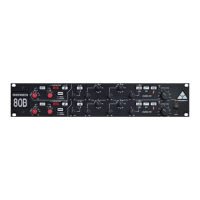
The Series 80B rack incorporates a classic four band equaliser which is identical to that employed
in the Trident Series 80 console. It consists of frequency-switchable high and low pass shelving
sections, coupled with two swept low and high mid range bands and a switchable 50Hz, 12dB per
octave filter. Both swept midranges have been carefully chosen for maximum effect on music
programme and a good degree of overlap is provided.
Series 80B
®
®


 To Next Page
 Loading...