Page 18
E Series Ethernet Radio – User Manual
Understanding RF Path Requirements
A radio modem needs a minimum amount of received RF signal to operate reliably and provide adequate data throughput.
In most cases, spectrum regulatory authorities will also dene or limit the amount of signal that can be transmitted, and the transmitted power will
decay with distance and other factors, as it moves away from the transmitting antenna.
It follows, therefore, that for a given transmission level, there will be a nite distance at which a receiver can operate reliably with respect to the
transmitter.
Apart from signal loss due to distance, other factors that will decay a signal include obstructions (hills, buildings, foliage), horizon (effectively the
bulge between two points on the earth), and (to a minimal extent at UHF frequencies) factors such as fog, heavy rain-bursts, dust storms, etc.
In order to ascertain the available RF coverage from a transmitting station, it will be necessary to consider these factors. This can be done in a
number of ways, including
(a) using basic formulas to calculate the theoretically available signal - allowing only for free space loss due to distance,
(b) using sophisticated software to build earth terrain models and apply other correction factors such as earth curvature and the effects of
obstructions, and
(c) by actual eld strength testing.
It is good design practice to consider the results of at least two of these models to design a radio path.
Part D – System Planning and Design
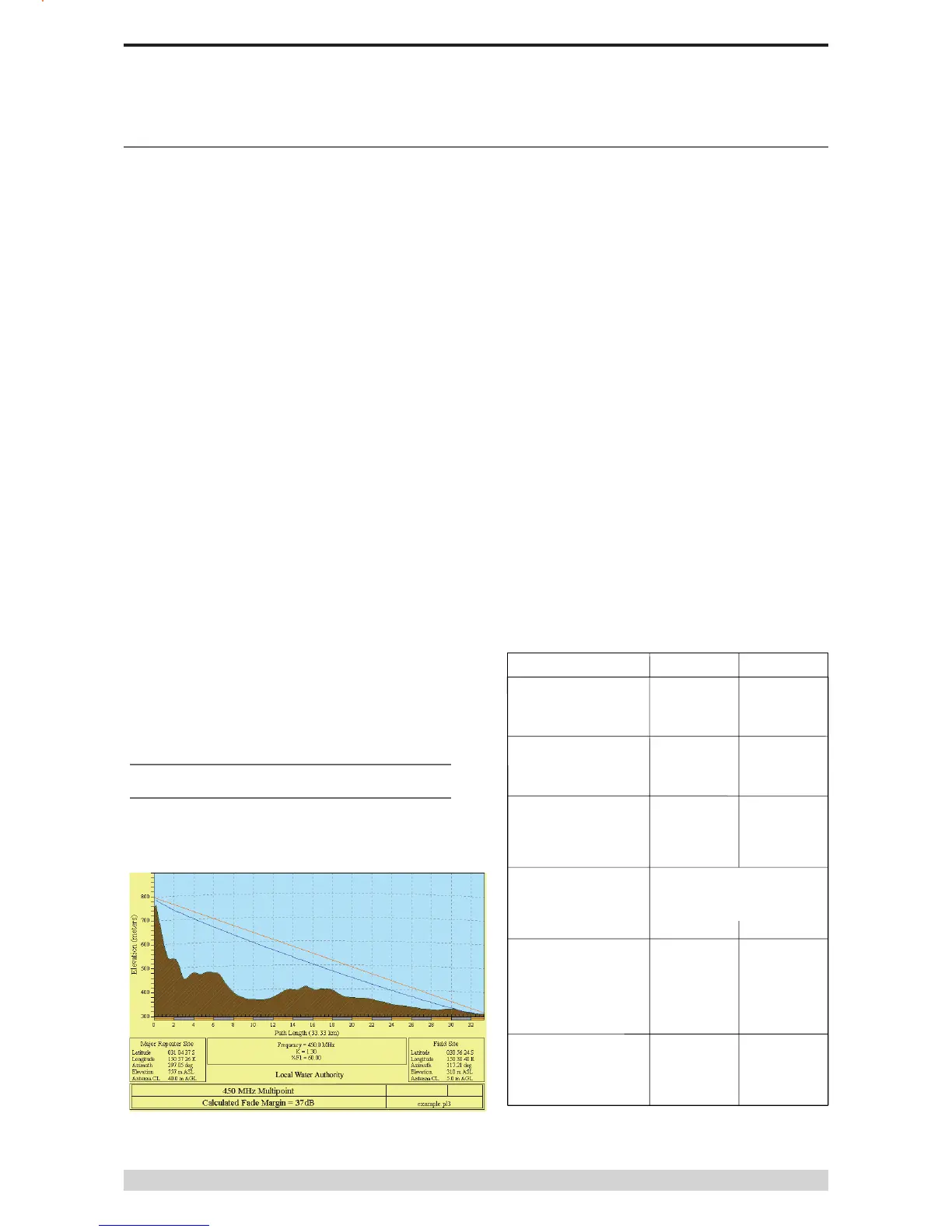
Examples of Predictive Path
Modelling
Clear line of site
Radio path with good signal levels, attenuated only by free space
loss.



 To Next Page