28
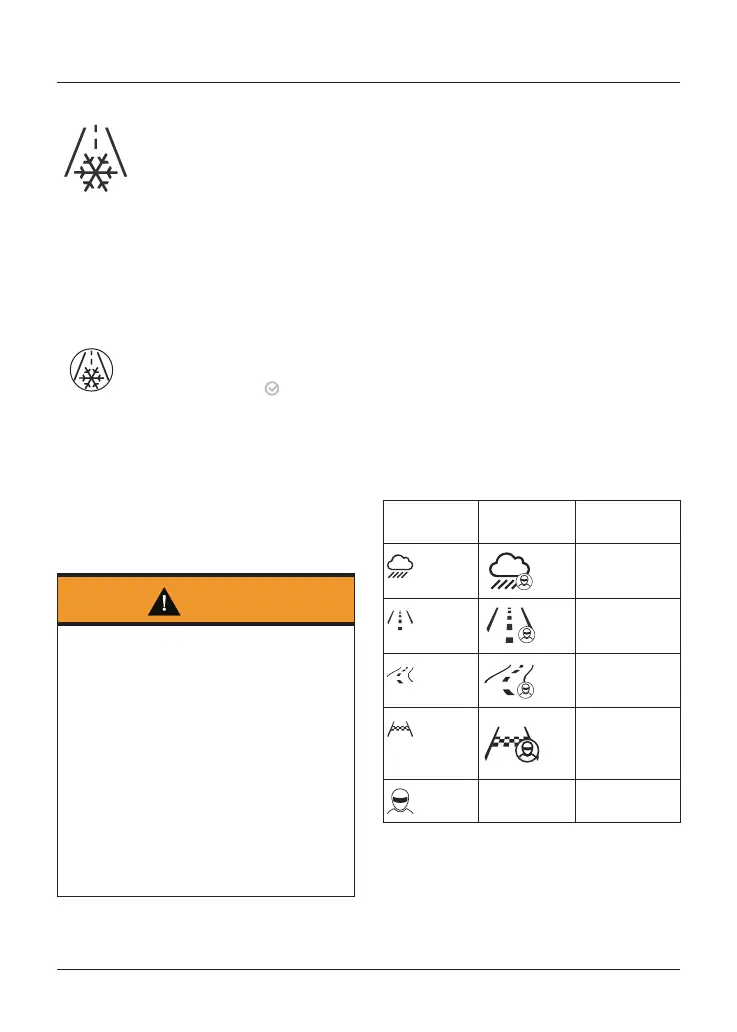
Frost Symbol
The frost symbol will illumi-
nate if the ambient air temperature is
4°C (39°F) or lower.
The frost symbol will remain illuminated
until the temperature rises to 6°C (42°F).
An alert will also be displayed in the in-
formation tray.
ACKNOWLEDGE
CAUTION: LOW AIR TEMPERATURE
RISK OF SURFACE ICE
1/3 warnings
When the motorcycle is stationary the
heat of the engine may affect the accu-
racy of the ambient temperature
display.
Once the motorcycle starts moving the
display will return to normal after a
short time.
Warning
Black ice (sometimes called clear ice)
can form at temperatures several de-
grees above freezing (0°C (32°F)),
especially on bridges and in shaded ar-
eas.
Always take extra care when the tem-
peratures are low and reduce speed in
potentially hazardous driving condi-
tions such as bad weather.
Excess speed, hard acceleration, heavy
braking or hard cornering when roads
are slippery may result in loss of mo-
torcycle control and an accident.
Riding Modes
The riding modes allow adjustment of
the throttle response (MAP), Anti-lock
Brake System (ABS) and Traction Control
(TC) settings to suit differing road condi-
tions and rider preferences.
Riding modes can be conveniently se-
lected using the MODE button and
joystick located on the left hand switch
housing, whilst the motorcycle is sta-
tionary or moving, see page 29.
Note:
• Up to five riding modes are availa-
ble depending on the motorcycle
model’s specification.
If a riding mode is edited (other than the
RIDER mode), the icon will change as
shown below.
Default Icon Rider Edited
Icon
Description
RAIN
ROAD
SPORT
TRACK
(Speed Triple RS
only)
- RIDER
Each riding mode is adjustable. For more
information, see page 38.
Availability of the ABS, MAP and TC set-
ting options vary between models.



 To Next Page