4
Informationen zum Vorbild
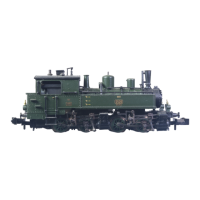
Im Rahmen des Ausbaus der bayerischen Lokalbahnen wurden
zunehmend Lokomotiven benötigt, die starke Steigungen und
enge Radien bewältigen konnten. Maffei baute daraufhin eine
4-Zylinder-Verbund-Lokomotive der Bauart Mallet.
Der hintere feste Hauptrahmen trug die Hochdruckzylinder und
im vorderen beweglichen Antriebsdrehgestell waren die Nieder-
druckzylinder angeordnet. Da diese Lokomotiven jedoch sehr un-
ruhig liefen und zum Entgleisen neigten, wurden sie von der DRG
schon Mitte der 30er-Jahre des letzten Jahrhunderts wieder
ausgemustert und größtenteils als Werkslokomotiven verkauft.
So z.B. die „Zuckersusi“, die an die Zuckerfabrik Regensburg
geliefert wurde. Sie war dort bis 1972 im Dienst und steht heute
bei der Deutschen Museums-Eisenbahn in Darmstadt.
Achsanordnung B‘B
Länge ü. Puffer 10.010 mm
Höchstgeschwindigkeit 45 km/h
Dienstmasse 42,6 t
Nennleistung 265 kW (380 PS)
Baujahr ab 1899
Wheel arrangement 0-4-4-0T
Length over the buffers 10.010 mm / 32 ft. 10-1/8 in.
Maximum speed 45 km/h / 28 mph
Service weight 42.6 metric tons
Nominal power 265 kilowatts / 380 hp
Built starting in 1899
Information about the Prototype
As part of the expansion of the Bavarian Local Railroad, there
was an increasing need for locomotives capable of mastering
the steep grades and sharp curves on this railroad. Maffei built a
4-cylinder compound Mallet design locomotive for this purpose.
The rear rigid main frame supported the high pressure cylinders
and the low pressure cylinders were located in the front pivoting
frame. Since these locomotives were not very smooth in their
operation and since they had a tendency to derail, they were re-
tired by the DRG as early as the mid-1930s and were sold for the
most part as industrial locomotives. An example is the “Sugar
Susie”, which was sold to the Regensburg Sugar Refinery. It was
in service there until 1972 and is now at the German Railroad
Museum in Darmstadt.


 To Next Page