Need help?
Do you have a question about the Trotec TDS 10 M and is the answer not in the manual?
Explains symbols used in the manual to convey warnings and information.
Provides essential safety guidelines for operating the heater, including child safety.
Details critical warnings for safe placement, usage, and electrical safety.
Details necessary knowledge and training for safe operation.
Explains symbols shown on the appliance for user guidance.
Explains the safety thermostat and its function in case of overheating.
Explains the function and heating principle of the ceramic heater.
Illustrates the heater with numbered components.
Lists all items included in the product packaging.
Instructions for unpacking the device and mounting the transport handle.
Information regarding initial start-up, positioning, and connecting the power cable.
Identifies and explains the functions of the device's controls.
Step-by-step guide for switching the device on and off.
Covers no start, no heat, fan issues, reduced airflow, and noise.
Schedule for regular checks and cleaning tasks.
A record-keeping section for maintenance history.
Safety steps required before performing any maintenance tasks.
Specifications for TDS 10 M and TDS 20 M models.
Visual identification of replaceable components for TDS 10 M.
Detailed list of part numbers, specifications, and quantities for TDS 10 M.
Visual identification of replaceable components for TDS 20 M.
Detailed list of part numbers, specifications, and quantities for TDS 20 M.
Manufacturer details and contact information for technical support.
Details product model, type, year, EU directives, and harmonised standards.
This document provides comprehensive instructions for the TDS 10 M and TDS 20 M ceramic heaters, covering their function, usage, and maintenance.
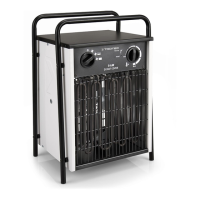
The ceramic heater is designed to generate and distribute warm air within enclosed spaces. Its primary function is to heat the air using a ceramic heating element. The air surrounding this element is then blown into the room by a fan, ensuring efficient heat distribution. This makes the device suitable for various applications such as construction trailers, garages, market stalls, workshops, gastronomy sectors, warehouses, halls, and shipyards. The device is intended for heating closed rooms only, adhering to specific technical data and safety guidelines.
Before initial operation, the transport handle must be attached to the device. This involves loosening two screws and washers from the top of the housing, then using them to mount the handle. Once assembled, the device should be placed in an upright and stable position. When positioning the device, it's crucial to observe minimum distances from walls and other objects as specified in the technical annex to ensure proper air circulation and prevent overheating. The power cable should be fully unwound and checked for damage before connecting it to a properly fused mains socket. It's important to guide the power cable along the back of the device, never the front, to avoid interference with airflow or potential hazards.
The control panel features two switches: Heating level I and Heating level II. To switch on the device, first activate the Heating level I switch, which illuminates the operating light and engages heating level 1. For maximum heating capacity, additionally switch on the Heating level II switch, which activates heating level 2. When shutting down the device, first switch off Heating level II, then Heating level I. After switching off, the device should be allowed to cool down completely before being unplugged from the mains socket.
Safety is paramount when operating this device. Users must be aware of the dangers associated with electrical devices in damp areas and should have read and understood all safety instructions. The device should not be used in small rooms if occupants cannot leave independently or are not under constant supervision. It is strictly prohibited to use the device in potentially explosive atmospheres, aggressive atmospheres, or outdoors. The device must not be placed on wet or flooded ground, near bathtubs, shower trays, swimming pools, or other water containers. Direct exposure to squirting water is also forbidden. Objects, limbs, or clothing should never be inserted into or placed on the device, nor should the device be covered during operation. A safety distance of at least 1 meter must be maintained between the device's air outlet and all combustible materials like textiles, curtains, beds, and sofas. The air inlet and outlet must remain unobstructed. The device should not be placed on combustible ground or high-pile carpets and must always be used with its feet attached. Children under 3 years old should be kept away unless continuously supervised, and children between 3 and 8 years old should only operate the appliance under supervision and after understanding the hazards. The device is not a toy and should be kept away from children and animals. Any safety signs, stickers, or labels must remain legible. In case of overheating, the device is equipped with a safety thermostat that turns off the heating while the fan continues to run. If the thermostat fails, overheating protection will trip, shutting down the device completely, requiring professional service.
Maintenance is crucial for the device's longevity and safe operation. Before any maintenance, the device must be switched off, unplugged from the mains socket, and allowed to cool down completely. Tasks requiring the housing to be opened must only be performed by authorized specialist companies or Trotec. Regular checks include inspecting air inlets and outlets for dirt and foreign objects, cleaning them if necessary, and visually checking the inside of the device for dirt. The exterior should be cleaned with a soft, damp, lint-free cloth, ensuring no moisture enters the housing. Aggressive cleaning agents, solvents, alcohol-based, or abrasive cleaners should not be used. The housing should be wiped dry after cleaning. Attachment screws should be checked, and a test run performed periodically. A maintenance and care log is provided to record these activities, ensuring a systematic approach to upkeep. In the event of malfunctions, users should check the power connection, power cable, mains plug, and on-site fusing. If the fan motor or heating resistor is suspected to be defective, or if the overheating protection has tripped, professional assistance is required. If the air current is reduced, the air inlet and outlet should be checked and any dirt removed. If the device is loud or vibrates, its stable and upright position should be verified. After any maintenance or repair work, a waiting period of at least 3 minutes is recommended before switching the device back on.
 General
| Power | 2 kW |
|---|---|
| Fan stages | 1 |
| Heating stages | 1 |
| Thermostat | Yes |
| Mobility | Portable |
| Overheating protection | Yes |
| Protection class | IP20 |
| Nominal current consumption | 8.7 A |
| Supply voltage | 230 V |
| Frequency | 50 Hz |
| Power cable | 1.5 m |
| Heating element | Stainless steel |


 To Next Page