____________________
Operation
To
Change
From
HIGH
Range
to
LOW
Range
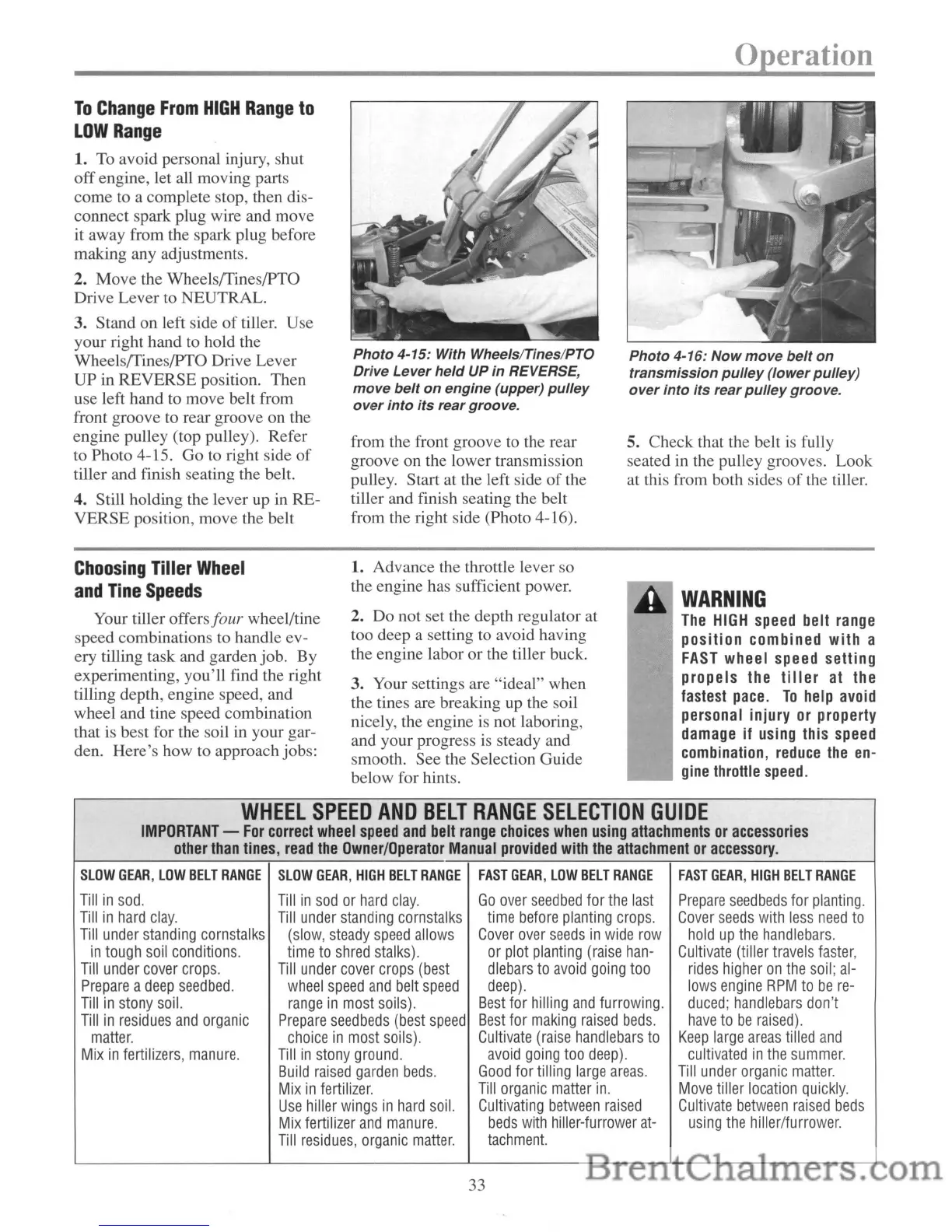
1. To avoid personal injury, shut
off engine, let all moving parts
come to a complete stop, then dis-
connect spark plug wire and move
it away from the spark plug before
making any adjustments.
2. Move the WheelsffineslPTO
Drive Lever to NEUTRAL.
3. Stand on left side
of
tiller. Use
your right hand to hold the
WheelsffineslPTO Drive Lever
UP in REVERSE position. Then
use left hand to move belt from
front groove to rear groove on the
engine pulley (top pulley). Refer
to Photo 4-15. Go to right side
of
tiller and finish seating the belt.
4. Still holding the lever up in RE-
VERSE position, move the belt
Photo 4-15: With WheelslTines/PTO
Drive Lever held UP in REVERSE,
move belt
on engine (upper) pulley
over into its rear groove.
from the front groove to the rear
groove on the lower transmission
pulley. Start at the left side
of
the
tiller and finish seating the belt
from the right side (Photo 4-16).
Photo 4-16:
Now
move belt on
transmission pUlley (lower pulley)
over into its rear pulley groove.
5. Check that the belt
is
fully
seated in the pulley grooves. Look
at this from both sides
of
the tiller.
Choosing
Tiller
Wheel
and
Tine
Speeds
Your tiller
offers/our
wheel/tine
speed combinations to handle ev-
ery tilling task and garden job. By
experimenting, you'll find the right
tilling depth, engine speed, and
wheel and tine speed combination
that
is
best for the soil in your gar-
den. Here's how to approach jobs:
1. Advance the throttle lever so
the engine has sufficient power.
2. Do not set the depth regulator at
too deep a setting to avoid having
the engine labor or the tiller buck.
3. Your settings are "ideal" when
the tines are breaking up the soil
nicely, the engine
is
not laboring,
and your progress is steady and
smooth. See the Selection Guide
below for hints.
WARNING
The
HIGH
speed
belt
range
position
combined
with
a
FAST
wheel
speed
setting
propels
the
tiller
at
the
fastest
pace.
To
help
avoid
personal
injury
or
property
damage
if
using
this
speed
combination,
reduce
the
en-
gine
throttle
speed.
WHEEL
SPEED
AND
BELT
RANGE
SELECTION
GUIDE
IMPORTANT
-
For
correct
wheel
speed
and
belt
range
choices
when
using
attachments
or
accessories
other
than
tines,
read
the
Owner/Operator
Manual
provided
with
the
attachment
or
accessory.
SLOW
GEAR,
LOW
BELT
RANGE
SLOW
GEAR,
HIGH
BELT
RANGE
FAST
GEAR,
LOW
BELT
RANGE
FAST
GEAR,
HIGH
BELT
RANGE
Till
in
sod.
Till
in
sod
or
hard
clay.
Go
over
seedbed
for
the
last
Prepare
seedbeds
for
planting.
Till
in
hard
clay.
Till
under
standing
cornstalks
time
before
planting
crops.
Cover
seeds
with
less
need
to
Till
under
standing
cornstalks
(slow,
steady
speed
allows
Cover
over
seeds
in
wide
row
hold
up
the
handlebars.
in
tough
soil
conditions.
time
to
shred
stalks).
or
plot
planting
(raise
han-
Cultivate
(tiller
travels
faster,
Till
under
cover
crops.
Till
under
cover
crops
(best
dlebars
to
avoid
going
too
rides
higher
on
the
soil;
al-
Prepare
a
deep
seedbed.
wheel
speed
and
belt
speed
deep).
lows
engine
RPM
to
be
re-
Till
in
stony
soil.
range
in
most
soils).
Best
for
hilling
and
furrowing.
duced;
handlebars
don't
Till
in
residues
and
organic
Prepare
seedbeds
(best
speed
Best
for
making
raised
beds.
have
to
be
raised).
matter.
choice
in
most
soils).
Cultivate
(raise
handlebars
to
Keep
large
areas
tilled
and
Mix
in
fertilizers,
manure.
Till
in
stony
ground.
avoid
going
too
deep).
cultivated
in
the
summer.
Build
raised
garden
beds.
Good
for
tilling
large
areas.
Till
under
organic
matter.
Mix
in
fertilizer.
Till
organic
matter
in.
Move
tiller
location
quickly.
Use
hiller
wings
in
hard
soil.
Cultivating
between
raised
Cultivate
between
raised
beds
Mix
fertilizer
and
manure.
beds
with
hiller-furrower
at-
using
the
hiller/furrower.
Till
residues,
organic
matter.
tachment.
33


 To Next Page
 Loading...