Choosing Wheel and Tine Speeds
With a little experimenting, you can soon find
the proper tilling depth, engine throttle setting,
and wheel and tine speeds that are just right for
the piece of soil on which you are working. What
this means is:
1. You advance the throttle lever on the handle-
bars to keep the engine running at a sufficient
power level to do the job. Don't run your engine
at full throttle all of the time. Instead, try to judge
when the engine is providing the proper amount
of p
ower
- not too
iittle
, but not to o much.
Matching engine power to the work is easier on
the engine and on the tiller. The sound of your
engine operating will be your best guide.
2. You have the depth regulator set in a notch
which is not so deep that it causes the engine to
labor or the tiller to jump.
3. You have the tines turning over fast enough to
really break up the soil with a minimum number
of passes. Faster engine and wheel speeds may
be desirable to break up the last bits of soil or
vegetation when you are making final passes, or
when you are cultivating.
Avoid
Making Fo
otprin
ts
When making final tilling or
CU
ltivating passes,
always try to walk alongside the tiller on the side
that is not yet finished.
If the ground has been
well prepared, you can easily walk alongside
while guiding your tiller with one hand.
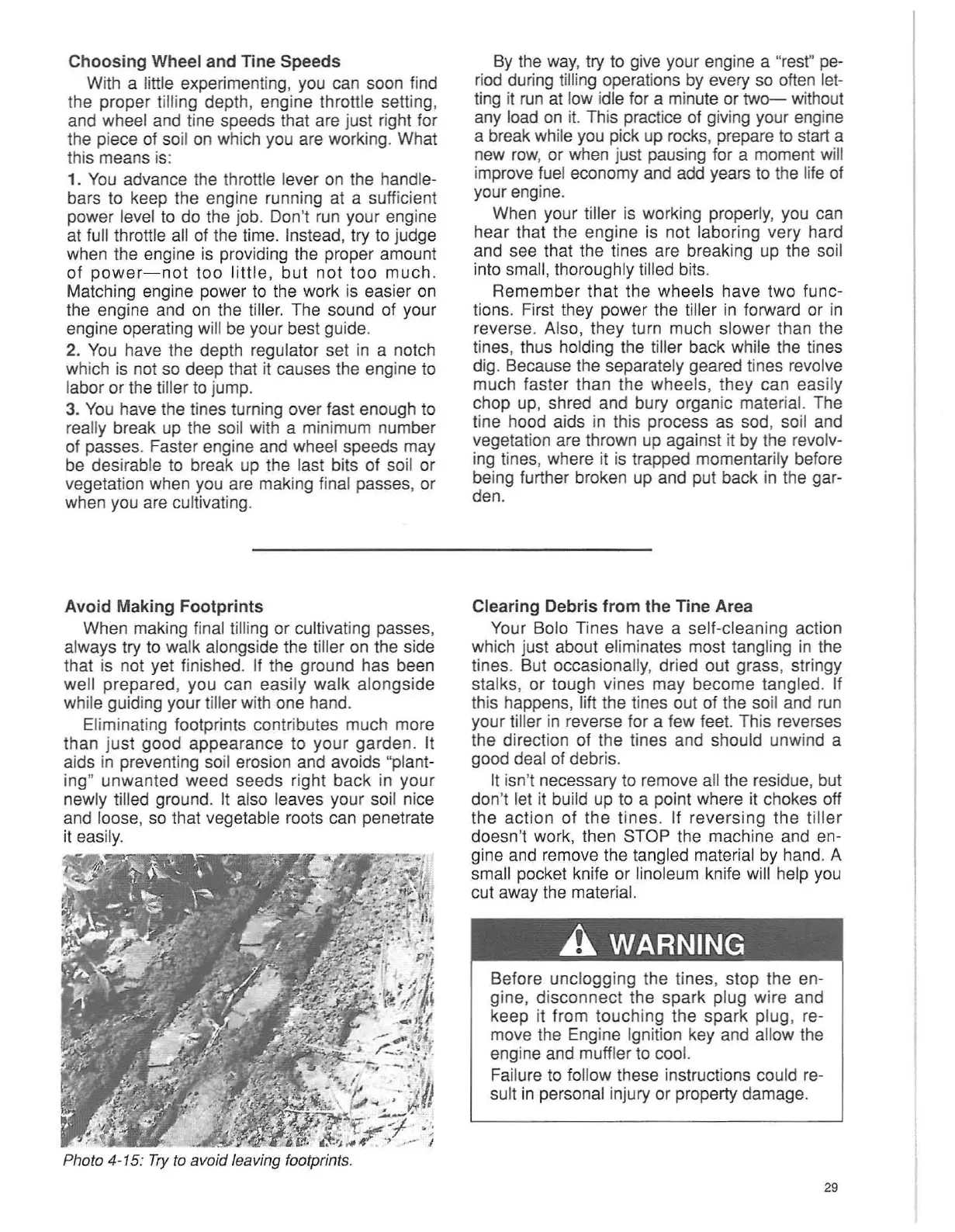
Eliminating footprints contributes much more
than just good appeara nce to your garden .
It
aids in preventing soil erosion and avoids "plant-
ing" unwanted weed seeds right back in your
newly tilled ground. It also leaves your soil nice
and loose, so that vegetable roots can penetrate
it easily.
By the way, try to give your engine a "rest" pe-
riod during tiiling operations by every so often let-
ting it run at low idle for a minute or
two-
without
any ioad on it. This practice of giving your engine
a break while you pick up rocks, prepare to start a
new row, or when just pausing for a moment will
improve fuel economy and add years to the life of
your engine.
When your tiller is working properly, you can
hear that the engine is not laboring very hard
and see that the tines are breaking up the soil
into small, thoroughly tilled bits.
Remember that the wheels have two func-
tions. First they power the tiller in forward or in
reverse. Also, they turn much slower than the
tines, thus holding the tiller back while the tines
dig. Because the separately geared tines revolve
much faster than the wheels, they can easily
chop up, shred and bury organic material. The
tine hood aids in this process as sod, soil and
vegetation are thrown up against it by the revolv-
ing tines, where it is trapped momentarily before
being further broken up and put back in the gar-
den.
Clearing Debris from the Tine Area
Your Bolo Tines have a self-cleaning action
which just about eliminates most tangling in the
tines. But occasionally, dried out grass, stringy
stalks, or tough vines may become tangled. If
this happens, lift the tines out of the soil and run
your tiller in reverse for a few feet. This reverses
the direction of the tines and should unwind a
good deal of debris.
It isn't necessary to remove all the residue, but
don't let it build up to a point where it chokes off
the action of the tines. If reversing the tiller
doesn't work, then STOP the machine and en-
gine and remove the tangled material by hand. A
small pocket knife or linoleum knife will help you
cut away the material.
A WARNING
Before unclogging the tines, stop the en-
gine, disconnect the spark plug wire and
keep it from touching the spark plug, re-
move the Engine Ignition key and allow the
engine and muffler to cool.
Failure to follow these instructions could re-
sult in personal injury or property damage.
29


 To Next Page
 Loading...