EasyManua.ls Logo

Troy-Bilt ProLine - User Manual

Troy-Bilt ProLine
40 pages
Print Icon
To Next Page IconTo Next Page
Loading...
Operators Manual
Rear-tine Tiller Model
664D—Pony
®
665B—ProLine
®
E666M—Pony
®
ES
Warning: This unit is equipped with an internal combustion engine and should not be used on or near any unimproved forest-covered, brush-
covered or grass-covered land unless the engine’s exhaust system is equipped with a spark arrester meeting applicable local or state laws (if any).
If a spark arrester is used, it should be maintained in effective working order by the operator. In the State of California the above is required by law
(Section 4442 of the California Public Resources Code). Other states may have similar laws. Federal laws apply on federal lands. A spark arrester
for the muffler is available by contacting the service department at Troy-Bilt LLC, P.O. Box 361131 Cleveland, Ohio 44136-0019.
IMPORTANT:READ SAFETY RULES AND INSTRUCTIONS CAREFULLY
TROY-BILT LLC, P.O. BOX 361131, CLEVELAND, OH 44136-0019
PRINTED IN USA FROM NO. 770-10597C
(9/16/2004)
Question and Answer IconNeed help?

Do you have a question about the Troy-Bilt ProLine and is the answer not in the manual?

Overview

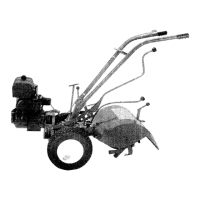
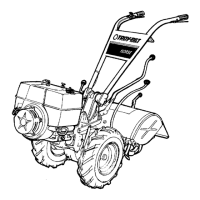
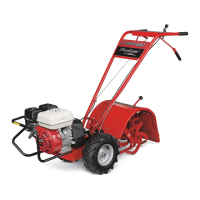
This document is an operator's manual for the Troy-Bilt Rear-tine Tiller, specifically models 664D-Pony®, 665B-ProLine®, and E666M-Pony® ES. The manual provides comprehensive instructions for assembly, operation, and maintenance of the tiller, emphasizing safety precautions throughout.

Function Description:

The Troy-Bilt Rear-tine Tiller is designed for various gardening applications, including preparing seedbeds, cultivating, and power composting. It features rear-mounted, forward-rotating tines that dig into the soil, while powered wheels assist in moving the unit. The tiller is capable of breaking up hard-packed soil, mixing in organic matter, and creating rows for planting. The reversing feature is primarily for maneuvering the tiller and should not be used for tilling in reverse.

Important Technical Specifications:

  • Tilling Depth: Adjustable from approximately 1-1/2 inches (travel position) up to six to eight inches, depending on soil conditions.
  • Engine: Internal combustion engine (specifics detailed in a separate Engine Owner's Manual).
  • Battery (Model E666M): 12-volt automotive-type battery, 270 CCA.
  • Tire Pressure: 15-20 PSI (pounds per square inch) for both tires, ensuring equal inflation to prevent pulling to one side.
  • Transmission Gear Oil: API rated GL-4 or GL-5 gear oil, SAE 140, SAE 85W-140, or SAE 80W-90. The transmission holds approximately 3-1/4 pints (52-54 ounces).
  • Weight: Over 170 lbs., depending on the model, requiring two or more people for loading/unloading.
  • Handlebar Height: Adjustable to four different settings for user comfort.

Usage Features:

  • Controls:
    • Wheel Gear Lever: Two positions: ENGAGE (wheels turn with clutch engagement) and DISENGAGE (freewheeling mode for moving without engine running). Must be in ENGAGE position before starting the engine or engaging clutches.
    • Forward Clutch Control: Two interconnected levers that, when pulled against the handlebars, engage forward drive to the wheels and tines. Releasing them stops forward motion.
    • Reverse Clutch Control: A knob that, when pulled out, engages reverse drive to the wheels and tines for maneuvering. Releasing it stops reverse motion. Not for tilling.
    • Depth Regulator Lever: Controls tilling depth by engaging notched settings. The highest notch (lever all the way down) provides a "travel" position, raising tines off the ground. Moving the lever up increases tilling depth.
    • Engine Throttle Control Lever: Regulates engine speed (FAST, SLOW, STOP for recoil start models).
    • Electric Start Keyswitch (Model E666M): Used to start and stop the engine (OFF, RUN, START).
  • Tilling Techniques:
    • Start with shallow depth settings and gradually increase.
    • Walk behind and to one side of the tiller, using one hand on the handlebars, allowing the tiller to pull itself. Avoid pushing down on handlebars.
    • Avoid tilling soggy, wet soil.
    • Walk on the untilled side to avoid making footprints in freshly tilled soil.
    • Recommended tilling patterns include overlapping passes (half tiller width) and crosswise tilling for thorough pulverization.
    • When tilling on moderate slopes, till up and down rather than terracing, ensuring the uphill wheel stays in soft, newly tilled soil for stability.
  • Power Composting: Tilling under organic matter (crop residues, leaves, grass clippings) to enrich soil. Use deepest depth setting possible without causing the engine to labor. "Fishtailing" (swaying handlebars) helps clear tines.

Maintenance Features:

  • Regular Checks:
    • Hardware: Check all nuts, bolts, and screws for tightness every 10 operating hours.
    • Engine Oil: Check level before each use and every 5 operating hours. Change every 10 operating hours or more frequently in dusty conditions.
    • Transmission Gear Oil: Check level every 30 operating hours or whenever leakage is noticed. Drain and refill only if contaminated.
    • Tires: Check air pressure (15-20 PSI) before each use.
    • Tines: Inspect for wear at the beginning of each tilling season and every 30 operating hours. Replace when worn short, narrow, or pointed.
    • Belts: Check tension on forward clutch belt after the first 2 hours and every 10 operating hours. Check for cracks, cuts, or frayed edges at the end of each tilling season.
    • Air Cleaner: Inspect and service as instructed in the engine manual, more often in dusty conditions.
    • Spark Plug: Inspect, clean, or replace every 100 operating hours or annually.
    • Spark Arrester Screen: Remove and clean according to engine manual.
    • Engine Cleaning: Keep engine clean to prevent overheating.
  • Lubrication: Grease lubrication points (wheel shaft, depth regulator lever, tine shafts, handlebar adjustment screws) every 10 operating hours using #30 weight engine oil or general purpose grease.
  • Battery Maintenance (Model E666M): Keep cables and terminals clean, apply petroleum jelly/grease, and ensure rubber boot covers positive terminal. Charge battery fully before storage and every two months.
  • Off-Season Storage: Clean tiller and engine, perform routine lubrication, protect engine (fuel lines, carburetor, fuel tank) from gum deposits, store in a clean, dry area, and charge battery.
  • Troubleshooting Guide: Provides solutions for common issues like engine not starting, running poorly, overheating, or problems with wheel/tine engagement.

Safety Features:

  • Safety Alert Symbol (exclamation mark in a triangle) used to indicate potential hazards.
  • Warnings against operating near underground cables, pipes, or hoses.
  • Instructions for safe fuel handling due to flammability and explosive vapors.
  • Emphasis on keeping hands and feet away from rotating parts.
  • Procedures for stopping the engine and disconnecting the spark plug wire before any maintenance or inspection.
  • Warnings against operating with loose garments or jewelry, barefoot, or with light footwear.
  • Caution against operating the tiller if tired or under the influence of alcohol, drugs, or medication.
  • Warnings regarding engine exhaust (carbon monoxide) and hot engine parts.
  • Specific instructions for safe loading and unloading of the tiller using ramps and multiple people.
  • Warnings against tampering with engine governor settings.
  • Instructions for safe operation on slopes and when encountering hard-packed soil or obstacles.

Troy-Bilt ProLine Specifications

General IconGeneral
BrandTroy-Bilt
ModelProLine
CategoryTiller
LanguageEnglish

Related product manuals