26
25
Icon
Meanings
The range of sharpening angles per side
Fillet-knife
Kitchen knife
Hunting knife, EDC knife
Chopping angles
о
8-13
о
13-18
о
18-22
о
more than 27
The sharpening angles in the table are indicated per each side of the knife
* when using whole-milled fillet clamps (not included)
Razor Sharpness
о*
under 8
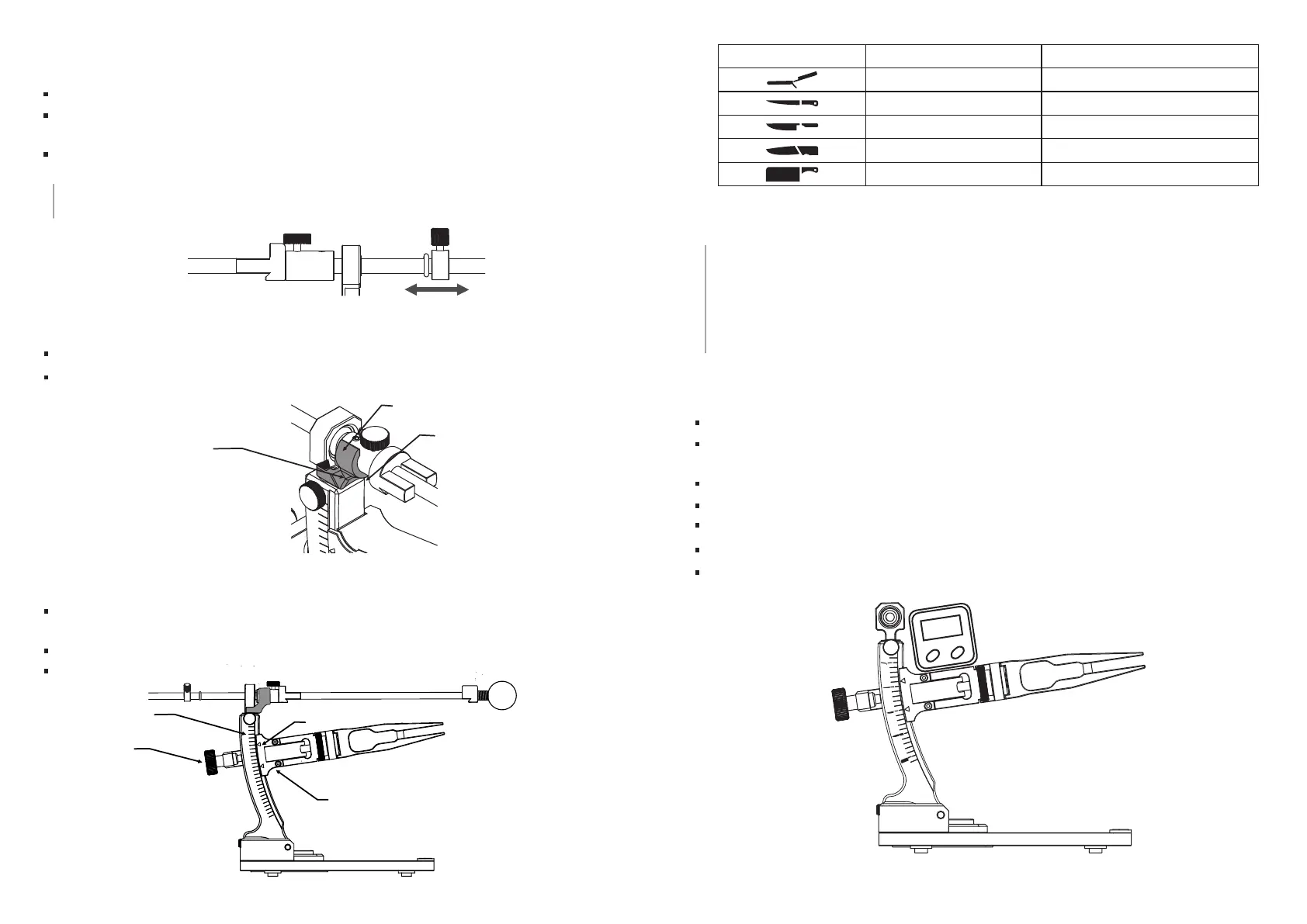
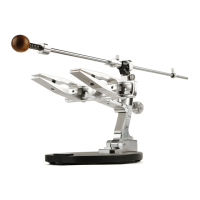
5.11. Parking of the abrasive holder
To put the holder on the parking lot:6.6.
turn the holder with the sharpening stone with working surface of the sharpening stone up;6.6.
carefully place the parking bracket (1) at the base of the hinged joint (2).6.6.
(fig. 11)
5.12. Setting the sharpening angle:
To set the sharpening angle, you need to:7.1.
loosen the screw (3) and move the rotary mechanism (4) along the rack (1) until the pointer
7.1.
(2) aligns with the desired angle value on the sharpening angle scale;
7.1.
approximate angle values are given in the table below;
7.1.
tighten the screw (3).
7.1.
(fig. 12)
5.13. Using digital protractor*
For more accurate angle setting, use a digital protractor. To do this, 6.13.
set the protractor on the reference plane (3) on the abrasive holder; 6.13.
having supported the sharpening stone in the holder on the blade of the knife clamped 6.13.
in the clamps; 6.13.
reset the protractor reading with the button; 6.13.
without turning it off, move it to the reference plane (7) on the body of the rotary mechanism; 6.13.
the protractor will show the angle of sharpening on this side of the knife with an accuracy of 0.1°; 6.13.
smoothly install the rotary mechanism in the desired position according to paragraph 5.12; 6.13.
remove the protractor from the reference plane and start sharpening.6.13.
*Digital protractor is not included in the kit.
* The precise angle depends on the distance of the knife blade relative to the edge of the clamping
jaws, the thickness of the sharpening stone together with the blank, the use of an abrasive
thickness compensator.
The maximum deviation of the table data from the actual sharpening angle when using the abrasive
thickness compensator in the upper position is 25±2 %. Moving the CE in the jaws at a distance
of 17±8 mm leads to a deviation of the scale readings from the actual sharpening angle by 4±1%.
(fig. 13)
5.10 Abrasive holder limiters
To prevent the sharpening stone from breaking off, set the abrasive holder with a limiter::6.3.
loosen the thumb screw of the limiter;;6.3.
determine the maximum stroke of the sharpening stone so that it does not extend its plane 6.3.
beyond the cutting edge of the knife along the entire length;6.3.
place the limiter close to the hinged joint and tighten the thumb screw;6.3.
Despite the fact that there is a rubber damper in front of the limiter, avoid sharp impacts of the
limiter on the hinged joint.
3
1
2
3
1
2
4
(fig. 10)


 To Next Page