Introduction
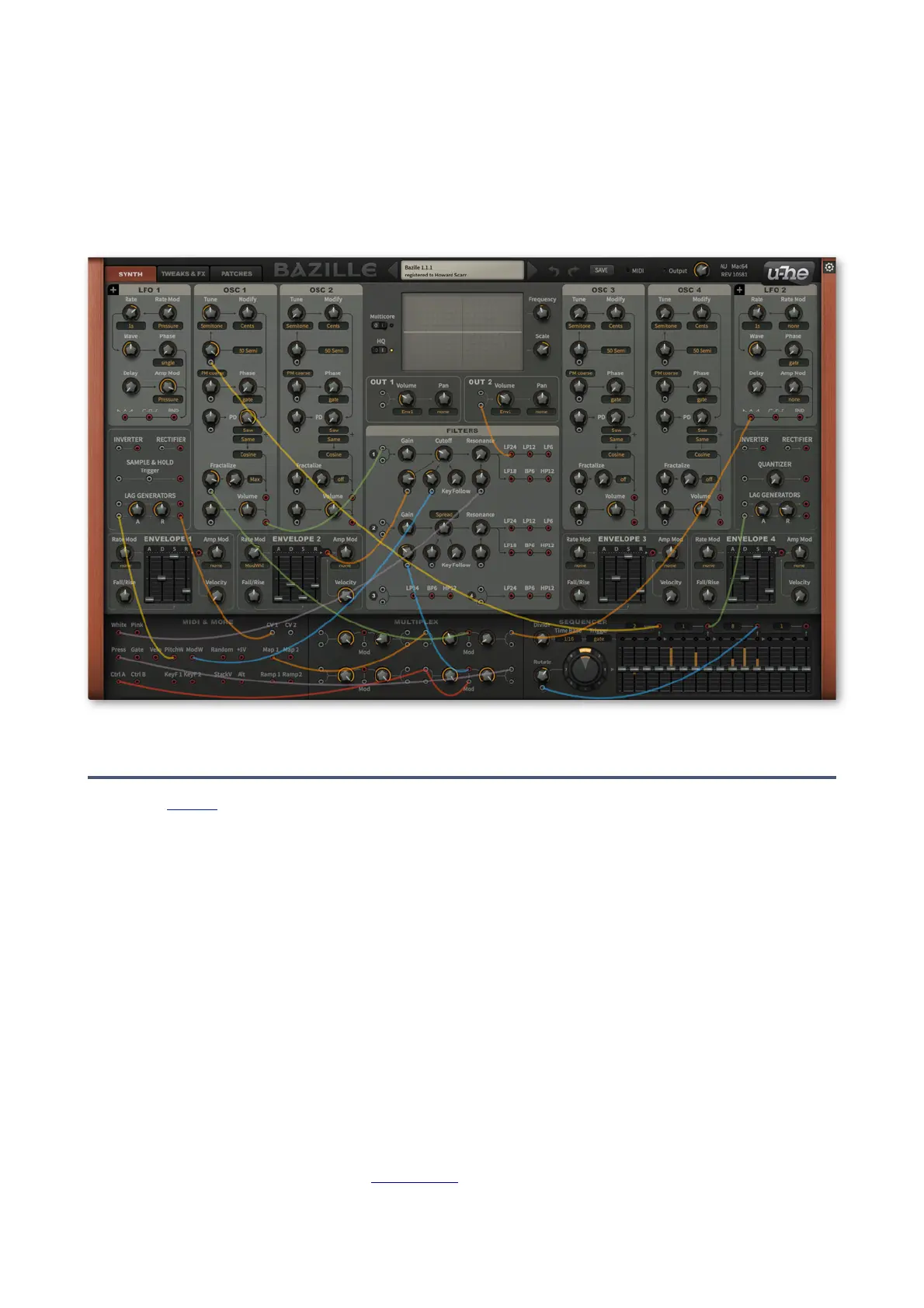
To follow this user guide it helps if you already know a thing or two about patching modular synths,
as well as the basics of FM and PD (phase distortion) synthesis. If you have any questions that an
Internet search can’t answer, please feel free to post a message in our user forum at KVR!
Installation
Go to the Bazille product page at u-he.com, download the appropriate installer for your computer
and unzip the compressed file. Open the Bazille folder and start the installer app.
The only demo restriction is a mild crackling that occurs at irregular intervals after about two
minutes of use. The demo is otherwise fully functional. Those crackles disappear after you have
entered a serial number. For more information, refer to the ReadMe file included with the installer.
CPU usage and audio quality
As a polyphonic modular synth, Bazille can be quite CPU-hungry! Monophonic operation without
voice stacking should be fine, even on older computers. Activating Multicore, which distributes
voices evenly across all available CPU cores, can help maximize the number of playable voices.
Note: Due to inherent technical limitations of the synthesis method, Bazille’s PD-based oscillators
are prone to aliasing. If you have Bazille installed on a high-performance system you should try
activating the HQ (higher quality) option.
Better Bazille
Early Bazille adopters should notice some improvements in this version, especially the powerful
new preset browser. The minor fixes include much better envelope LFO-triggering. Although this
particular fix affects some old patches, we feel that it was worth implementing – especially in such
a “geek machine” as Bazille! See the explanation in the Tips & Tricks chapter.


 To Next Page