Checking tires for tread wear
All the tires have tread wear indicators (“ ” marking)
between the tread blocks. When the tread is worn ush
with the tread wear indicators, it means that the tread
has reached a depth of about 1.6 mm. If the tread
is worn flush with any of the tread wear indicators,
replace the tire with a new one. If replacement of a tire
is needed, both the front tires or rear tires should be
replaced as a set. Make sure new tires are the same
size as those to be replaced.
Hub nut check
CAUTION
A loose hub nut can be dangerous. In the worst
case, the wheel comes off the truck, causing the
truck to tip over.
Check the hub nuts for looseness. All hub nuts
should be tightened to the specied torque.
Hub nut tightening torque
Front wheels Rear wheels
128 – 190 N-m
(13 – 19.4
kgf-m)
(94 – 140 ft-lbs)
Single and doubles tires:
471 – 549 N-m (48 – 56 kgf-m)
(347 – 405 ft-lbs)
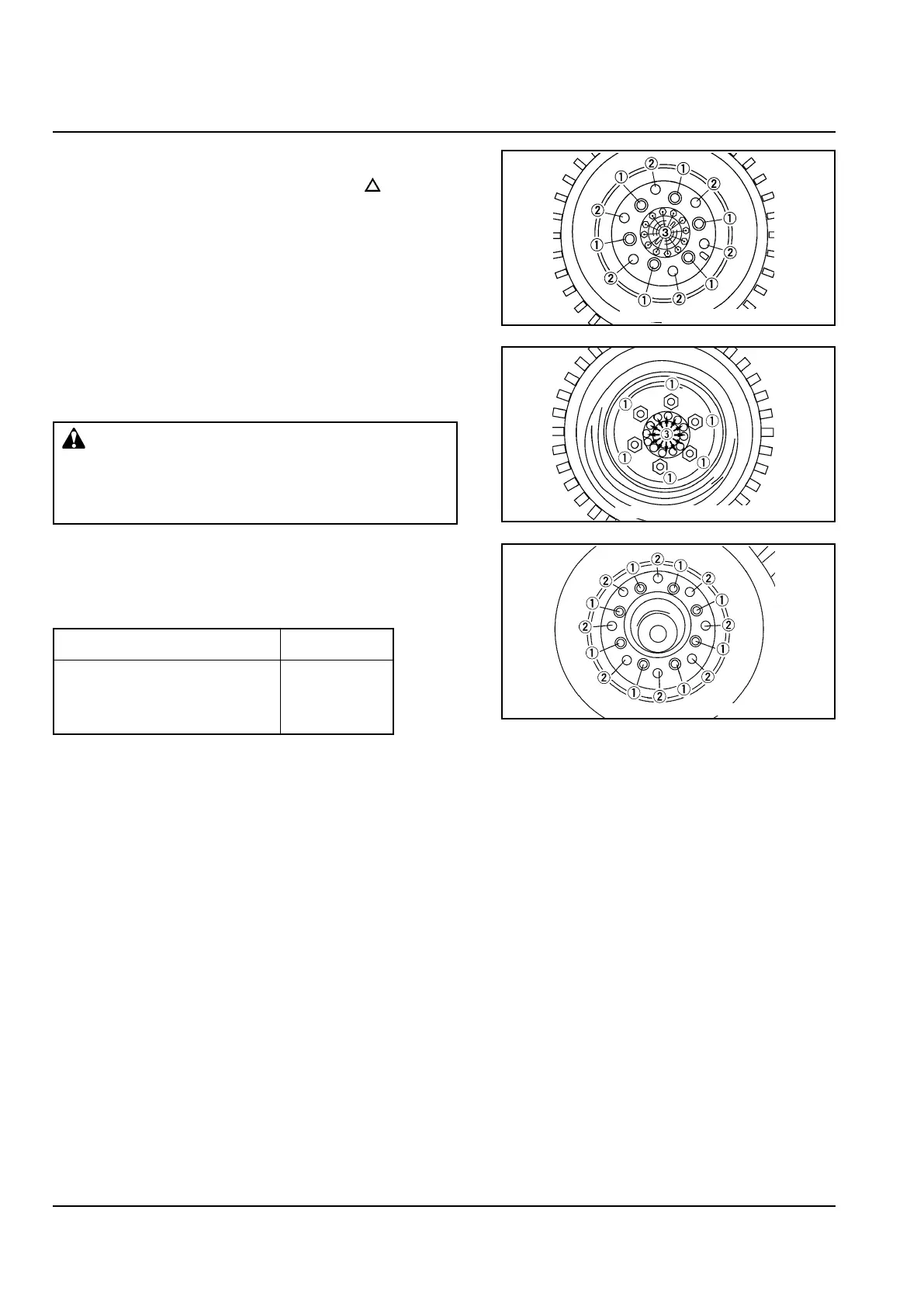
Tightening order for double tires
Double tires are installed by locking the inner tire rim
with inner hub nuts (square nuts) and then by locking
the outer tire rim with outer hub nuts (hex. nuts).
First, tighten the inner nuts (square nuts) in a
diagonal order to the specied torque and then
tighten the outer nuts (hex. nuts) in the same manner
as above.
Tightening drive shaft mounting bolts
If any loose bolt is found, retighten it to the following
torque:
96 – 111 N-m (9.8 – 11.3 kgf-m) (71 – 82 ft-lbs)
① Hub nuts
② Rim connecting bolts
③ Drive shaft mounting bolts
1.5- to 2.5-ton (front wheel)
3- to 3.5-ton (front wheel)
Rear wheel




 To Next Page