This document is an Operation & Maintenance Manual for UniCarriers diesel-powered forklift trucks, specifically models FD160-2, FD180-2, FD200-2, and FD230-2. It provides comprehensive information for owners and operators regarding safe operation, maintenance, and technical specifications of these industrial vehicles.
Function Description:
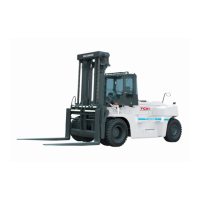
The UniCarriers forklift trucks are designed for transporting and stacking palleted loads or materials within prescribed height limits. With appropriate attachments, they can handle various types of loads, including paper rolls, drums, lumber, and freight containers. The trucks are equipped with a mast and forks at the front, which act as a fulcrum to balance the center of gravity of the truck and the load, crucial for stability and safety. These models are diesel-powered, making them suitable for outdoor use or well-ventilated indoor environments.
Important Technical Specifications:
The manual details specifications for four models: FD160-2, FD180-2, FD200-2, and FD230-2.
- Rated Load: Ranges from 16000 kg (FD160-2) to 23000 kg (FD230-2).
- Basic Load Center: 900 mm for all models.
- Max. Height: 3000 mm for all models.
- Fork Lifting Speed (no load): Ranges from 400 mm/s (FD160-2) to 260 mm/s (FD230-2).
- Fork Lifting Speed (loaded): Ranges from 330 mm/s (FD160-2) to 230 mm/s (FD230-2).
- Traveling Speed (fwd/rev 1st, 2nd, 3rd):
- FD160-2: 7.5, 14.5, 34.0 km/h
- FD180-2: 8.0, 15.0, 34.0 km/h
- FD200-2: 8.0, 15.5, 34.0 km/h
- FD230-2: 8.0, 15.0, 32.0 km/h
- Gradeability (tire slip, no load): Ranges from 1/3.8 (FD160-2) to 1/4.3 (FD230-2).
- Gradeability (tire slip, loaded at 1.6 km/h): Ranges from 1/4.0 (FD160-2) to 1/6.6 (FD230-2).
- Min. Turning Radius: Ranges from 5000 mm (FD160-2, FD180-2) to 5350 mm (FD230-2).
- Min. Stacking Aisle Width: Ranges from 4430 mm (FD160-2) to 4650 mm (FD230-2).
- Overall Length: Ranges from 7165 mm (FD160-2) to 7990 mm (FD230-2).
- Overall Width: Ranges from 2970 mm (FD160-2) to 3060 mm (FD200-2, FD230-2).
- Overall Height (mast): Ranges from 3290 mm (FD160-2) to 3580 mm (FD230-2).
- Overall Height (overhead guard): Ranges from 3200 mm (FD160-2) to 3260 mm (FD200-2, FD230-2).
- Overall Height (mast raised): Ranges from 4790 mm (FD160-2) to 5080 mm (FD230-2).
- Wheelbase: 3650 mm for all models.
- Tread (front): Ranges from 2195 mm (FD160-2, FD180-2) to 2185 mm (FD200-2, FD230-2).
- Tread (rear): Ranges from 2340 mm (FD160-2, FD180-2) to 2300 mm (FD200-2, FD230-2).
- Fork Size (length x width x thickness):
- 1830 x 250 x 90 mm (FD160-2)
- 1830 x 260 x 100 mm (FD180-2, FD200-2)
- 2440 x 310 x 98 mm (FD230-2)
- Fork Spacing: Ranges from 790 – 2750 mm (FD160-2) to 950 – 2750 mm (FD230-2).
- Weight: Ranges from 22510 kg (FD160-2) to 30760 kg (FD230-2).
- Engine: Isuzu 6BG1T diesel engine with turbocharger (all models).
- Total Displacement: 6.494 liters.
- Rated Output: 125 kW (170 PS)/2200 rpm.
- Maximum Torque: 620 N-m (63 kgf-m)/1800 rpm.
- Tires: Pneumatic tires, with specific sizes and plies for front and rear wheels across models.
- Inflation Pressure (front and rear): Ranges from 784 kPa (8.0 kgf/cm²) to 882 kPa (9.0 kgf/cm²).
- Rim Size (front and rear): 8.50V x 24 for all models.
- Refill Capacities:
- Hydraulic oil tank: 180 liters (ISO VG32 or VG22 depending on temperature).
- Brake oil tank: 3 liters (Mineral Brake Oil, SAE5W-20).
- Reduction gear/differential: 28 liters (Gear oil API Class GL-4 and higher, SAE90, SAE80W, or SAE75W depending on temperature).
- Final reduction gear (each): 5 liters (Gear oil API Class GL-4 and higher, SAE90, SAE80W, or SAE75W depending on temperature).
- Transmission/torque converter: 30 liters (Engine oil SAE10W or ATF DEXRON, ATF depending on temperature).
- Radiator: 32 liters (UniCarriers Long Life Coolant, 50% concentration).
- Fuel tank: 400 liters (Light oil/diesel fuel).
- Engine crankcase: 10-12 liters (Engine oil API Class CD and higher, various SAE grades depending on temperature).
- Grease fitting: As required (Lithium-based multi-purpose grease NLGI No. 0, 1, or 2).
Usage Features:
- Safety First: Emphasizes the importance of reading and understanding the manual, wearing protective gear (hard hat, safety shoes, goggles, gloves), and proper training for operators and supervisors.
- Operating Environment: Instructions for planning travel routes, marking lanes, setting speed limits, keeping unauthorized personnel and vehicles out of operating areas, and ensuring adequate lighting.
- Load Handling: Detailed procedures for safe stacking, unstacking, and transporting loads, including maintaining a low center of gravity, proper fork spacing, and avoiding overloading. It explicitly warns against using the truck to transport people, tow other vehicles, or push loads with forks.
- Stability: Explains the concept of the "triangle of balance" and how the center of gravity shifts with load, mast tilt, and movement. Operators are advised to slow down significantly when turning to prevent tipping.
- Starting and Driving: Procedures for starting the engine (including preheating for cold weather), engaging gears, and using the inching pedal for precise movements. It highlights the importance of stopping completely before reversing direction and using engine braking on grades.
- Driving on Slopes: Specific instructions for driving on slopes, including keeping the load pointed uphill when loaded and the rear end uphill when unloaded, and avoiding the inching pedal on downward slopes.
- Dockboard Operation: Cautions for driving over dockboards, including securing them, blocking trailer wheels, and using jacks to support trailers.
- Parking: Guidelines for safe parking, such as choosing a level, hard, out-of-traffic area, lowering forks to the ground, applying the parking brake, and removing the key. If parking on a slope is unavoidable, wheels must be blocked.
- Optional Equipment: The truck can be equipped with various optional features like an operator's cab (with headlights, wiper, air conditioner), high-lift mast, side shifter, fork extension sleeve, fire extinguisher, exhaust purifying muffler, manual pump type automatic greaser, beacon light, and different tire types.
- Controls: Detailed descriptions of all controls, including the starter switch (OFF, ON, START, PREHEAT), combination lamp switch, turn signal switch, horn button, shift hold selection switch, parking brake switch, automatic transmission mode selector switch (POW/ECO), emergency travel switch, meters (speedometer, fuel gauge, cooling water temperature gauge, brake air pressure gauge, hour meter), warning/indicating lights, lift lever, tilt lever, attachment lever, steering wheel, steering column tilt lever, inching pedal, brake pedal, and accelerator pedal.
- Cab Features (Option): Describes the operator's cab, including head lights, front windshield, front windshield wiper, door, door handle, door lock, side windows, interior light, rear windshield wiper, windshield wiper fluid tank, rear-view mirror, car heater, air conditioner, and ventilation control.
Maintenance Features:
- Preoperational Checks: Daily inspections are mandatory before operation, covering general condition, oil/water leaks, tire inflation pressure and condition, hub nut tightness, overhead guard, brake oil level, cooling water level, engine oil level, hydraulic oil level, hydraulic piping and cylinders, battery electrolyte level, lamps, operator's seat and steering column adjustment, shift lever, load handling levers, parking brake, warning lights, meters, fuel level, lift chain tension, mast operation, exhaust gas condition, brake test, and steering test. Any defects must be reported and repaired before use.
- Periodic Inspections: Emphasizes the importance of monthly (200 hours), 3-month (600 hours), 6-month (1200 hours), and annual (2400 hours) inspections. These checks cover a wide range of components, including the air cleaner, engine oil and filter, radiator, shift lever, axles, wheel bearings, brake system, forks, mast, lift chains, attachments, cylinders, power steering unit, electrical wiring, and greasing points.
- Safety Parts Replacement: A list of critical safety parts that must be replaced at specified intervals (e.g., master cylinder cups, brake booster rubber parts, hoses, lift chain, load handling system hoses) regardless of their apparent condition, as their failure can lead to serious accidents.
- Engine Maintenance: Procedures for changing engine oil and oil filter, inspecting the intake and exhaust system, and handling turbo-charged engines (warming up, shutting down).
- Fuel System Maintenance: Instructions for air bleeding the fuel system, replacing fuel filter cartridges, and draining water from the fuel tank.
- Cooling System Maintenance: Procedures for changing cooling water, cleaning the radiator, and measures to prevent overheating or freezing.
- Battery Maintenance: Cautions for handling batteries, including avoiding open flames, maintaining proper electrolyte levels, wearing safety glasses and gloves, and correct connection/disconnection of booster cables.
- Tire Maintenance: Procedures for replacing tires, adjusting inflation pressure, and checking for damage.
- Hydraulic System Maintenance: Checks for hydraulic oil level, piping, cylinders, and filters, as well as changing hydraulic oil.
- Greasing: Identification of greasing points on the mast and steering system.
- Long-Term Storage: Guidelines for preparing the truck for long-term storage, including cleaning, applying anti-rust, removing the battery, and covering components. Also, procedures for operating the truck after long-term storage.
- Genuine Parts and Lubricants: Recommends using only genuine UniCarriers parts and specified lubricants to ensure optimal performance and longevity.
- Warning Symbols: The manual uses DANGER, WARNING, CAUTION, and NOTE symbols to highlight various safety alerts and important information.
- Caution Plates: The truck is equipped with caution plates that provide essential safety information and operating instructions, which should be read and understood. Damaged or missing decals must be replaced.

 Need help?
 General

 To Next Page