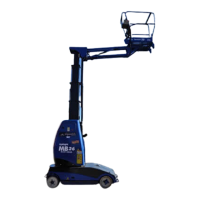
SB85J Fixed Axle – 0112975
Appendix A – Glossary
aerial platform – a mobile device that has an adjustable position
platform, supported from ground level by a structure.
ambient temperature – the air temperature of the immediate environ-
ment.
ammeter – an instrument for measuring the strength of an electric
current in amperes.
authorized personnel – personnel approved as assigned to perform
specific duties at a specific location.
base – the relevant contact points of the aerial platform that form the
stability support (e.g. wheels, casters, outriggers, stabilizers).
boom – a movable cantilever beam which supports the platform.
center of gravity – the point in the aerial platform around which its
weight is evenly balanced.
chassis – the integral part of the aerial platform that provides mobil-
ity and support for the booms.
fall restraint – a system that is used while working on a boom lift within
the boundaries of platform guardrails to provide restraint from being
projected upward from the platform. This system includes a harness or
belt, lanyard, and a lanyard anchor. Federal OSHA, ANSI, and UpRight
require the use of additional fall protection beyond the platform guard-
rails on boom supported aerial platforms.
floor or ground pressure – the maximum pressure, expressed in pounds
per square inch, a single wheel concentrates on the floor or ground.
gradeability – the maximum slope that the aerial platform is capable
of travel.
ground fault circuit interrupter (GFCI) – a fast-acting circuit breaker
that opens to stop electrical circuit flow if it senses a very small current
leakage to ground. The GFCI is used to protect personnel against a
potential shock hazard from defective electrical tools or wiring.
guardrail system – a vertical barrier around the platform to prevent
personnel from falling.
hazardous location – any location that contains, or has the potential
to contain, an explosive or flammable atmosphere as defined by
ANSI/NFPA 505.
intermediate boom – a telescopic boom section that extends and
retracts from within the main boom. The intermediate boom is be-
tween the base, or lower most section of the main boom, and the tip
boom.
jib – an articulating boom attached to the tip boom which increases
the overall boom reach.
level sensor – a device that detects a preset degree of variation from
perfect level. The level sensor is used to sound an alarm if operating
on a slope greater than the preset value.
lower controls – the controls located at ground level for operating
some or all of the functions of the aerial platform.
main boom – a boom assembly located between the turntable and the
platform.
manufacturer – a person or entity who makes, builds or produces an
aerial platform.
maximum travel height – the maximum platform height or the most
adverse configuration(s) with respect to stability in which travel is per-
mitted by the manufacturer.
maximum wheel load – the load or weight that can be transmitted
through a single wheel to the floor or ground.
Minimum Safe Approach Distance – the minimum safe distance that
electrical conductors may be approached when using the aerial plat-
form. Also called M.S.A.D.
operation – the performance of any aerial platform functions within
the scope of its specifications and in accordance with the manufacturer’s
instructions, the users work rules, and all applicable governmental
regulations.
operator – a qualified person who controls the movement of an aerial
platform.
personal fall arrest system – a fall protection system that is used
while working on an unprotected edge (such as a roof top with no
guardrail). This system includes a harness, lanyard or other connecting
device, a fall arrestor, an energy absorber or decelerator, an anchor-
age connector, and a secure anchorage such as a building beam,
girders or columns. An aerial platform is not a fall arrest anchorage.
platform – the portion of an aerial platform intended to be occupied
by personnel with their tools and materials.
platform height – the vertical distance measured from the floor of the
platform to the surface upon which the chassis is being supported.
prestart inspection – a required safety inspection routine that is
performed daily before operating the aerial platform.
qualified person – a person, who by reason of knowledge, experience,
or training is familiar with the operation to be performed and the
hazards involved.
rated work load – the designed carrying capacity of the aerial plat-
form as specified by the manufacturer.
stow – to place a component, such as the platform, in its rest position.
tip boom – a telescopic boom section that extends and retracts from
within the main boom. The tip boom is nearest the platform.
turning radius – the radius of the circle created by the wheel during a
360° turn with the steering wheels turned to maximum. Inside turning
radius is the wheel closest to the center and outside turning radius is
the wheel farthest from the center.
turntable – the structure above the rotation bearing which supports the
main boom. The turntable rotates about the centerline of rotation.
unrestricted rated work load – the maximum designed carrying ca-
pacity of the aerial platform allowed by the manufacturer in all oper-
ating configurations.
upper controls – the controls located on or beside the platform used
for operating some or all of the functions of the aerial platform.
wheelbase – the distance from the center of the rear wheel to the
center of the front wheel.
working envelope – the area defined by the horizontal and vertical
limits of boom travel that the platform may be positioned in.
working height – platform height plus six feet.



 To Next Page