11
BEFORE EACH USE
Your VAN RYSEL bike was designed in Flanders, near the cobbleones of the famous spring classics. Your bicycle mu be maintained regularly to ensure its proper
functioning and your safety.
Before using your bike, check the condition of parts that can wear, including the rims, brakes, tyres, eering and transmission of your bike. In the event of abnormal wear or
any deformation, have your bike checked by a Decathlon workshop.
FRAME
Make sure there is no crack on the frame. No suspicious noise mu be heard. In case of crack or crunch sound, please contact your Decathlon workshop.
BRAKES
For your safety, check the front and rear brakes before each use of your bike. Check the wear of the pads and the tightness of the xing screws. They mu be in perfect
condition. Check all brake mounting components regularly. Disc brakes should be checked regularly. In the event of a brake uid leak, action is required. Get in touch with a
Decathlon workshop.
New disc brakes need a break-in period. Braking force will gradually increase as break-in progresses. Be sure to take these increases into account when using the brakes
during this break-in period.
Setting up the brakes:
The break-in procedure involves gradually braking several times, at increasing speeds. It is important to alternate the front and rear brakes and observe the following eps:
1. Ride at 15 km/h and gradually brake to 5 km/h, 10 times in a row.
2. Ride at 20 km/h and gradually brake to 5 km/h, 10 times in a row.
3. Ride at 25 km/h and gradually brake to 5 km/h, 10 times in a row.
Between each age, release and ride a few dozen metres to properly ventilate the disc and caliper.
WHEELS AND TYRES
Regularly check the wheels. Make sure they are turning without any friction, and without any scratching in the bearings. Refer to the wear indicators if the rims have them (on
the outside or inside of the rim) and replace them if necessary. Make sure the wheels are tight. Check that the axles are tightened accordingly to the TIGHTENING TORQUE
part of this user guide.
TYRE PRESSURE
Regularly check the tyres and check the pressure. The pressure is shown on the side of the tyre and/or rim. If the pressure is indicated on both the rim and the tyre, inate
the tyres with the maximum pressure indicated on the rim independently of the maximum pressure indicated on the tyre. The rims may have a dierent and lower maximum
pressure than the tyres. The risk of puncture is high if the tyres are underinated. Check the absence of holes or cuts and their level of wear.
TRANSMISSION
Make sure it is clean and lubricated. The transmission mu remain silent. A chain that is not tight enough can come o and cause falls, while a chain that is too tight impedes
the performance of the bike. Regularly check the chain tension. The bike chain is automatically tensioned since the bike is equipped with a derailleur.
HEADSET
Braking with your front brake and shaking slightly your bike back and forth, check the lack of play in the headset. Also make sure, while rotating your handlebar, that the
bearings turn without hardness or scratching.
MAINTENANCE
MAINTENANCE INSTRUCTIONS
Your bike requires regular maintenance and inspections adapted to your use. Periodic checks mu be carried out by qualied, experienced
mechanics.
WARNING, like any mechanical component, a cycle undergoes high ress and wears out. The dierent materials and components can react dierently to wear or fatigue.
If a component’s expected life span is exceeded, it may break suddenly, thus risking injury to the cycli. Cracks, chips and discolouring in high-ress areas indicate that
the component has exceeded its lifespan and should be replaced. To assess this, have parts that wear (including the rims, brakes, tyres, eering and transmission of your
bicycle) regularly checked, maintained and adjued by a qualied, experienced mechanic. When replacing components, you mu use genuine spare parts to ensure the
safety and reliability of the bike.
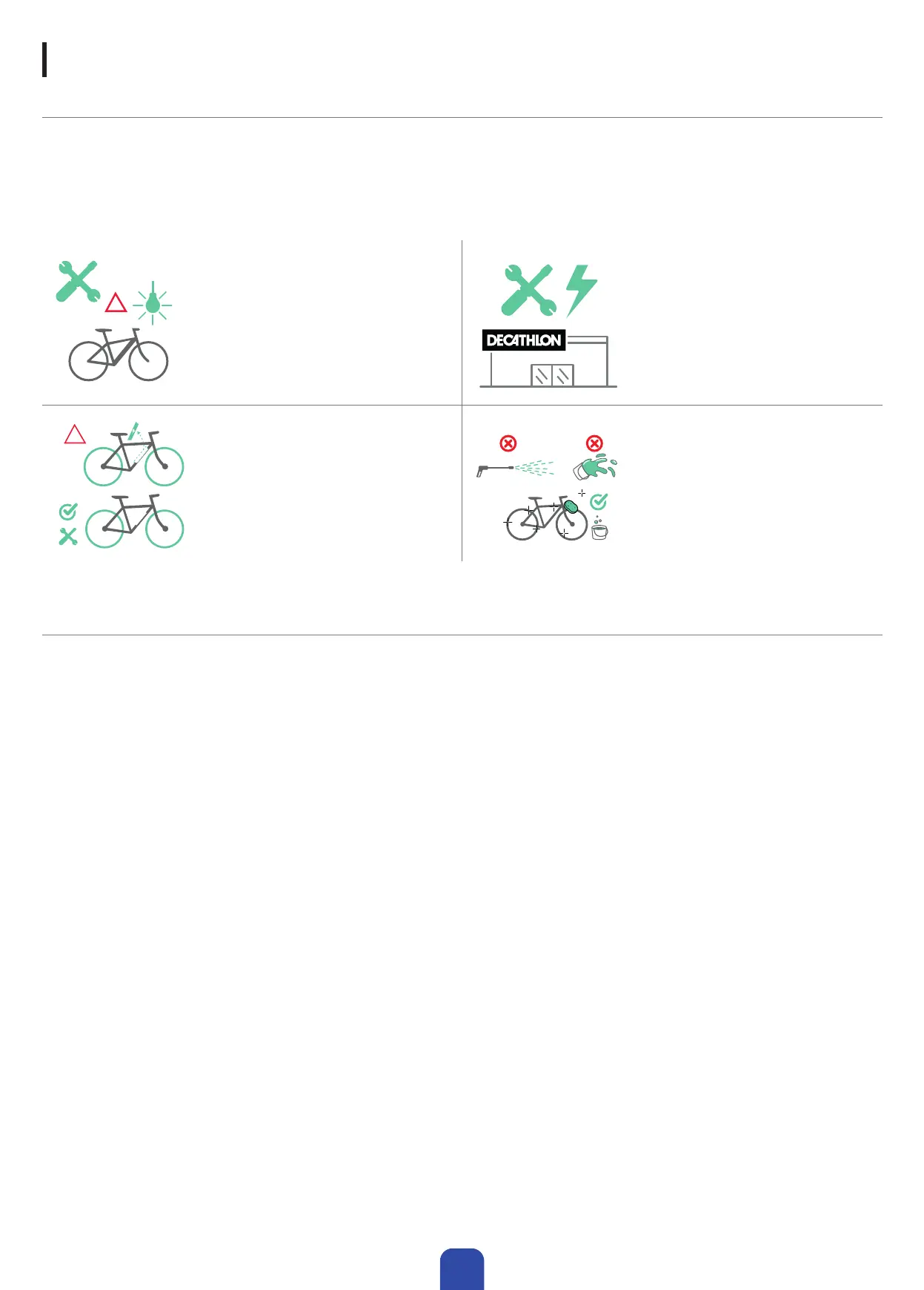
!
When performing bike maintenance, ensure there is
adequate lighting.
The frame, forks and all components mu be
checked regularly by our Decathlon after-sales
service. Since gear adjument is tricky, contact
one of our qualied technicians. And always refer
to the manufacturer’s recommendations. If the
bike suers a fall, check the electric components.
If cable, button or frame is physically damaged,
go to a DECATHLON workshop for an electric
te.
!
All cleaning, electrical or mechanical maintenance
operations mu be carried out without power. If
the battery is removable, remove it. Maintenance
operations specic to the bike’s electric syem
mu be performed by trained, qualied a. If the
chain comes o, shutdown the power before any
intervention.
Do not clean the bike using a high pressure
water jet. Washing with a damp sponge is
recommended. When cleaning the electric
bike, do not immerse the electrical elements
such as the battery, motor, screen, etc.
The charging port mu be properly closed.
After washing: dry and oil the transmission
components (derailleur, lever), suspension,
brake levers as well as the chain.
For more information on use, maintenance, after-sales services or if you have any queions, visit DECATHLON’s support website (www.support.decathlon.com) or visit
a DECATHLON ore.
MAINTENANCE FREQUENCY
Headset :
Check before each use. Change every 10 000km or once a year.
Transmission:
Check every 1 000km. We advise you to change the chain more regularly (every 3500/4000km) to guarantee a better lifespan for the re of the transmission.
Brakes:
Check the discs and pads before each use. Change the brake pads once they are worn. Clean the disc regularly with a dedicated product.
Derailleur hangers/fork:
Check the tightening torque of the derailleur hanger and the fork hanger once a year.
Accessories:
Accessories such as mudguards, crutches, bottle holders, frame locks, lighting are subject to numerous vibrations in use. Remember to regularly check the xing screws and
tighten them if necessary following the tightening recommendations mentioned in the TIGHTENING TORQUE section of this manual.


 To Next Page
 Loading...