5
4 SAFETY AND ACCIDENT PREVENTION INFORMATION
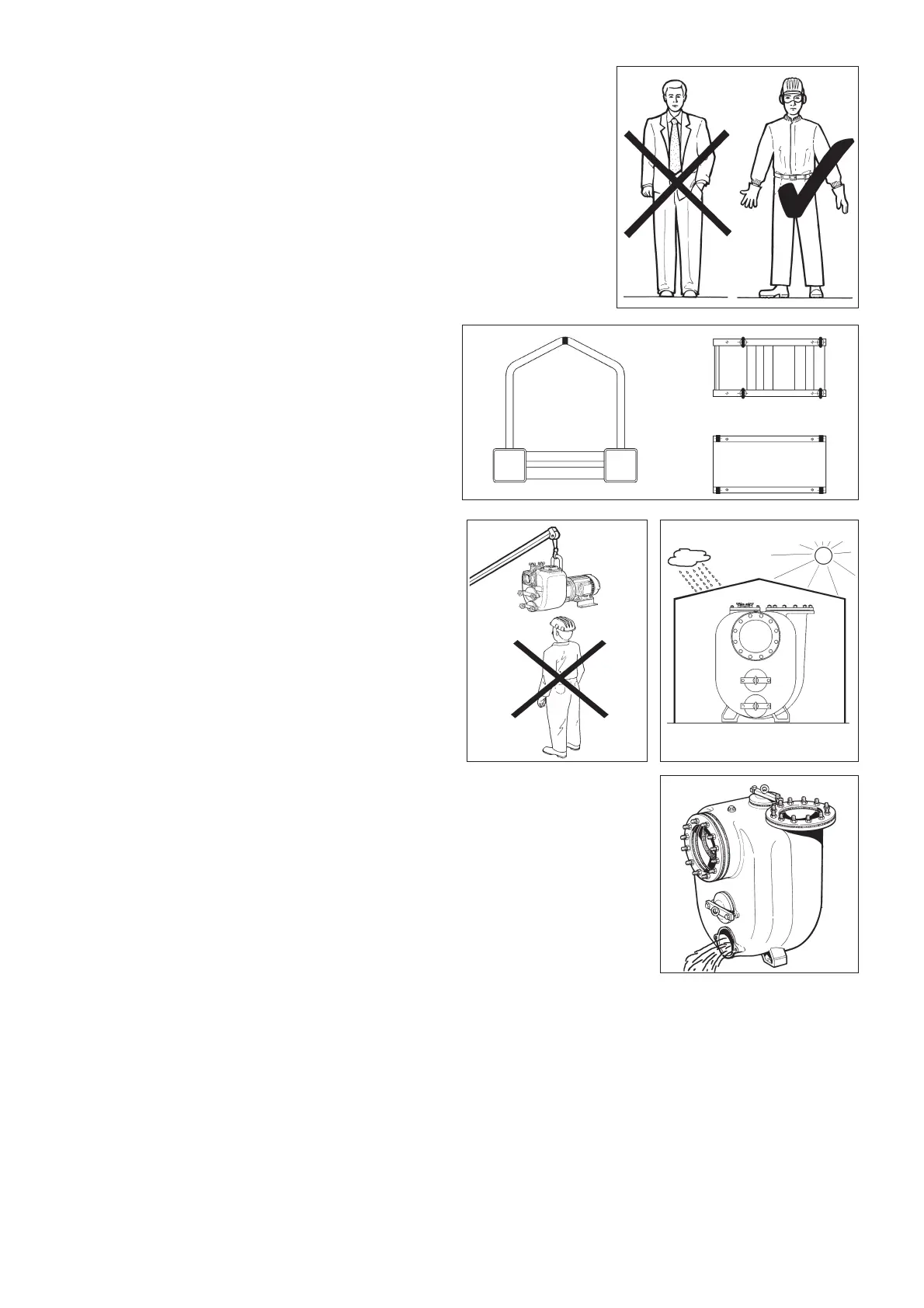
When working near the pump, dress appropriately, avoiding clothes with loose items (ties,
scarves, etc.) which could get caught in moving parts. Use overalls made according to
safety regulations, gloves, insulating shoes, safety glasses, ear plugs and helmet (fig.1).
Do not carry out maintenance on the engine while it is running.
Keep hands away from moving parts (e.g. belts, couplings, etc.).
Keep hands away from hot areas of the engines (fig. 4).
Do not mount on the pump to carry out maintenance operations of any kind.
5 IN CASE OF EMERGENCY
Turn off the electrical supply (for electrically driven pumps).
Shut off the engine (for engine driven pumps).
Notify the person responsible for running the plant immediately.
6 HANDLING AND TRANSPORT
6.1 Method of transport
The pump must be transported safely.
6.2 Installation
During installation and maintenance, all the components used
must be handled and transported securely by using suitable
slings. Handling must be carried out by specialised personnel to
avoid damage to the pump and to persons. The lifting rings
attached to various components should be used exclusively to
lift the components for which they have been supplied. Figure
(1) highlights in black the lifting points of some typical base
plates.
Maximum lifting speed: Vmax
≤≤
0,5 m/s
Do not stand or pass under the pump while it is being
hoisted!(fig.3)
7 STORAGE
Store the pump under cover wherever possible. If the pump
must be stored in the open, cover it with a tarpaulin and grease
the bearings to avoid rusting. (fig. 4).
Avoid the accumulation of moisture around the pump.
Drain the casing through the drain cover (fig. 5) and the rear
plug mounted on some models. During winter months and
cold weather, the liquid could freeze and damage the pump
casing. If the liquid is hazardous, take all necessary
precautions to avoid damage and injury before emptying
the pump casing. From time to time, turn the pump shaft to
avoid encrustation inside the pump
8 ASSEMBLY
If the pump is supplied with bare shaft (pedestal version) it must be coupled to an electric
motor or internal combustion engine, taking account of the following:
- the coupling must be correctly sized for the power to be transmitted
- the coupling must be correctly aligned (see paragraph 9)
- the coupling guard must comply with applicable safety standards
- the rated power of the motor or engine
- the power absorbed by the pump (see the motor name plate)
- the motor or engine speed (see the motor name plate)
- the pump speed
9 INSTALLATION
The base plates of electrically or engine driven pumps must be anchored to a levelled concrete slab in which the foundation bolts have
been buried following the diagram supplied with the unit or available on request. The slab must be robust to absorb any vibrations and
sufficiently rigid to maintain the alignment of the pump to the motor or engine.
For trailer mounted pumps, block the wheels using the two chocks supplied.
9.1 Assembly
While the base plate is being anchored to the slab, check the flatness by placing a spirit level on the delivery flange of the pump.
If adjustments are necessary, the face of the slab must be adapted to the base plate, never the base plate to the slab.
The pump casing must be suitably supported when the pump is coupled to a gear box for agricultural use.
fig. 2
fig.3
fig. 1
fig. 4
fig. 5


 To Next Page
 Loading...