16
12.1.3 Pumps with type TCW - TC8W mechanical seals
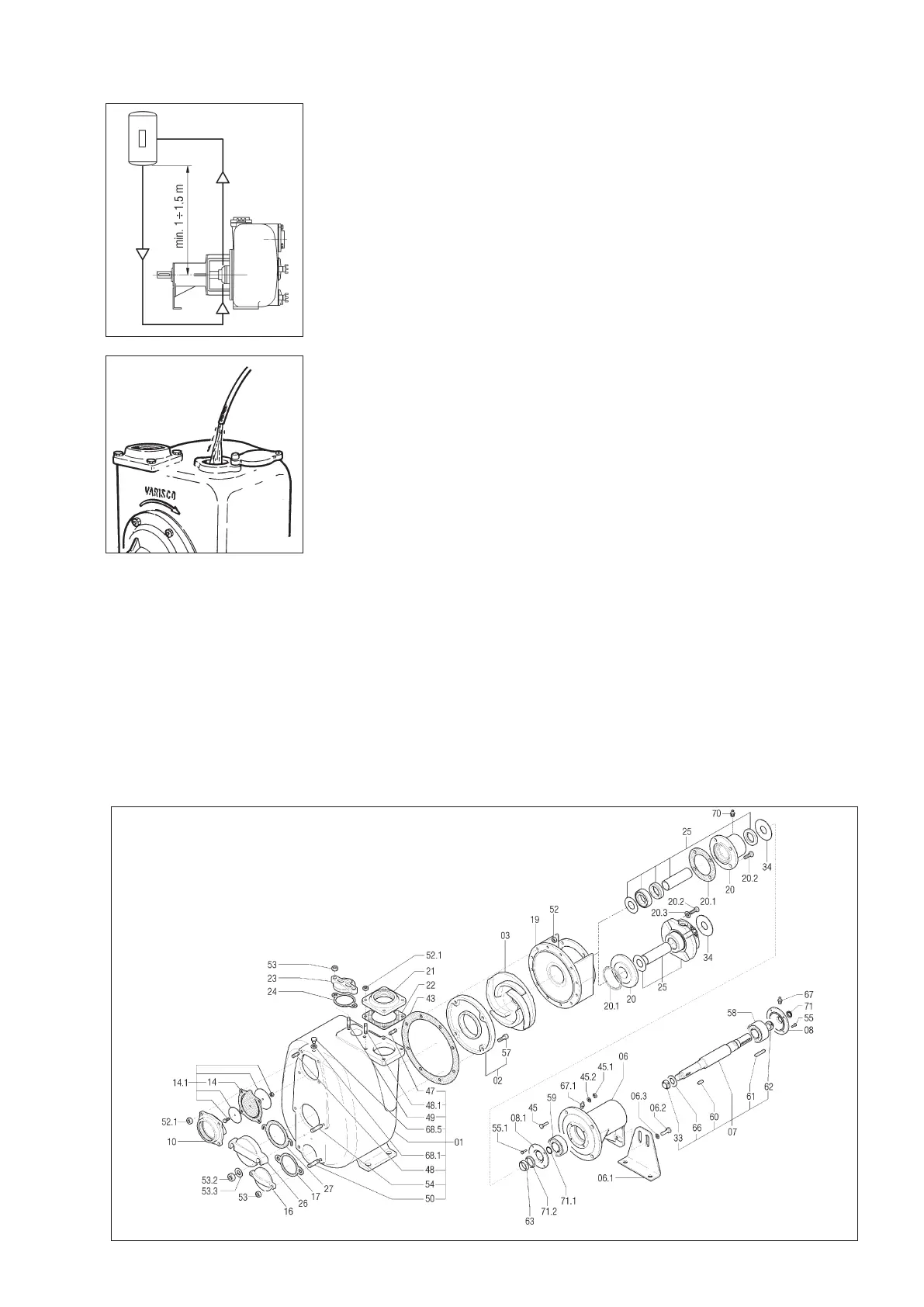
Type TCW, TC8W mechanical seals are flushed according to API 610 Plan 52-53 (see diagram in
fig. 8).
Plan 52 has a non-pressurised tank.
Plan 53 has a pressurised tank with a pressure from 1 to 2 bar higher than the pump operating
pressure.
The flushing liquid must be compatible with the pumped liquid.
12.2 Filling the pump casing
Fill the pump casing completely with the liquid to be pumped through the opening on the top of
the casing (fig. 9). Some models have a plug. When the pump is stopped, the casing does not
empty and therefore it is not necessary to refill it.
12.3 Priming
Attention: if the pump does not prime, do not operate it for more than 2 minutes to avoid
overheating the liquid and damaging the seal.
If the pump does not prime, read paragraph 14.1.
Never exceed the maximum speed shown on the pump name plate.
When the pump has primed:
- Check the shaft seal for leaks.
- Check that the current absorbed by the motor does not exceed the rated value shown on the name plate.
If the pump does not seem to be operating normally, it must be stopped and the cause found (see paragraph 15).
13 MAINTENANCE
Before maintenance is carried out, the pump must be stopped and the electrical supply disconnected. The supply must only
be switched on again by the person who carries out the maintenance.
Attention: residual liquid may be found in the pump casing, head and suction line. Take the necessary precautions if the liquid is
hazardous, inflammable, corrosive, poisonous, infected, etc.
13.1 Inspection and checks
Check from time to time that the pump is working correctly. Use the instruments mounted in the system (pressure gauge, vacuum
gauge, ammeter, etc.) to see if the pump continues to meet its duty.
Periodic maintenance of the parts subject to wear, in particular, the impeller and wear plate, is recommended.
12.1.3 Pumps with type 4 - 5 mechanical seals
Type 4 - 5 mechanical seals are flushed according to API 610 Plan 52-53 (see diagram in fig. 8).
Plan 52 has a non-pressurised tank.
Plan 53 has a pressurised tank with a pressure from 1 to 2 bar higher than the pump operating
pressure.
The flushing liquid must be compatible with the pumped liquid.
12.2 Filling the pump casing
Fill the pump casing completely with the liquid to be pumped through the opening on the top of
the casing (fig. 9). Some models have a plug. When the pump is stopped, the casing does not
empty and therefore it is not necessary to refill it.
12.3 Priming
Attention: if the pump does not prime, do not operate it for more than 2 minutes to avoid
overheating the liquid and damaging the seal.
If the pump does not prime, read paragraph 14.1.
When the pump has primed:
- Check the shaft seal for leaks.
- Check that the current absorbed by the motor does not exceed the rated value shown on the name plate.
If the pump does not seem to be operating normally, it must be stopped and the cause found (see paragraph 14).
13 MAINTENANCE
Before maintenance is carried out, the pump must be stopped and the electrical supply disconnected. The supply must only
be switched on again by the person who carries out the maintenance.
Attention: residual liquid may be found in the pump casing, head and suction line. Take the necessary precautions if the liquid is
hazardous, inflammable, corrosive, poisonous, infected, etc.
13.1 Inspection and checks
Check from time to time that the pump is working correctly. Use the instruments mounted in the system (pressure gauge, vacuum
gauge, ammeter, etc.) to see if the pump continues to meet its duty.
Periodic maintenance of the parts subject to wear, in particular, the impeller and wear plate, is recommended.
fig. 8
fig. 9
fig. 10


 To Next Page